Clear Sky Science · en
The characteristics and spatiotemporal evolution of heatwaves and droughts across six typical regions in China
Why hotter, drier years matter to everyday life
Across China, summers are not just getting warmer—they are bringing longer heatwaves and more stubborn droughts that threaten drinking water, harvests, and city life. This study takes a close look at how these extremes have changed over the past two decades in six key regions, from the North China Plain to the Tibetan Plateau, and what might happen by mid‑century if current trends continue. By tying together satellite, ground, and economic data, the authors show how rising greenhouse gases are linked to shifting water supplies and growing risks for people, farms, and ecosystems.
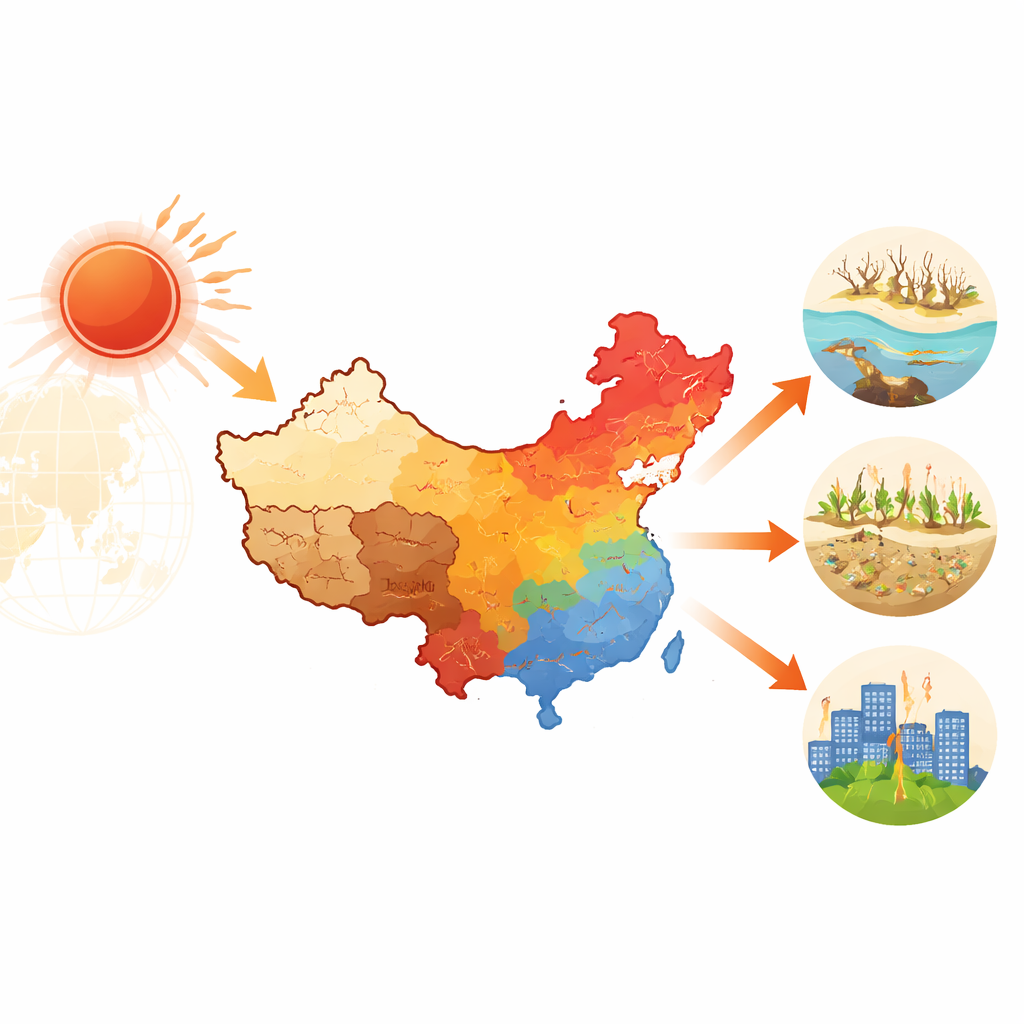
Mapping six very different Chinese landscapes
The researchers focus on six regions that together capture much of China’s variety: the dry, erosion‑prone Loess Plateau; the densely populated and farm‑intensive North China Plain; the high, cold Qinghai–Tibet Plateau, often called Asia’s “water tower”; the humid but fast‑urbanizing Pearl River Basin in the south; the vast and economically vital Yangtze River Basin; and the mixed farming and industrial Songliao Basin in the northeast. Using a global land data system that blends satellite and model outputs, checked against nearly 30 weather stations, they track temperature, rainfall, soil moisture, groundwater, rivers, and evaporation from 2004 to 2023 to build a consistent picture across these contrasting settings.
Counting and timing heatwaves and droughts
Instead of relying on simple fixed temperature cutoffs, the team defines a heatwave as any spell of at least three warm‑season days when daily temperatures rank among the hottest 10 percent for that location. Likewise, a drought episode is any three‑day‑or‑longer period when moisture in the top 40 centimeters of soil falls into the driest 10 percent. For each event they measure how often it happens, how long it lasts, how strong it is, and how early in the year it begins. They also track where the “center of mass” of heat or dryness moves over time, revealing how hotspots migrate within each basin.
Hotter spells, deeper dryouts, and shifting seasons
The results show clear increases in both heatwaves and soil‑based droughts across China’s key regions. On average, events are happening more often, lasting longer, and becoming more intense, while the first episodes of the year are arriving earlier. If the recent pace simply continues, by 2050 the frequency, strength, and duration of these extremes could be roughly 1.14 to 1.33 times today’s levels, with first events coming up to several days sooner. Patterns vary by region: the Yangtze Basin sees many separate events; the Tibetan Plateau has fewer but stronger ones; the Songliao Basin combines moderate counts with high intensity; and the Loess Plateau and Pearl Basin experience frequent but shorter bursts. Northern areas tend to warm persistently, while the southeast shows stronger swings in rainfall, evaporation, groundwater, and soil moisture.
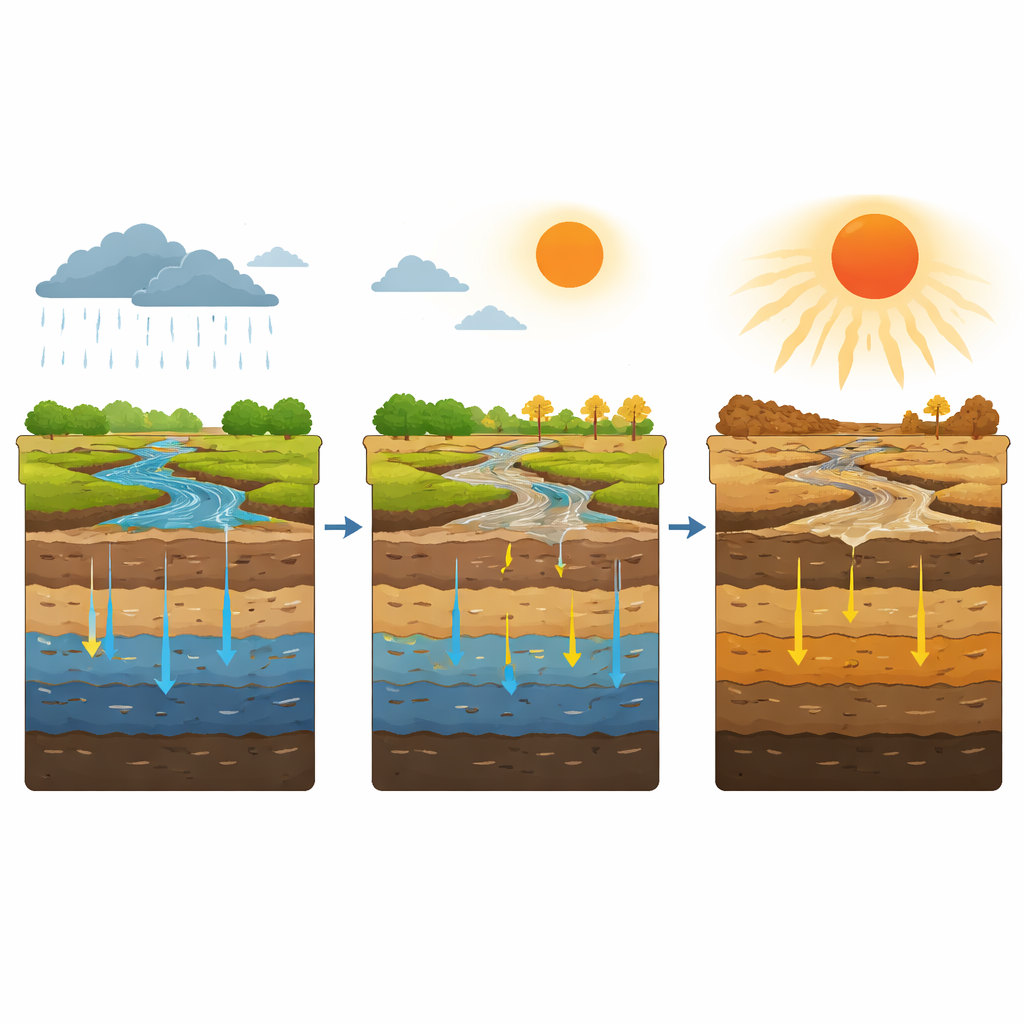
Water, food, and people in a tightening climate link
Beyond simple counts, the study examines how heatwaves immediately alter water flows. After hot spells, temperatures remain higher almost everywhere. In the north, soil dries and groundwater often declines, while some southeastern regions briefly see more rain, evaporation, and runoff. Statistical links reveal that hotter air is strongly tied to the intensity of heatwaves, river runoff to how long they last, and food production to how often and how early they occur. Drought behavior, by contrast, tracks most closely with rainfall, groundwater and total water storage, and population growth. Importantly, as levels of carbon dioxide, methane, and nitrous oxide have climbed, both heatwaves and droughts have become more frequent, longer, and more intense, echoing global assessments that human‑driven warming is reshaping extremes.
What this means for the years ahead
For a non‑specialist, the message is straightforward but sobering: if greenhouse gas emissions continue along recent paths, many of China’s most important river basins are likely to face more common and more damaging hot and dry spells within a few decades. These changes threaten crops, strain rivers and aquifers, and stress cities and ecosystems, especially where water is already scarce and populations are dense. While the authors stress that their future estimates are simple extensions of past trends rather than detailed climate forecasts, they make clear that cutting emissions and improving water and land management are both urgently needed to reduce rising risks to food, water, and social stability.
Citation: Yang, Y., Liu, D. The characteristics and spatiotemporal evolution of heatwaves and droughts across six typical regions in China. Sci Rep 16, 14012 (2026). https://doi.org/10.1038/s41598-026-43650-1
Keywords: heatwaves, drought, China river basins, climate change, water resources