Clear Sky Science · en
Quantum-enhanced privacy aggregation for healthcare monitoring in wireless body area networks
Why safer wearable health tech matters
Smart watches, glucose patches, and other body-worn sensors are rapidly moving medicine out of the hospital and onto our skin. These devices can spot heart rhythm problems, warn of low blood sugar, and keep an eye on breathing and movement around the clock. But sending such intimate data over the air to hospital servers raises a tough question: can we enjoy the benefits of constant monitoring without handing over the keys to our most private health information—especially in a future where quantum computers may break today’s security?
The challenge of protecting body data
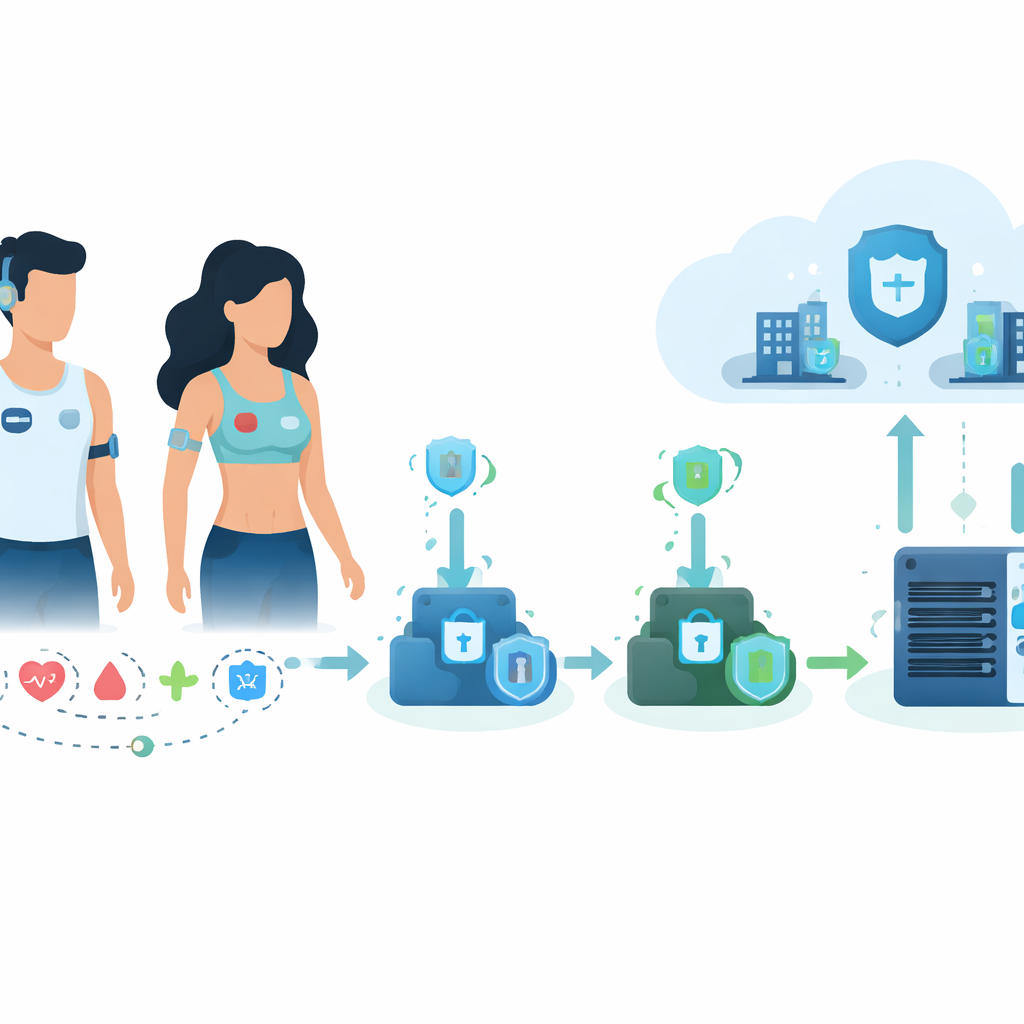
Wireless body area networks link multiple small sensors on or in a patient’s body to nearby hubs and then to hospital or cloud systems. They must work on tiny batteries, respond in fractions of a second, and still meet strict medical rules. Existing security methods struggle to satisfy all of these needs at once. Strong, conventional encryption drains batteries and may be cracked by powerful quantum computers. Some privacy tools keep data safe but are so slow and heavy that they are unusable in emergencies. Other fast systems share too much information, letting attackers guess whether a person’s records were used to train an artificial intelligence model—potentially revealing diagnoses or hospital visits.
A layered shield for health signals
The authors propose a new framework, called Quantum-Enhanced Privacy Aggregation (QEPA), that combines several cutting-edge tools into a single, three-layer system. At the lowest layer, each patient wears several sensors measuring heart activity, blood sugar, blood oxygen, breathing, and motion. These devices clean up the raw signals, turn them into precise numbers, and then encrypt both the data and the local learning updates they compute. In the middle layer, small coordinator boxes located nearby securely add together this encrypted information from about 30 sensors each, without ever seeing the underlying readings. At the top layer, a powerful medical server decrypts only the combined results, updates a shared prediction model, and then sends improved settings back down, all while keeping individual patients hidden.
Mixing quantum keys and smart math
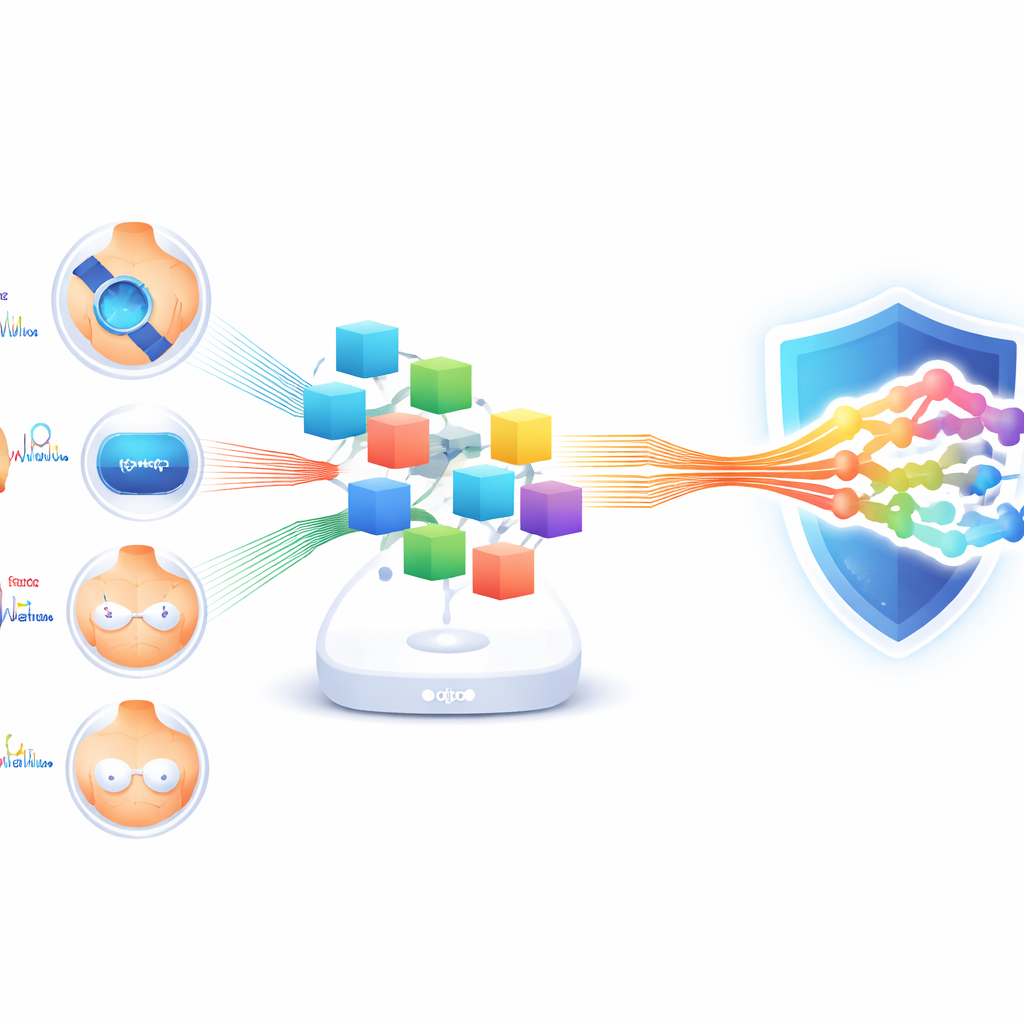
QEPA’s main innovation is how it blends different privacy and security ideas so they reinforce one another. First, it uses a quantum key distribution scheme—based on fragile single particles of light—to create secret keys between sensors and coordinators. Any attempt to listen in would disturb these particles in a detectable way, giving information-theoretic protection even against future quantum computers. Second, a new lightweight encryption method lets devices add up encrypted values quickly and with low energy use, avoiding the delays of older homomorphic schemes. Third, the learning process is arranged hierarchically so that only group summaries, not individual updates, travel to the server; the system also adds carefully calibrated random noise to these summaries, making it mathematically hard for an attacker to tell if any given person’s data was part of the training set.
Keeping doctors in the loop
High security is not enough on its own for medical use; clinicians must be able to understand why an algorithm raises an alarm or gives a diagnosis. QEPA therefore includes an explanation layer that uses a method known as SHAP to estimate how much each signal and feature—such as a section of an electrocardiogram or a trend in blood glucose—contributed to a particular decision. These explanations are compared with expert knowledge from cardiologists and other specialists, and the system achieves a close match. This helps doctors trust the recommendations, check for errors, and spot when the model may be drifting away from accepted clinical patterns over time.
How well the system performs in practice
The team tested QEPA on a simulated network of 1,500 sensors spread across 200 virtual patients, using real clinical datasets for heart rhythms, glucose, oxygen levels, and movement. The framework reached nearly the same diagnostic accuracy as a standard, unprotected learning approach, while sharply reducing the chance that an attacker could infer who participated in training. It also cut communication costs and energy use compared with older encryption methods, staying within the tight budgets of battery-powered wearables and sub-second response times needed for emergencies like dangerous heart rhythms. Even when many devices were assumed to be compromised and trying to poison the learning process, the system’s layered defenses kept the model’s error within medically acceptable bounds.
What this means for future care
In simple terms, QEPA shows that it is possible to design a body-wide monitoring system that is fast, power-frugal, and highly accurate, while still guarding patients’ privacy against both today’s hackers and tomorrow’s quantum attacks. The approach is not yet ready for every setting—it currently relies on line-of-sight quantum links and supports only certain types of encrypted computation—but in controlled environments like intensive-care units or specialized clinics, it points the way toward quantum-safe, regulator-ready medical telemetry. As quantum networking and hardware improve, ideas from QEPA could help make continuous, personalized monitoring a routine part of care without sacrificing the confidentiality people rightly expect.
Citation: Othman, S.B., Ali, O. Quantum-enhanced privacy aggregation for healthcare monitoring in wireless body area networks. Sci Rep 16, 13731 (2026). https://doi.org/10.1038/s41598-026-43649-8
Keywords: wireless body area networks, quantum-safe security, privacy-preserving healthcare, federated learning, medical wearables