Clear Sky Science · en
EffectorFisher: association of disease phenotype with pangenomic protein-isoform profiles for improved prediction of fungal pathogenicity effectors
Why this matters for our food
Fungal diseases quietly rob global harvests of enough grain to feed hundreds of millions of people. These microscopic invaders succeed by releasing special molecules, called effectors, that help them disarm plant defenses. Finding which effectors are at work in a given fungus could let breeders choose wheat varieties that stand up to infection. But current computer methods spit out huge lists of possible effector proteins, far more than scientists can test in the lab. This study introduces EffectorFisher, a new way to narrow those lists by directly tying fungal proteins to the visible symptoms they cause on crops.
How fungi and wheat battle it out
Plant-pathogenic fungi attack by secreting small proteins into their host’s tissues. Some of these effectors slip past standard immune alarms and either weaken defenses or even trigger cell death in the plant. Wheat, in turn, carries receptors that can sense particular effectors. In a classic “gene-for-gene” relationship, certain receptors recognize an effector and stop the infection. In an “inverse” version, which is common for fungi that kill host cells, recognition by a different class of receptors actually helps the fungus by promoting cell death. Because different wheat varieties carry different receptor sets, the same fungal strain may devastate one cultivar yet barely touch another. That variation in disease severity is the key signal EffectorFisher exploits.
Why earlier prediction tools were not enough
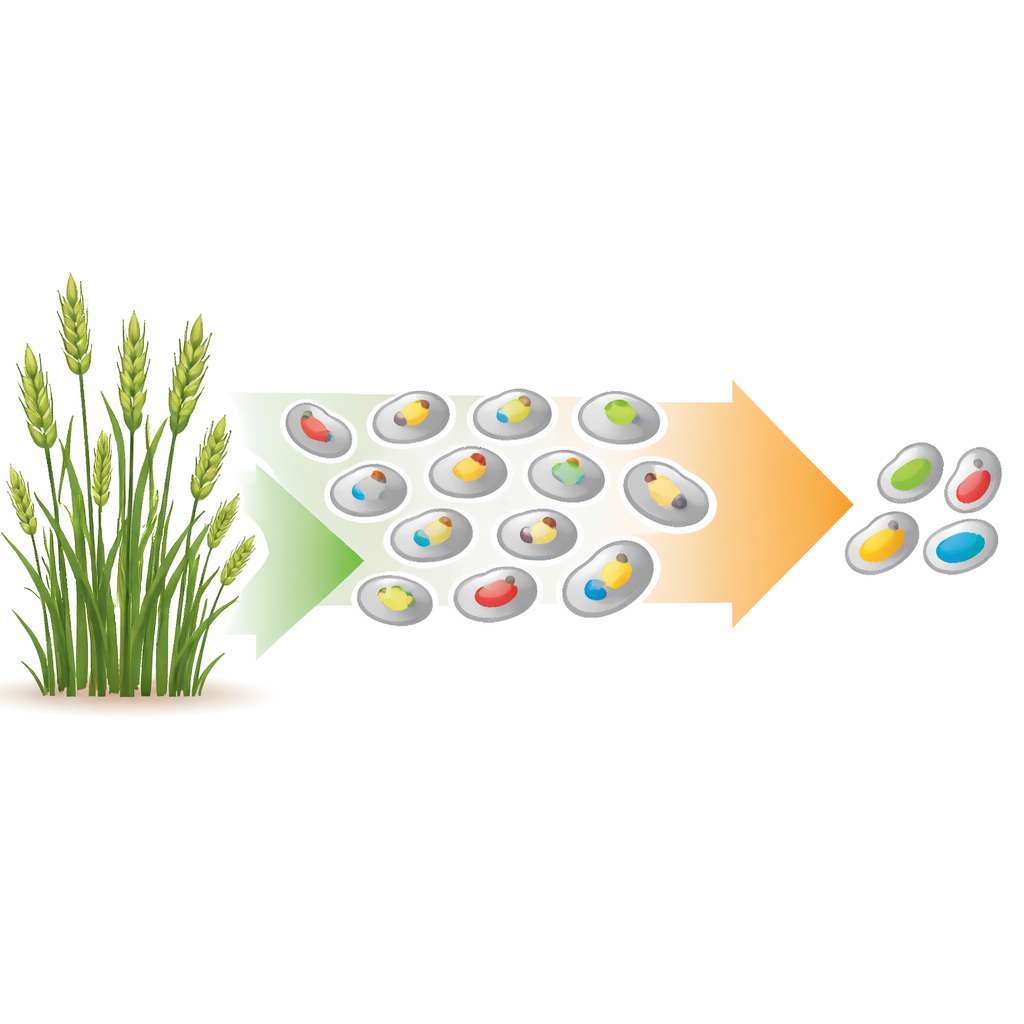
In recent years, bioinformatic pipelines such as Predector have accelerated effector hunting. They scan fungal genomes for proteins that look effector-like: small, rich in certain amino acids, secreted from the cell, and sometimes similar to known virulence factors. However, fungal genomes evolve quickly, accumulating many background mutations that scramble simple DNA signals without necessarily changing protein function. As a result, genome-wide association approaches that rely on single-letter DNA changes often drown in noise, especially in fungi where a mutation process called repeat-induced point mutation is widespread. Predector and related tools therefore tend to return hundreds or thousands of candidates, many of which are housekeeping proteins or otherwise unrelated to disease.
Linking protein variants to disease symptoms
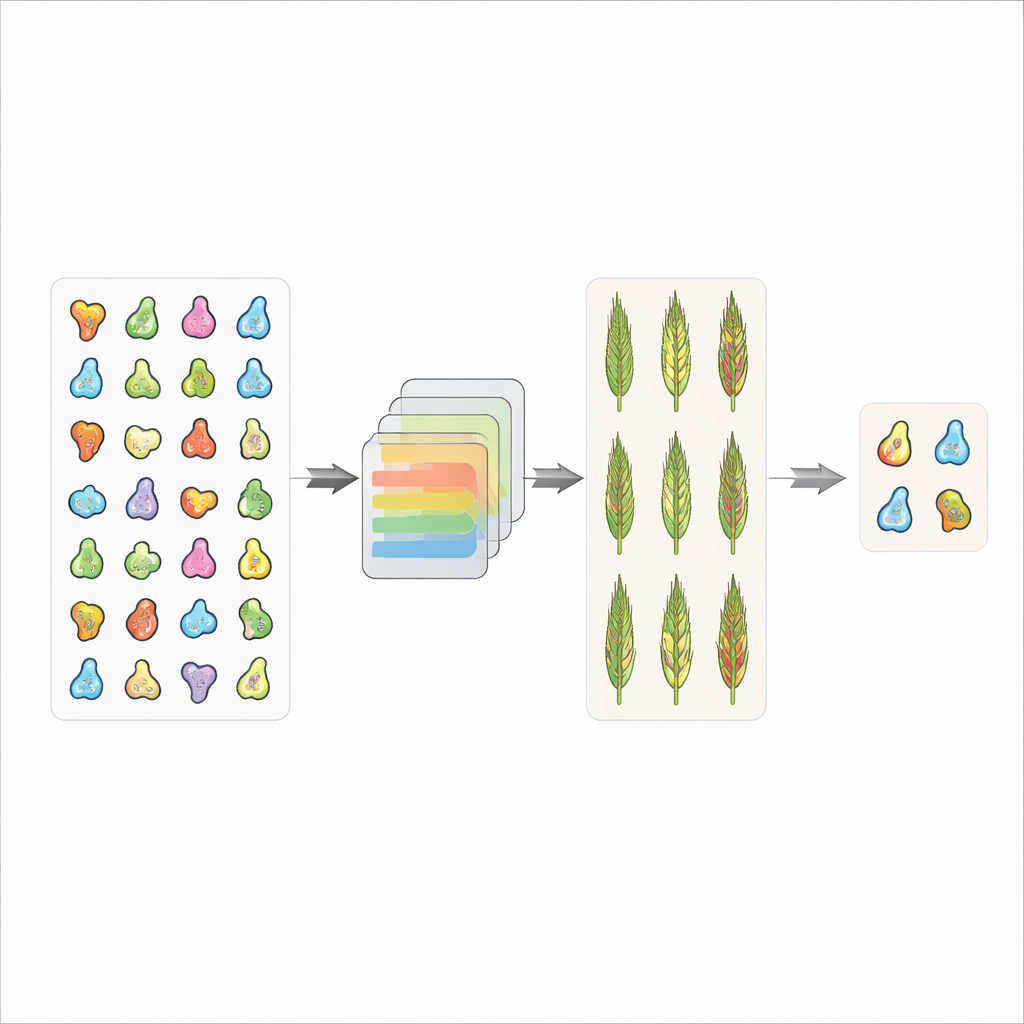
EffectorFisher takes a different angle. Instead of asking only “what looks like an effector?”, it also asks “which proteins shift in step with disease severity on different wheat varieties?”. The authors first construct a pangenome for each pathogen species: a combined catalogue of all genes and all distinct protein versions, or isoforms, found across many fungal isolates. For each candidate effector group identified by Predector, they record which isoforms appear in which isolates. Then they compare these isoform patterns to disease scores from controlled infections on panels of wheat cultivars. Using a statistical test, EffectorFisher scores how strongly the presence or absence of each isoform is associated with high or low disease on each cultivar, keeping proteins that show a tight link and discarding those that do not.
Putting the method to the test
The team benchmarked EffectorFisher on two well-studied wheat pathogens: Parastagonospora nodorum, which kills host tissue outright, and Zymoseptoria tritici, which initially lives more quietly before causing damage. Both species already have several experimentally confirmed effector proteins. Starting from Predector’s broad candidate lists, EffectorFisher slashed the number of predicted effector proteins while moving the known effectors much higher in the rankings. For P. nodorum, the method cut candidates from 185 down to as few as about 50 to 120 while still recovering all known effectors, and improved their ranking up to roughly fourfold. For Z. tritici, where the biology is somewhat different, it reduced more than 1,300 candidates to under 900 and roughly doubled the ranking strength of many confirmed effectors. The analysis also revealed which effector variants were most strongly linked to susceptibility or resistance in specific wheat cultivars.
What this means for future crop protection
Because EffectorFisher works directly at the protein level and uses full pangenomes rather than a single reference genome, it can sidestep some of the pitfalls that plague DNA-based association studies in highly mutated fungal genomes. The authors show that useful results can be obtained even with modest datasets, as long as the fungal isolates and wheat cultivars are chosen to span a range of disease outcomes. In practical terms, this approach offers plant pathologists shorter, more focused lists of effector candidates to test in the lab, and clearer clues about which wheat varieties will resist which pathogen populations. As more fungal genomes and disease surveys are collected, tools like EffectorFisher could help breeders stay a step ahead in the evolutionary arms race between crops and the pathogens that threaten global food security.
Citation: Hossain, M., Gray, N., Misiun, P. et al. EffectorFisher: association of disease phenotype with pangenomic protein-isoform profiles for improved prediction of fungal pathogenicity effectors. Sci Rep 16, 13077 (2026). https://doi.org/10.1038/s41598-026-43646-x
Keywords: fungal effectors, wheat disease, pangenome, protein isoforms, effector prediction