Clear Sky Science · en
Challenges and opportunities of Napier grass-derived biochar via liquefied gas for humic acid adsorption and DFT analysis
Turning Grass into a Water Helper
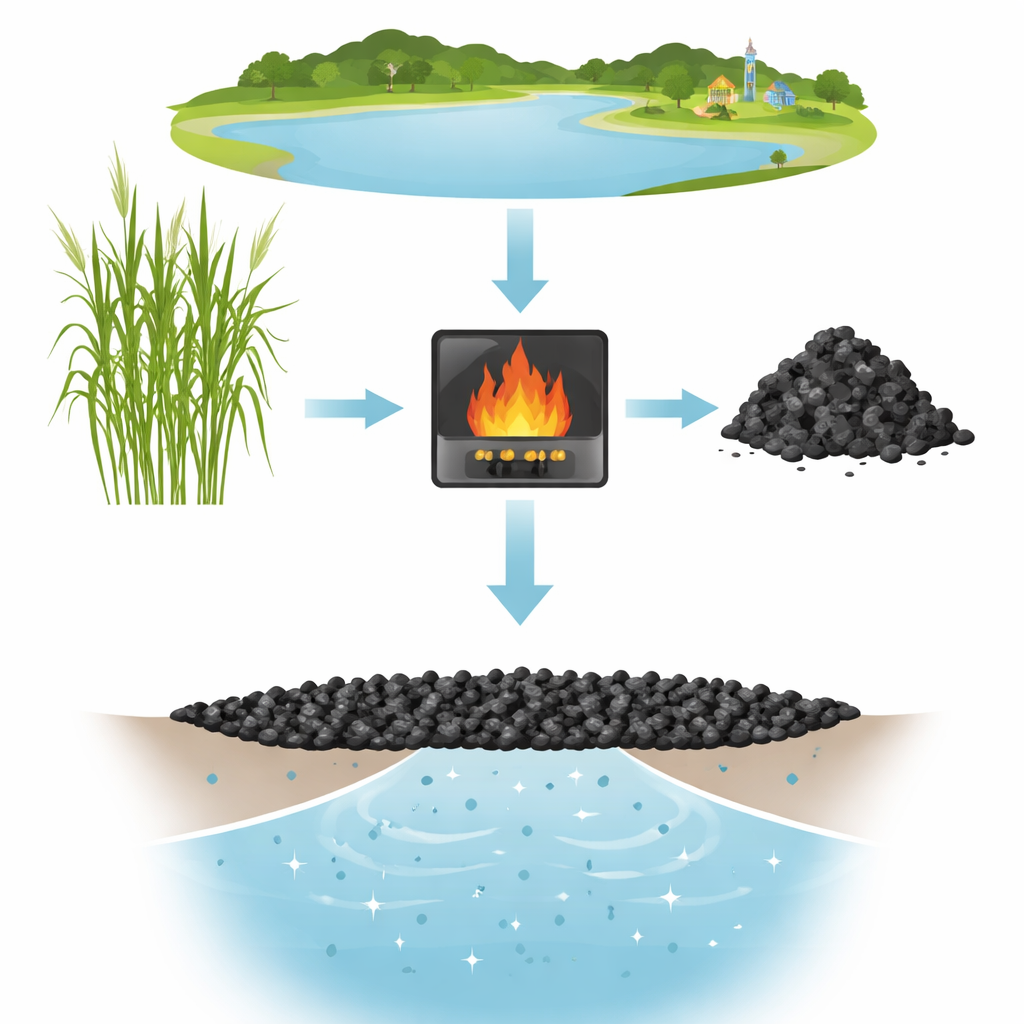
Clean drinking water depends not only on removing germs, but also on getting rid of invisible natural compounds that can turn into harmful chemicals during treatment. This study explores an inventive idea: using char made from Napier grass, a common livestock plant in Thailand, to help clean up a university reservoir. By heating leftover grass stems into a porous, carbon-rich material called biochar, the researchers tested whether this low-cost product could capture troublesome natural substances from water and reduce the formation of unwanted by-products when chlorine is used for disinfection.
Why Natural Water Can Hide Unseen Risks
Many lakes and rivers contain “dissolved organic matter,” the remains of plants and soils that seep into water. One important part of this mixture is humic acid, a dark, complex substance that helps color tea-colored streams and ponds. On its own, humic acid is not necessarily a major health threat. The trouble begins when water utilities add chlorine to kill microbes. Chlorine reacts with humic acid and similar compounds to create disinfection by-products, including a group of chemicals called trihalomethanes, some of which are suspected to increase cancer risk. In Chiang Mai, Thailand, a reservoir called Ang Kaew supplies water to the local university, making it an ideal real-world test bed for improved treatment approaches.
From Farm Grass to Porous Char
Napier grass is widely grown in Thailand as animal feed, but its tough stems often go unused. The team turned this farm residue into biochar by heating it to 600 °C in a pilot furnace that uses liquefied petroleum gas together with the gas released from the grass itself during burning. The resulting material, labeled CNP_600, was a black, porous solid rich in carbon. Microscopic imaging showed a rough, sponge-like surface, and measurements confirmed a relatively large internal surface area where dissolved molecules could stick. Chemical tests revealed that the biochar surface carried many oxygen-containing groups, such as acidic and alcohol-like sites, which are important for attracting and binding dissolved substances from water.
How Well the Grass Char Cleans Water
The researchers first studied how quickly and how strongly the biochar captured humic acid from test solutions. They found that most removal happened within six hours and that the process followed a pattern typical of chemical bonding rather than simple physical sticking. When they examined how much humic acid could be held at different concentrations, the results matched a model usually associated with rough, non-uniform surfaces. The team then moved from the lab to real water taken from the Ang Kaew reservoir. With a modest dose of biochar, the amount of dissolved organic carbon dropped by about half, and a light-absorbing signal at ultraviolet wavelengths, which tracks aromatic (ring-shaped) molecules that strongly form by-products, dropped by more than 70%. A combined index called SUVA fell from 2.0 to 1.2, indicating that the water after treatment contained fewer of these problematic aromatic components.
Peeking into the Invisible Chemistry
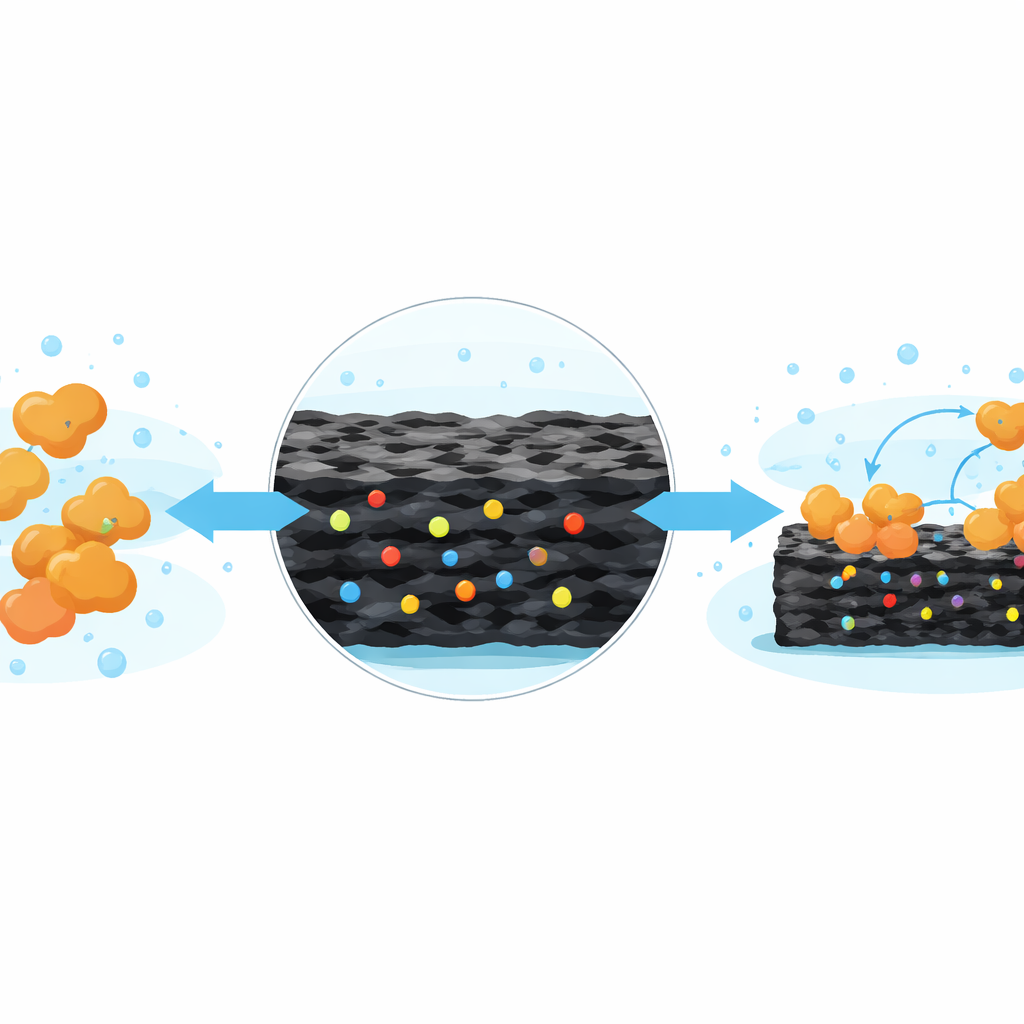
To understand why the Napier grass biochar preferred to grab humic acid, the team used computer simulations based on quantum chemistry. They built a simplified molecular model of the biochar surface, including key oxygen-bearing groups, and a representative model of a humic acid fragment. By calculating how electric charge is distributed across these structures, they identified negative regions around the oxygen atoms on the char and positive regions around certain hydrogen atoms. This pattern encourages humic acid molecules to approach and form hydrogen bonds—weak but numerous attractions—between their own oxygen-rich sites and the functional groups on the char. The calculations also showed that several possible arrangements of humic acid on the char surface are energetically favorable, with the most stable one forming multiple short, strong hydrogen bonds that hold the molecule in place.
What This Means for Safer, Affordable Water
Overall, the study shows that biochar made from Napier grass can meaningfully reduce natural organic matter in reservoir water, especially the aromatic portion most likely to generate hazardous disinfection by-products. Although its capacity is lower than that of some advanced commercial materials, the grass-based char is simple to produce from local agricultural waste and performs on par with conventional treatment steps in the existing water supply system. For communities seeking affordable ways to improve drinking water safety, especially in regions rich in biomass but short on funds, this work suggests that carefully prepared plant-based char could serve as a practical, climate-friendly addition to water treatment trains.
Citation: Promma, D., Kaewjan, T., Induvesa, P. et al. Challenges and opportunities of Napier grass-derived biochar via liquefied gas for humic acid adsorption and DFT analysis. Sci Rep 16, 13235 (2026). https://doi.org/10.1038/s41598-026-43639-w
Keywords: biochar, drinking water, humic acid, disinfection by-products, Napier grass