Clear Sky Science · en
Effects of curved carbon fiber plate bending stiffness on plantar pressure characteristics and performance during speed step in jump rope athletes
Why jump rope shoes matter
Jump rope is often seen as a simple playground activity, yet elite athletes treat it as a high-speed, high-impact sport. Each rapid step in a speed event sends force through small areas of the foot, repeated hundreds of times in half a minute. This study asked two questions that matter to athletes, coaches, and shoe designers: where exactly do those forces concentrate under the foot, and can special curved carbon fiber plates in the shoe make jumping both safer on the feet and faster on the rope?
How the study was set up
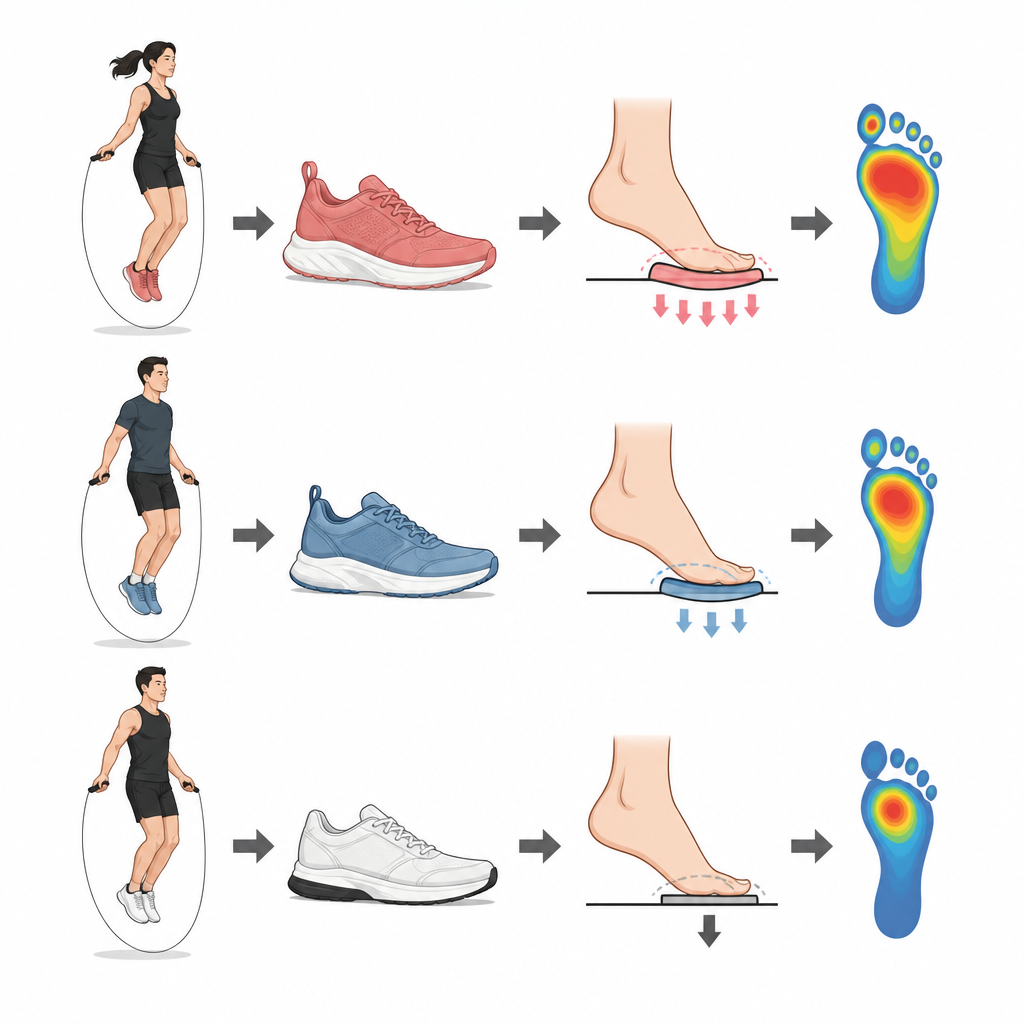
Researchers worked with 26 highly trained male jump rope athletes who could complete at least 120 speed steps in 30 seconds. Each athlete performed 30 second bouts of the “speed step,” a rapid alternation of the feet that is standard in competition. They repeated the test in three nearly identical pairs of shoes: a normal jump rope shoe, a version with a moderately stiff curved carbon fiber plate, and a version with an even stiffer plate. Thin pressure-sensing insoles recorded how force and pressure were spread across eight regions of the sole of the foot, from the big toe to the heel, while assistants counted how many jumps each athlete completed.
Where the foot takes the hit
The measurements showed that during the speed step, the front of the foot carries most of the burden. Peak force was greatest under the middle part of the forefoot, followed by the inner forefoot near the first three toes. The highest pressures occurred under the big toe and the joints at the base of the first to third toes. In contrast, the midfoot and heel experienced much smaller forces and pressures. This pattern confirms that propulsion in speed step skipping comes mainly from the front of the foot, with the big toe and nearby joints acting as key launch points off the ground.
What curved carbon plates changed
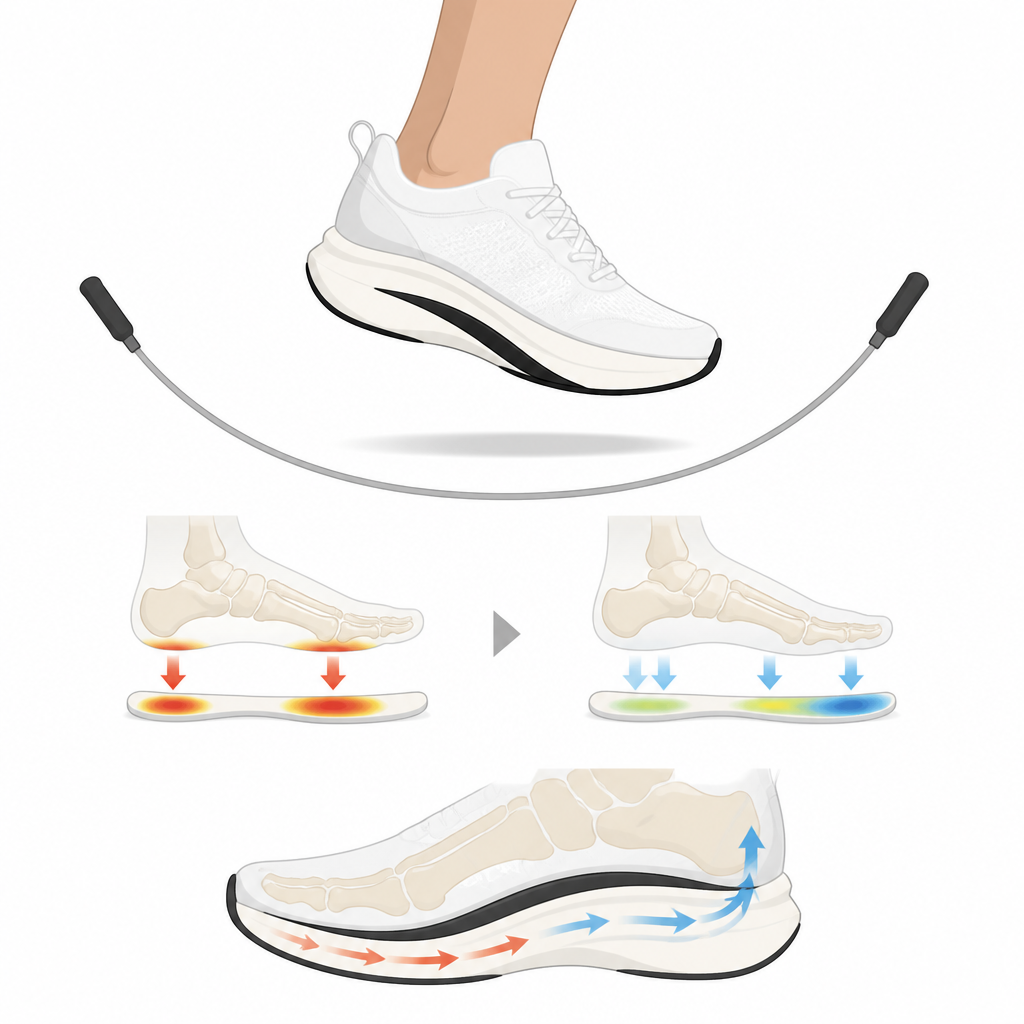
The team then compared how different shoe constructions altered these loads. Contrary to expectations based on running research, neither of the carbon plate shoes increased force at the heel. Instead, the stiffest curved plate slightly reduced the overall peak force under the entire foot compared with the normal shoe. More specifically, it lowered both peak force and the total force over time in the lesser toes and the inner midfoot. The moderately stiff plate also reduced loading in the inner midfoot but did not lessen forces in the toes. In one forefoot region, the moderate plate actually raised maximum pressure, suggesting that how stiffness is tuned can shift loads from one small area to another.
Did stiffer shoes make athletes faster
Despite their high-tech design, the carbon plate shoes did not help the athletes turn the rope faster. The number of jumps completed in 30 seconds and the contact time of each step were essentially the same across all three shoe types. The researchers note that speed step performance depends on precise timing between the feet and the rope, as well as upper and lower body coordination, not just on how stiff the shoe is. In this demanding skill, modest changes in sole stiffness may not be enough to show up as more jumps within such a short test.
What this means for athletes and designers
In everyday terms, the study concludes that elite speed step jumpers pound the front of their feet hardest, especially the big toe and nearby joints. Adding a very stiff curved carbon plate to the shoe did not turn athletes into faster jumpers, but it did redistribute how forces travel through the foot, easing the load on the smaller toes and part of the midfoot without lengthening ground contact time. For athletes and footwear designers, this suggests that curved carbon plates in jump rope shoes may be more useful as tools for shaping and potentially easing local foot stresses than as shortcuts to better performance.
Citation: Wu, K., Li, J., Suo, B. et al. Effects of curved carbon fiber plate bending stiffness on plantar pressure characteristics and performance during speed step in jump rope athletes. Sci Rep 16, 14880 (2026). https://doi.org/10.1038/s41598-026-43636-z
Keywords: jump rope, plantar pressure, carbon fiber plate, sports footwear, forefoot loading