Clear Sky Science · en
First time exploration and characterization of key-intermediates in palladium-catalysed coupling reactions
Catalysts at Work in Everyday Chemistry
Chemists rely on metal-based catalysts to build medicines, pigments, and advanced materials in just a few efficient steps. Palladium is one of the most powerful of these catalytic helpers, but much about how it actually works has been inferred rather than directly seen. This study captures and images, for the first time, key “in‑between” stages in a widely used palladium reaction, offering a rare snapshot of what really happens as simple starting materials are transformed into complex products.
Why Hidden Steps Matter
Modern organic chemistry often depends on “cross‑coupling” reactions, where carbon atoms from different molecules are joined together with surgical precision. Palladium catalysts are central to this chemistry and underlie the manufacture of many pharmaceuticals and specialty chemicals. These reactions usually begin with a crucial step called oxidative addition, where palladium inserts itself into a carbon–halogen bond (for example, a carbon–bromine bond), switching from a low to a higher oxidation state. Although textbooks widely depict this step, the actual short‑lived palladium complexes involved have been extremely difficult to isolate and characterize. Knowing their exact structure is key for designing faster, cleaner, and more selective reactions.
Building on Powerful Ring Molecules
The team focused on porphyrins, ring‑shaped molecules that are close relatives of the pigments in blood and chlorophyll. These compounds are attractive building blocks for light‑harvesting devices, sensors, and biomedical tools, but tailoring them usually requires several demanding synthetic steps. Here, the researchers used a brominated porphyrin and subjected it to a typical palladium‑catalyzed “aminocarbonylation” reaction. In this process, carbon monoxide and an amine are added to the starting material to form carboxamide groups, which act like molecular handles for further tuning. A widely used supporting ligand called Xantphos was chosen to control the metal center, because it is known to give highly active catalysts in related reactions.
Catching a Fleeting Palladium Stage
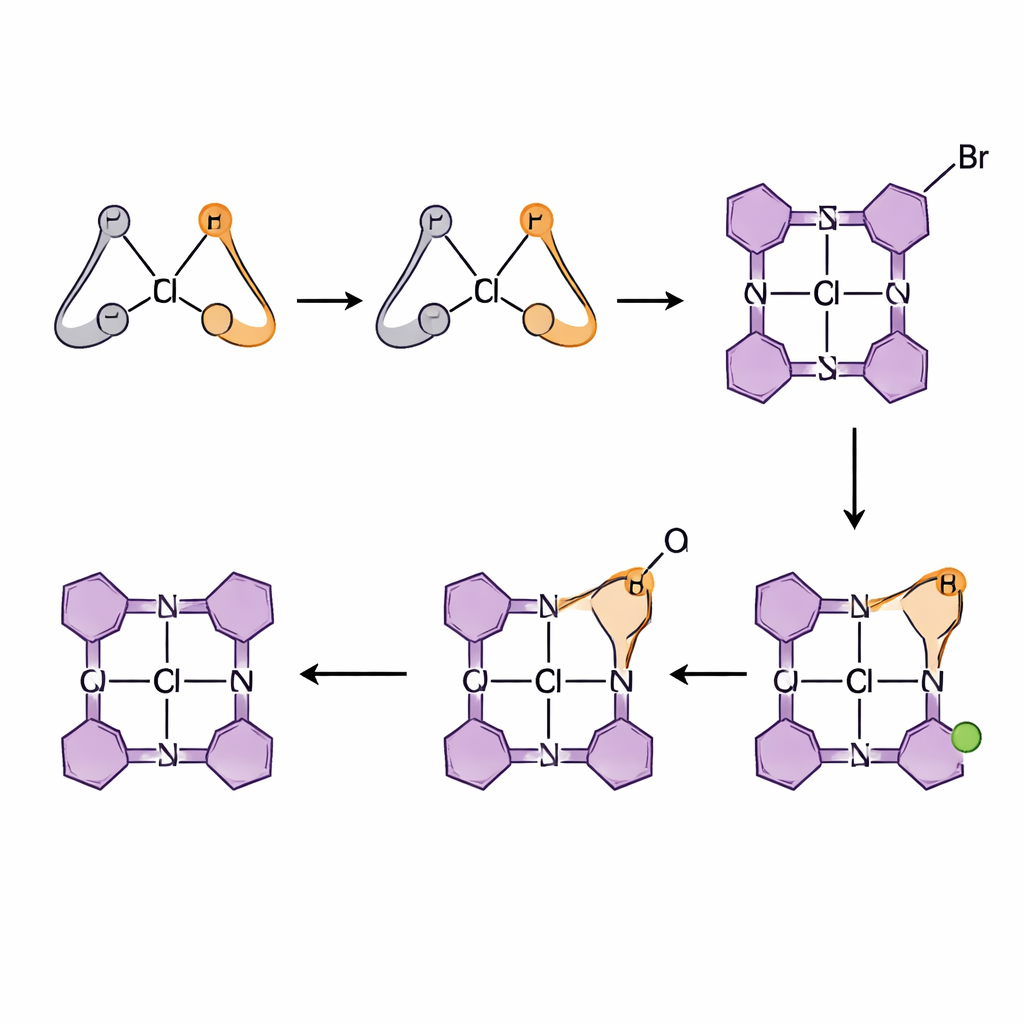
Under optimized reaction conditions, the palladium source and Xantphos first generate a highly reactive palladium(0) species. As this occurs, part of the Xantphos ligand itself is gently oxidized, turning one of its two phosphorus atoms into a harder oxygen‑containing site. This converts the original symmetrical “two‑armed” ligand into an unsymmetrical one that can grip the metal through both a softer phosphorus and a harder oxygen donor. When the brominated porphyrin meets this palladium(0) complex, it undergoes oxidative addition, forming a new palladium(II) complex in which the metal is bound simultaneously to the porphyrin ring and a halide. Remarkably, the authors were able to isolate this intermediate and determine its three‑dimensional arrangement by single‑crystal X‑ray diffraction.
Uncovering a Long‑Sought Intermediate
Careful experiments showed that the halide attached to palladium can swap during the catalytic process. In the full aminocarbonylation reaction, a salt present in the mixture donates chloride ions, which replace bromide to give a chloro‑porphyrinyl‑palladium complex. By repeating the reaction without any amine present, the researchers also obtained and crystallized the original bromo‑porphyrinyl‑palladium complex. Together, these structures proved that Xantphos hemioxide can bind the metal in a “heterobidentate” fashion—using one phosphorus and one oxygen arm—and that such complexes are not just theoretical proposals but real, isolable intermediates. The work maps this oxidative‑addition step directly onto a broader catalytic cycle that explains how the final carboxamide products arise.
Seeing How the Cycle Closes
With the oxidative‑addition intermediate and its chloride‑exchange variant now firmly identified, the rest of the catalytic story becomes easier to follow. After palladium binds the porphyrin, it coordinates carbon monoxide, inserts this carbon atom into the metal–carbon bond to form an acyl group, and then binds the amine. Loss of hydrogen halide leads to an amide‑bearing complex, which finally releases the carboxamide product and regenerates the active palladium(0) species. By capturing and characterizing these key palladium–porphyrin complexes, this study provides concrete evidence for a mechanism that had long been sketched only in diagrams. For chemists looking to design better catalysts and more sustainable routes to complex molecules, having such a clear structural picture of the working stages offers a powerful guide.
Citation: Szuroczki, P., Bényei, A., Aroso, R.T. et al. First time exploration and characterization of key-intermediates in palladium-catalysed coupling reactions. Sci Rep 16, 14059 (2026). https://doi.org/10.1038/s41598-026-43634-1
Keywords: palladium catalysis, cross-coupling, oxidative addition, porphyrin chemistry, aminocarbonylation