Clear Sky Science · en
High-performance Fe–Al@BTC MOF for supercapacitor and antibacterial applications: experimental, DFT, and molecular docking studies
Why this new material matters
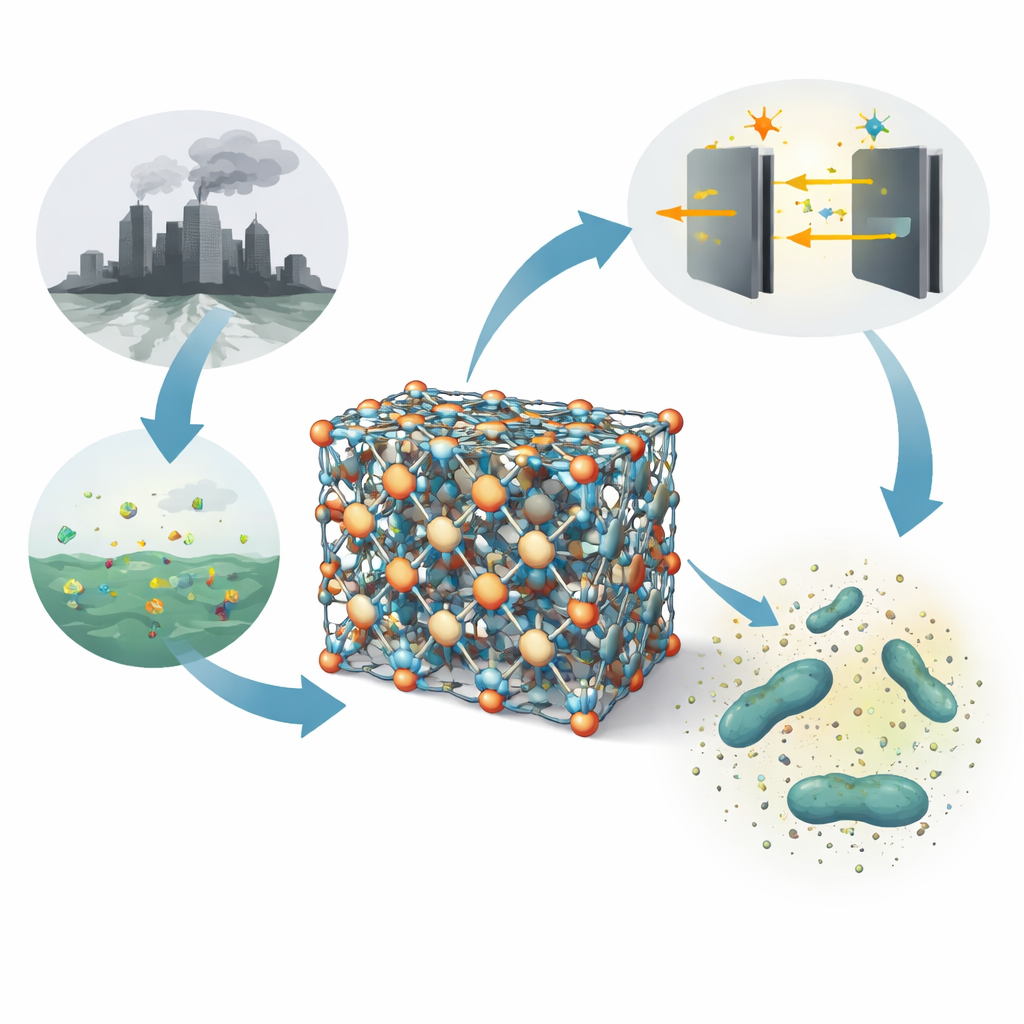
Modern life depends on both clean energy and clean water, yet we still struggle to store electricity efficiently and to stop dangerous microbes from spreading in the environment. This study presents a single, low-cost material that tackles both problems at once: a tiny, sponge‑like crystal that can quickly store electrical charge like a high‑performance supercapacitor electrode, while also powerfully killing harmful bacteria in water. By combining energy storage and disinfection in one substance, the work points toward devices that could help power and protect communities at the same time.
A crystal made from metal and carbon rings
The researchers created a material called a metal–organic framework, or MOF, built from iron and aluminum atoms linked together by small carbon‑based molecules. These building blocks self‑assemble into a rigid, highly porous 3D network resembling a microscopic honeycomb. Using a simple oven‑based process in a common solvent, the team synthesized yellow, nanoscale crystals of the new MOF, known as Fe–Al@BTC. A battery of techniques, including X‑ray diffraction and electron microscopy, confirmed that the crystals were well‑ordered, full of tiny pores, and composed of uniformly distributed iron, aluminum, carbon, and oxygen atoms. This intricate architecture gives the material a very large internal surface area where chemical reactions and charge storage can take place.
How it holds and moves electrical charge
To see whether Fe–Al@BTC could work in energy‑storage devices, the team examined how it interacts with light and with an electrical circuit. Optical measurements showed that the crystal absorbs visible light and behaves like a semiconductor with a relatively small energy gap, meaning electrons can be excited and move more easily. Electrochemical tests in an alkaline solution revealed that the material conducts mainly negative charge carriers, classifying it as an n‑type semiconductor with a very high density of mobile charges. When used as an electrode in a three‑electrode test cell, the MOF displayed the hallmarks of a strong supercapacitor: low resistance to charge transfer at its surface, a stable interface with the electrolyte, and a mixture of fast surface charging and deeper redox reactions centered on the iron atoms.
Storing bursts of energy like a supercapacitor
The team then pushed Fe–Al@BTC to act as a working electrode material. In cyclic voltammetry experiments, where voltage is swept back and forth while current is recorded, the curves took on broad, stable shapes that signaled highly reversible charge and discharge behavior. At slow sweep rates, ions from the surrounding liquid had enough time to penetrate deeply into the MOF’s network of micro‑ and mesopores, maximizing the use of active sites. Under these conditions, the material reached a specific capacitance of about 339 farads per gram, a strong performance for supercapacitor electrodes. As the voltage was scanned faster, the capacitance decreased slightly, as expected when ion motion starts to lag behind the changing electric field. Overall, the combination of porous structure, conductive pathways, and iron redox chemistry allowed Fe–Al@BTC to rapidly store and release electrical energy.
Stopping harmful bacteria in their tracks
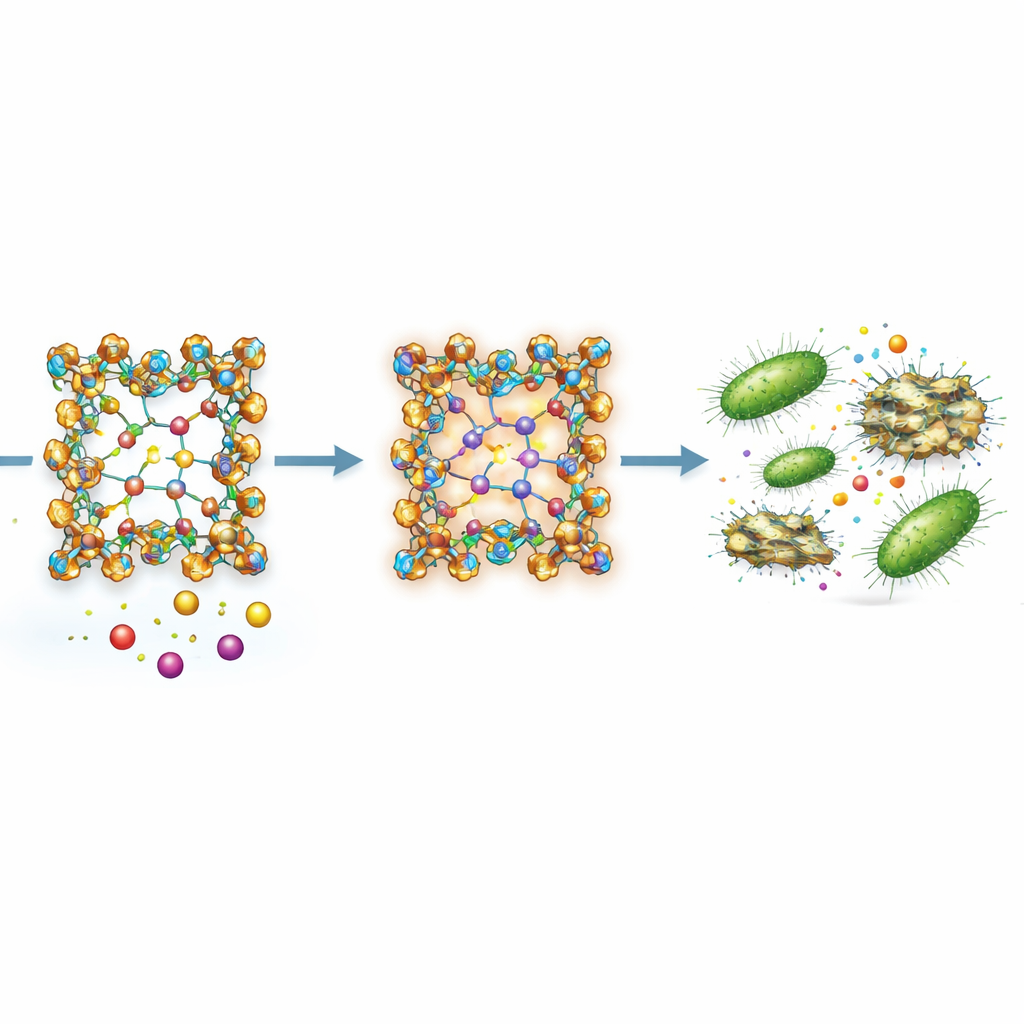
Beyond energy storage, the researchers tested whether the same MOF could halt bacterial growth. They exposed cultures of Bacillus species—environmental bacteria that can contaminate water—to increasing amounts of Fe–Al@BTC. Using both optical density measurements of liquid cultures and a traditional plate test that measures clear "kill zones" around samples, they found that bacterial growth dropped sharply as MOF concentration rose. At 600 milligrams per liter, the material completely stopped growth in both assays. The authors suggest that several forces are at work: charged groups on the MOF surface attract and disrupt the cell wall, iron and aluminum centers may bind to key cell components, and defects in the crystal can promote chemically reactive species that damage bacterial membranes and proteins.
Peeking into interactions at the atomic scale
To connect structure with function, the team turned to computer simulations. Quantum‑chemical calculations showed how the organic linker and metal centers combine to create a relatively small gap between the highest occupied and lowest unoccupied electron states, supporting the observed semiconducting and redox behavior. Molecular docking simulations then modeled how fragments of the MOF interact with an essential enzyme from Bacillus bacteria. The modeled complexes bound tightly through a mix of hydrogen bonding, electrostatic attraction, and hydrophobic contacts, hinting that the MOF can interfere with vital biochemical machinery in addition to damaging the cell envelope. These theoretical insights complement the lab measurements and help explain the dual energy and antibacterial performance.
What this could mean for everyday life
In plain terms, the study shows that a single, easily made crystal can both act like a fast, long‑lived electrical sponge for supercapacitors and serve as a potent killer of harmful bacteria in water. Because Fe–Al@BTC is based on relatively abundant metals and can be synthesized with straightforward methods, it holds promise for low‑cost devices that, for example, store energy from solar panels while simultaneously helping to disinfect water streams they contact. While more work is needed to scale up production, tune the synthesis, and evaluate real‑world safety, this multifunctional material offers a glimpse of future technologies where one smart solid can address both our energy needs and our environmental health.
Citation: Abdelnasser, E., Alaraj, A.M., Abdelfatah, M. et al. High-performance Fe–Al@BTC MOF for supercapacitor and antibacterial applications: experimental, DFT, and molecular docking studies. Sci Rep 16, 11359 (2026). https://doi.org/10.1038/s41598-026-43631-4
Keywords: metal-organic frameworks, supercapacitors, antibacterial materials, energy storage, water purification