Clear Sky Science · en
Nonlinear dynamics and stability of a delayed leukemia model with real-world applications
Why timing matters in blood cancer
Leukemia is a blood cancer where abnormal white blood cells grow out of control in the bone marrow, crowding out healthy cells. Doctors know that the disease and its treatment unfold over months or years, not instantaneously. This study asks a deceptively simple question: what happens if we build those waiting times directly into a mathematical model of leukemia? The answer is that timing can decisively tip the balance between a body overwhelmed by malignant cells and one that successfully regains control.
Breaking leukemia into simple building blocks
To explore this, the authors construct a compact mathematical picture of blood cell dynamics. They group cells into three broad types: healthy cells that can still become malignant, leukemic (infected) cells, and cells that have recovered or gained some form of protection. Equations describe how cells move between these groups, die naturally, or are removed by treatment and immune action. Crucially, the model includes a built-in delay between harmful interactions and their eventual impact. This delay represents biological processes such as the time needed for a leukemic cell to progress through its growth cycle, for the immune system to respond, or for a therapy to take full effect. The team proves that under realistic conditions the model behaves sensibly: cell numbers stay positive, remain bounded rather than blowing up, and the equations have a unique solution for a given starting state.
A threshold between remission and persistence
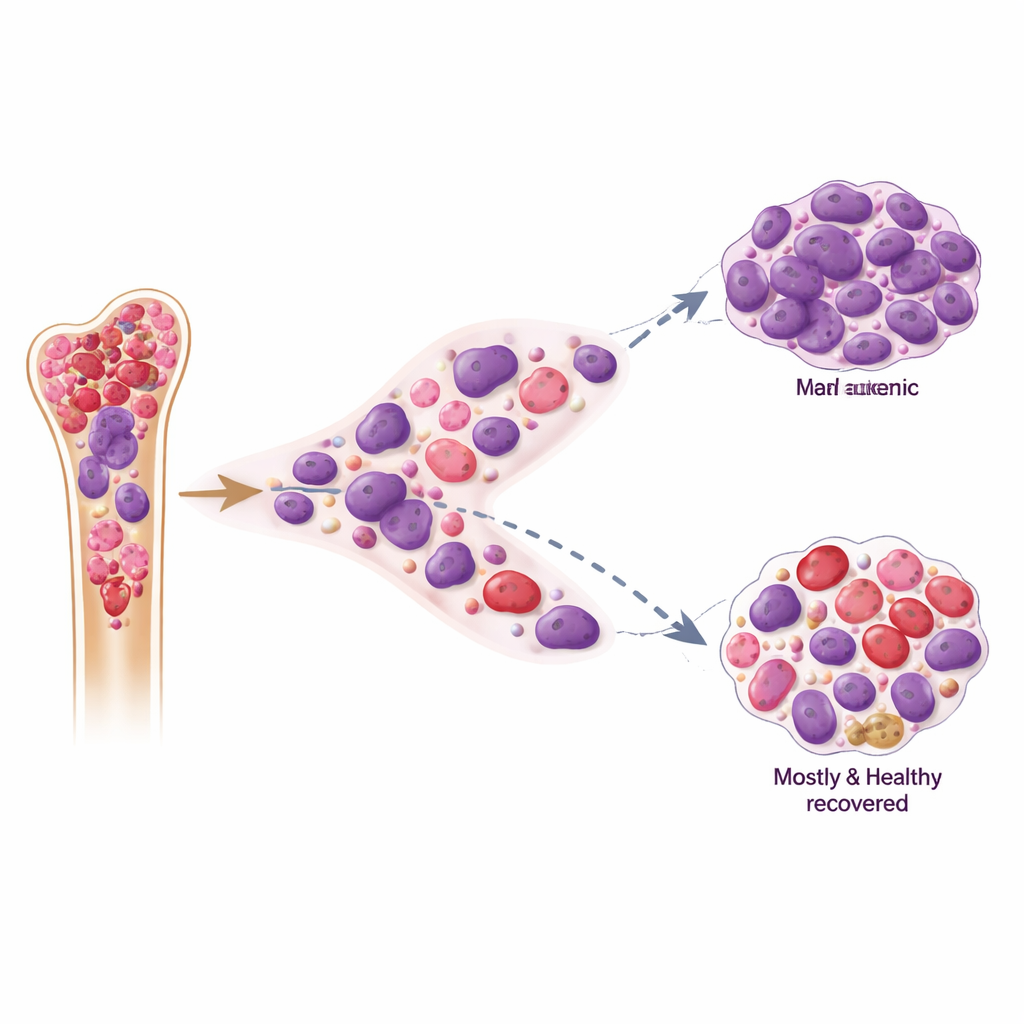
Within this framework, the researchers identify two possible long-term outcomes. In a leukemia-free state, malignant cells die out and healthy cells settle to a steady level. In a leukemia-existing state, malignant and immune cells coexist at constant levels, reflecting a chronic disease that neither disappears nor runs away unchecked. Which outcome is reached is governed by a single key quantity, a so-called reproduction threshold that captures how many new malignant cells one malignant cell effectively generates on average. If this threshold is below one, leukemia cannot maintain itself; if it is above one, the cancer persists. By carefully analyzing the equations, the authors demonstrate that when the threshold is low the leukemia-free state is not only stable to small disturbances but globally attractive: from any reasonable starting condition, the system drifts toward remission.
How delays and treatment reshape disease dynamics
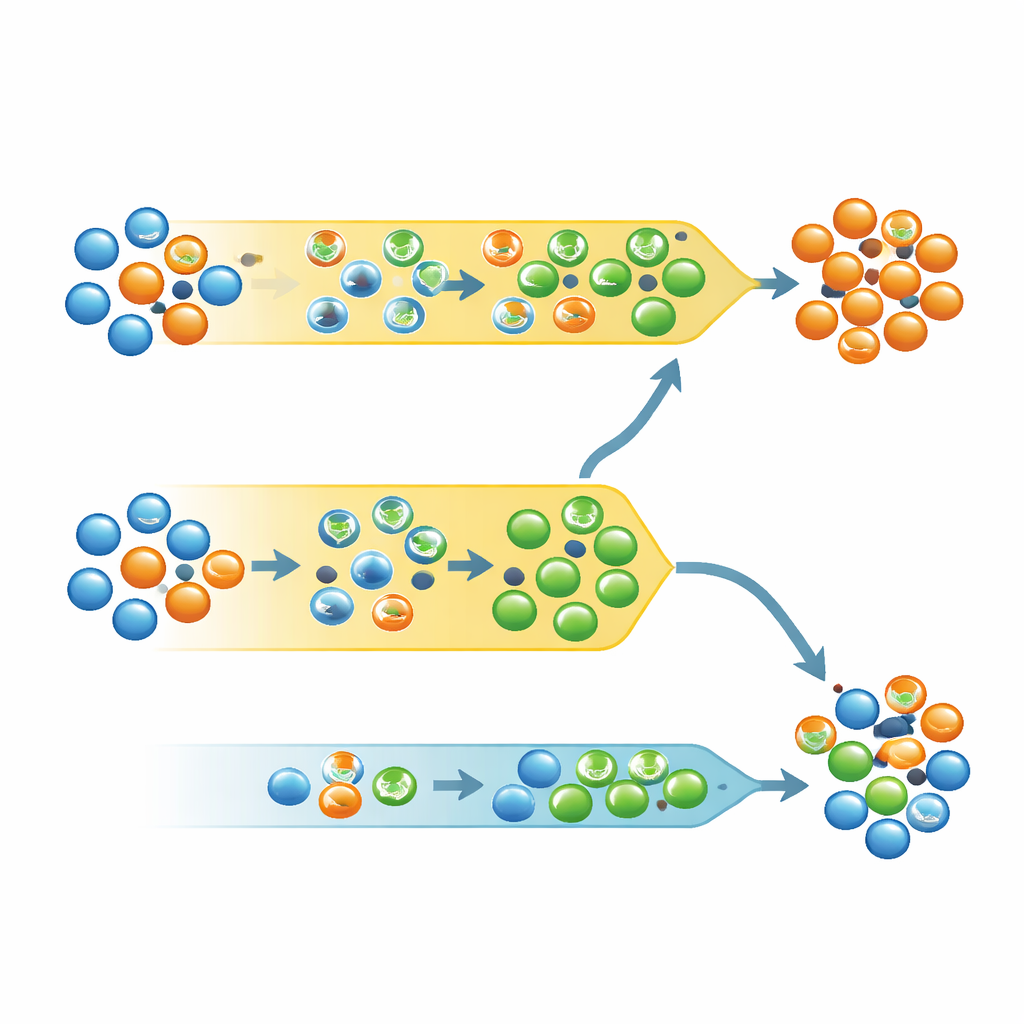
A central finding is how strongly the threshold depends on timing. Because the growth of leukemic cells must pass through a delayed stage, lengthening that internal delay effectively dilutes their impact. Mathematically, the threshold falls as the delay increases. Sensitivity calculations show that parameters boosting cell recruitment or the rate at which healthy cells become malignant push the threshold upward, promoting disease. In contrast, faster removal of malignant cells, higher natural death of unhealthy cells, and longer intrinsic delay all pull the threshold down. In simulations, extending the delay shrinks the malignant population and can even drive the system toward the leukemia-free state, even in scenarios where a simpler, delay-free model would predict a stable chronic burden.
Testing the model against real-world data
To see whether their idealized system connects to reality, the authors calibrate it using leukemia records from Portugal between 2010 and 2022. They adjust key parameters so that the simulated yearly number of new leukemia cases matches the reported national incidence. The fitted model reproduces the observed downward trend in new diagnoses over the last decade. In this calibrated picture, the effective threshold value starts above one and then drops below one in recent years, echoing improved disease control. The fitted delay falls in the range of several months, consistent with biologically plausible times for cell-cycle progression and immune or treatment responses. At the same time, parameters linked to therapy show shifts that correspond to stronger removal of malignant cells and weaker effective proliferation.
What this means for understanding leukemia
This work does not recommend deliberately delaying diagnosis or treatment; instead, it highlights that built-in biological waiting times can help restrain leukemia if they slow the net impact of malignant cells. By showing that such delays, along with more effective therapies, push the system toward a leukemia-free state, the study underscores the importance of capturing time patterns in mathematical models of cancer. The combination of rigorous analysis, computer simulations, and comparison with national data suggests that even a relatively simple delayed model can illuminate which biological and treatment factors most strongly influence whether leukemia lingers or fades.
Citation: Raza, A., Alsulami, M., Rocha, E.M. et al. Nonlinear dynamics and stability of a delayed leukemia model with real-world applications. Sci Rep 16, 13312 (2026). https://doi.org/10.1038/s41598-026-43629-y
Keywords: leukemia dynamics, delay differential model, cancer modeling, treatment timing, stability analysis