Clear Sky Science · en
Frequency super-resolution with quantum environment engineering in a weakly coupled three-nuclear-spin system
Seeing Hidden Details in Invisible Colors
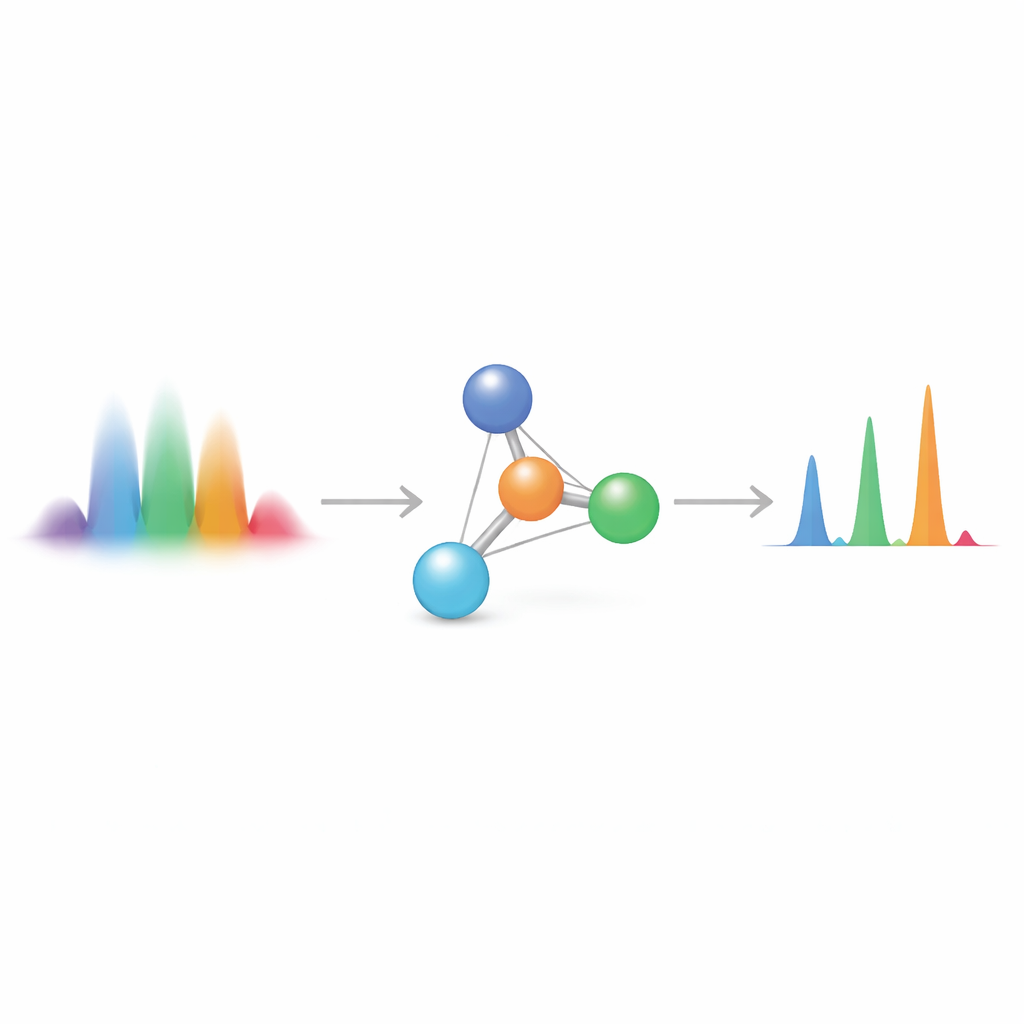
Many of the most powerful tools in modern science work by reading the “colors” of light and radio waves that atoms and molecules emit. But these spectra have a built‑in blur: if two spectral lines are too close in frequency, they merge into one and important details disappear. This paper shows how to beat that blur in frequency space, revealing tiny differences that were previously washed out, by carefully controlling the quantum surroundings of a small group of atomic nuclei.
Why Frequency Blurs Together
When scientists measure spectra—from visible light in astronomy to radio waves in medical imaging—they look for peaks that act like barcodes, encoding what kind of atoms are present and how they interact. In practice, these peaks are never razor‑thin. Random motion, magnetic noise, and other disturbances broaden each peak into a bell‑shaped line with a characteristic width. If two true frequencies lie closer together than this width, they overlap so strongly that traditional methods can no longer tell them apart. Numerical tricks can sometimes guess how many peaks are hiding inside, but they usually rely on assumptions about the shapes and number of peaks, and those guesses are not always trustworthy.
Borrowing a Trick from Super-Resolution Microscopy
Optical microscopy faced a similar problem: the famous diffraction limit said that details smaller than about half the wavelength of light could not be resolved. Super‑resolution techniques, such as photoactivated localization microscopy, skirted this rule by adding another dimension—time. Instead of trying to sharpen a single blurry picture, they switched on only a few fluorescent markers at a time, located each one precisely with the existing blur, and then built up a sharp image from many shots. This work applies the same philosophy to frequency measurements. Instead of changing time, the authors change the quantum state of the environment surrounding the spin they observe, effectively adding a new “axis” along which overlapping peaks can be separated.
Using Nearby Spins as a Quantum Control Knob
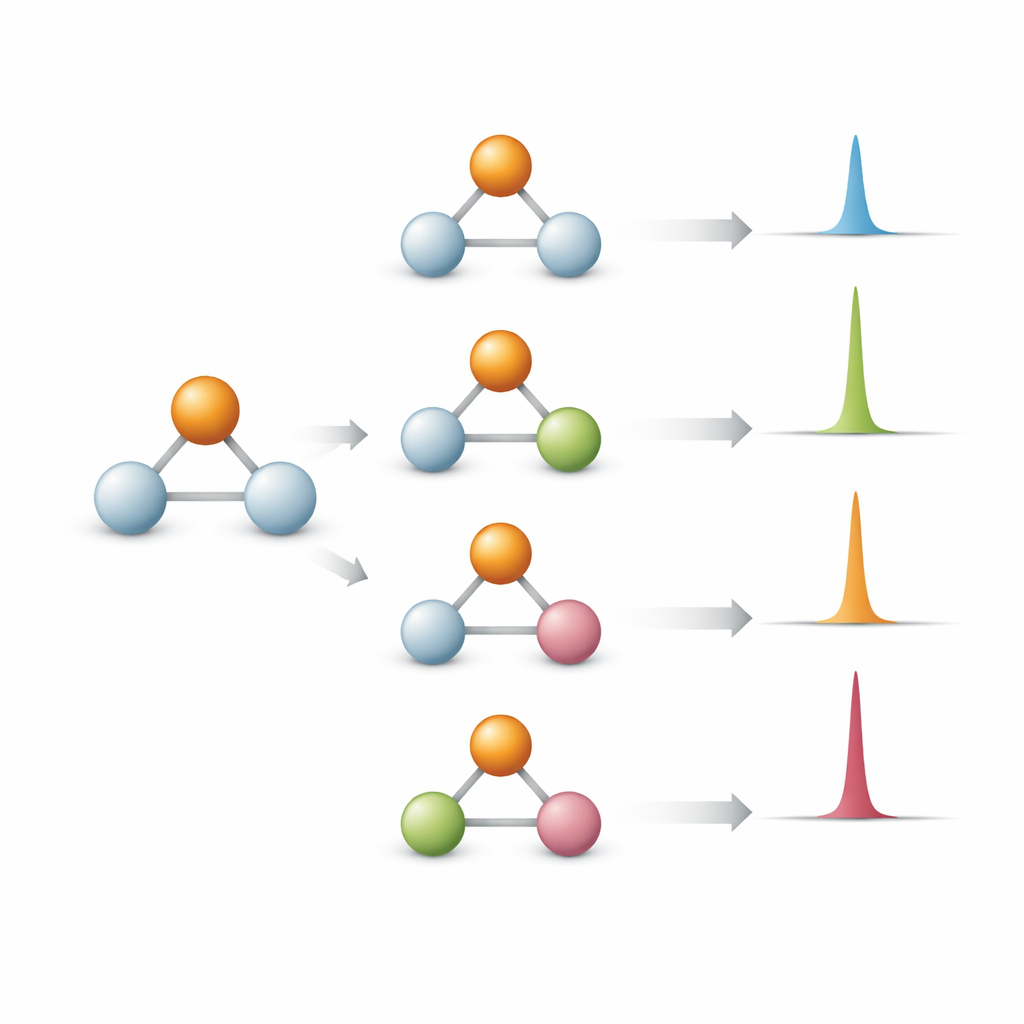
The team studies a simple but realistic system: three fluorine nuclei in a small organic molecule. One nucleus plays the role of the “observed” spin, while the other two form its quantum environment. Their mutual magnetic couplings slightly shift the observed spin’s frequency in different ways, depending on the exact joint state of all three. Under normal conditions and in the presence of magnetic noise, all these slightly shifted frequencies blend into a few wide, overlapping peaks. The key step is to prepare special so‑called pseudo‑pure states of the environment spins. Each such state acts like a clean, well‑defined configuration of the surrounding nuclei. In that configuration, the observed spin produces essentially a single frequency peak, even though the line itself is still broad.
Splitting One Fat Peak into Several Clean Ones
By engineering several distinct environment states one after another and measuring the spectrum each time, the researchers obtain a set of single‑peak spectra. Each one pinpoints a different underlying frequency component that was previously hidden inside a broad, merged signal. They show mathematically and numerically that in a weakly coupled multi‑spin system, the usual thermal spectrum can be reconstructed as a simple sum of these single‑peak spectra. In their experiments, they implement this protocol on a benchtop nuclear magnetic resonance device. For the fluorine spins in their molecule, the conventional spectrum displays only a few wide peaks with substructure that is hard to interpret. With the environment‑engineered measurements, those same features are decomposed into four clearly separate components, even when two of them lie closer together than the line width would normally allow.
Pushing Frequency Resolution Beyond Traditional Limits
To quantify how far they beat the usual limit, the authors repeatedly measure the positions of the separated peaks and analyze how precisely those positions can be determined over time. They find that the effective frequency resolution can reach down to about 0.3 hertz, roughly two hundred times finer than the roughly 60‑hertz width of each line. In other words, they can distinguish frequency differences as small as about 0.5% of the line width without narrowing the lines themselves. Because this approach relies on physical control of the quantum environment rather than heavy numerical fitting or extreme experimental conditions, it could be especially useful in low‑field and noisy situations, such as compact NMR devices, chemical analysis of small samples, or even components of medical imaging. In simple terms, they show that by turning the environment from a source of blur into a tool, it is possible to resolve “colors” in frequency that used to be indistinguishable.
Citation: Wang, T., Cao, Q., Du, P. et al. Frequency super-resolution with quantum environment engineering in a weakly coupled three-nuclear-spin system. Sci Rep 16, 13113 (2026). https://doi.org/10.1038/s41598-026-43627-0
Keywords: frequency super-resolution, quantum environment engineering, nuclear magnetic resonance, spin coupling, spectral decomposition