Clear Sky Science · en
Optimized topology control for large-scale IoT networks using graph-based localization
Smarter Maps for the Internet of Things
The Internet of Things (IoT) is filling homes, factories, and cities with tiny devices that sense and report everything from temperature to traffic. But getting all these gadgets to talk reliably, without draining their batteries, is harder than it sounds. This paper introduces IoTNTop, a new way to "draw" and manage the invisible map of who talks to whom in a huge IoT network, so that messages get through with low error while devices still last for years on a coin cell battery.
Why Network Shape Matters
Behind every IoT deployment lies a hidden web of wireless links among simple end-nodes and more capable gateways. Which links are active, how far they stretch, and how much power each device uses can make the difference between smooth data collection and constant dropouts. Traditional design methods often focus on keeping everything loosely connected or saving energy in isolation. They usually assume clean measurements and stable links, and they treat node positioning and network design as two separate problems. In the messy reality of factories, city streets, or remote farms, where signals reflect, fade, and interfere, these assumptions fall apart—links that look good on paper can be unreliable in practice.
Linking Location and Reliability
This work argues that knowing where devices are, even approximately, is tightly linked to how well they can communicate. Signal strength falls with distance, so any error in location becomes an error in estimating how strong a link really is. Instead of first localizing devices and then, in a separate step, designing the network, IoTNTop fuses both tasks. It uses partial and noisy distance measurements between nodes to reconstruct a spatial layout for both end-nodes and gateways, and it feeds that layout directly into decisions about which links to activate, what power to use, and how fast to send data. The key twist is an "error-centric" goal: the framework explicitly tries to minimize the probability that a transmitted symbol is decoded incorrectly, while still respecting limits on device power and data rate.
Building a Global Picture from Local Pieces
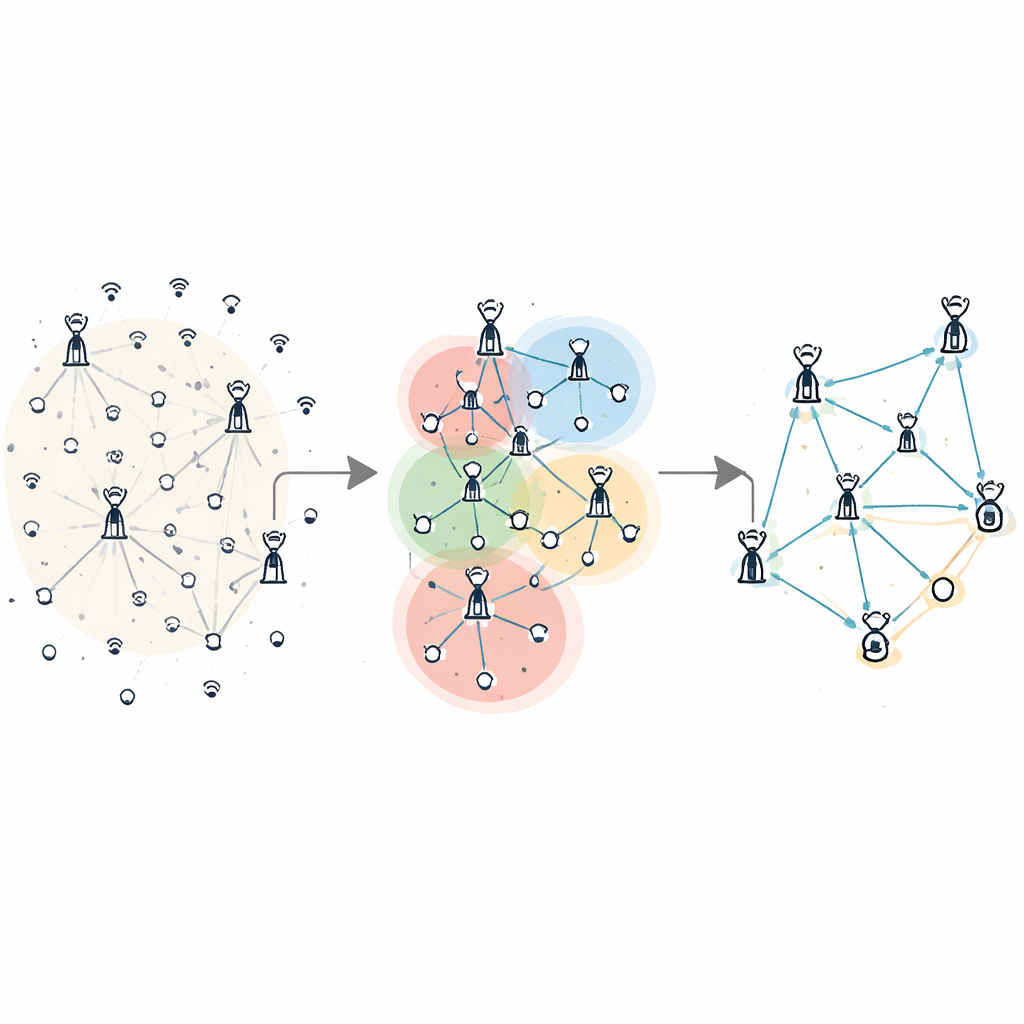
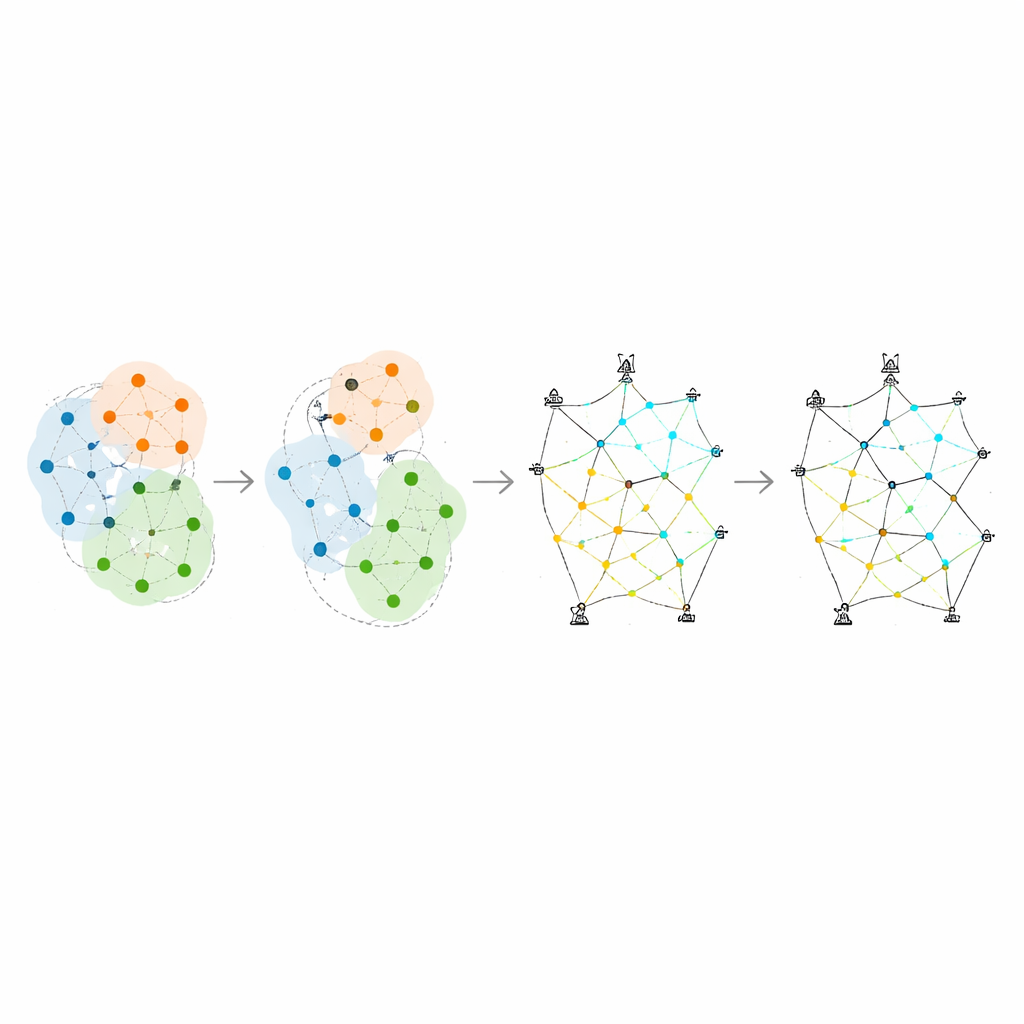
IoTNTop scales to large networks by breaking the problem into manageable chunks. First, it decomposes the network into overlapping local sub-graphs, each containing nearby nodes and rough distance estimates. Within each sub-graph, it computes a local map of node positions. Because each piece is built independently from noisy data, these local maps may be rotated, mirrored, or shifted relative to one another. A multi-stage stitching process then aligns them into a single, globally consistent picture. Using eigenvector-based synchronization to fix reflections and rotations, landmark-based alignment to adjust shifts and scale, and a mathematical technique called semidefinite programming to refine distances, IoTNTop produces a coherent geometry even when many distances are missing or inaccurate.
Turning Maps into Better Connections
Once the spatial layout is in place, IoTNTop turns to the job of choosing how the network should actually operate. It looks at all candidate links that meet a basic signal quality threshold and jointly decides which ones should be active, how much transmit power each node should use, and which data coding rates are feasible. A greedy procedure guided by signal-to-noise ratio prefers short, strong links and avoids those that are likely to cause errors or waste power. At the same time, the method enforces coverage requirements so that each node has at least one sufficiently good path to a gateway. A convergence check on overall error probability and data rate stops the optimization once improvements become marginal, keeping computation under control even for hundreds of nodes.
What the Simulations Show
Extensive computer simulations with up to 500 nodes scattered over several square kilometers show that IoTNTop outperforms a range of common strategies, including brute-force search, genetic algorithms, minimum-spanning-tree methods, and popular clustering schemes like HEED and LEACH. Under comparable conditions, most nodes managed to keep their symbol error probability below about 15%, while retaining 60–80% of their starting energy. The framework also sustained higher data rates at lower transmit powers and converged in fewer iterations, indicating both better communication quality and improved scalability. These advantages persisted across different noise levels, network sizes, and signal-to-noise regimes.
Clearer, Leaner Networks for the Real World
In everyday terms, IoTNTop learns a cleaner, more accurate map of where devices sit in space and uses that knowledge to wirelessly connect them in a way that wastes less energy and drops fewer bits. Rather than optimizing for abstract metrics like "number of links" or "lifetime" alone, it directly targets the chance that a message is misread, while staying within realistic power and coding limits. For city-wide sensors, industrial monitoring, and other large-scale IoT applications, this means networks that are both more robust and more efficient—getting more reliable data out of the same batteries and airwaves.
Citation: Dey, I., Marchetti, N. Optimized topology control for large-scale IoT networks using graph-based localization. Sci Rep 16, 13810 (2026). https://doi.org/10.1038/s41598-026-43621-6
Keywords: Internet of Things, wireless networks, node localization, topology control, energy-efficient communication