Clear Sky Science · en
Reception of conspecific cues alters testicular gene expression and improves fertility in boreal chorus frogs (Pseudacris maculata)
When Frog Songs Shape the Next Generation
On spring nights, ponds can sound like crowded concerts as male frogs call out for mates. This study asks a surprising question: do those calls do more than attract females? By working with boreal chorus frogs in controlled experiments, the researchers show that hearing other males calling not only changes behavior, but also quickly switches on genes in the testes and leads to healthier offspring. In other words, frog songs can tune fertility from the outside in.
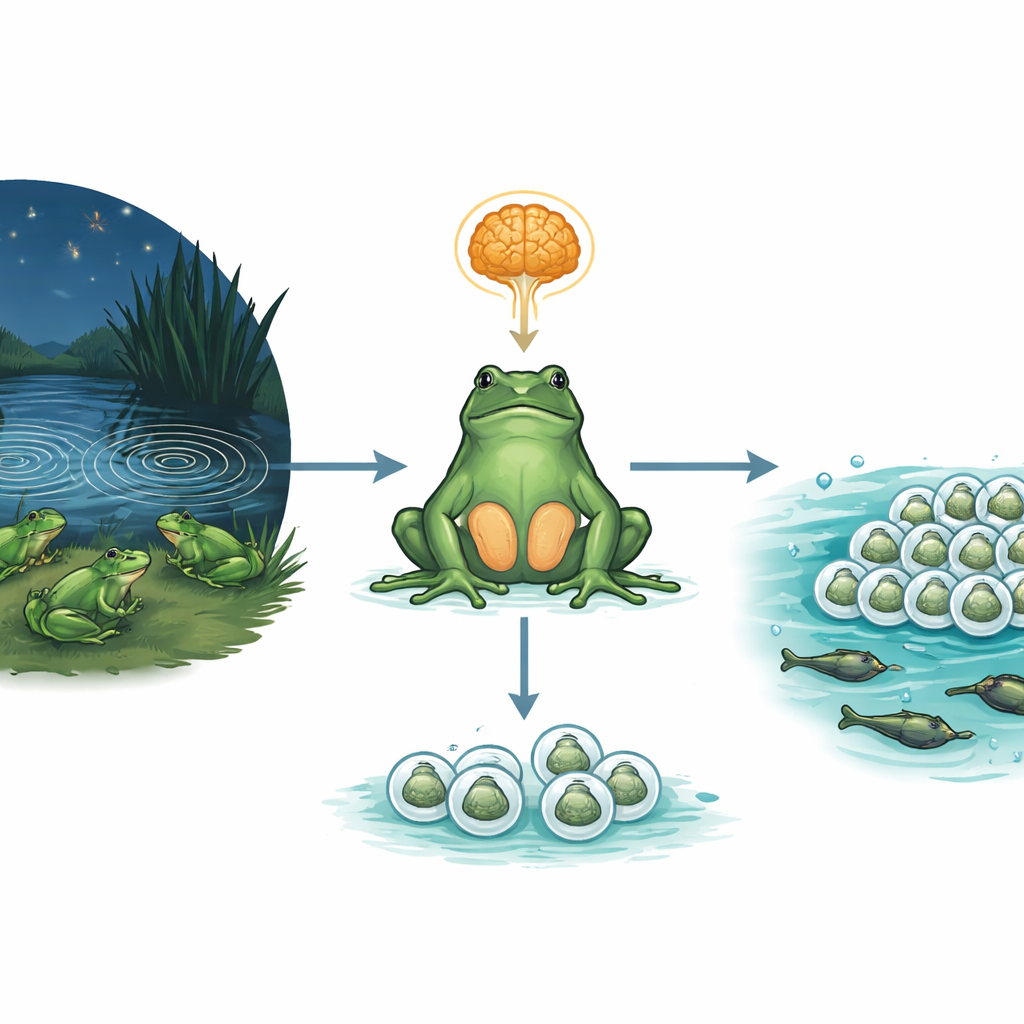
Busy Spring Nights in a Chorus Pond
Boreal chorus frogs breed in brief, explosive bursts each spring, when hundreds of males gather and call in unison. The team recreated this noisy scene in the lab using audio recordings of real choruses. Groups of frogs were placed in large tanks and heard either a playback of many males calling or a control recording with only wind, rain, and other pond sounds. This setup let the scientists isolate the effect of the social sound itself from other environmental factors such as temperature or light. They tracked how much the males called, how many eggs the females laid, and how well the resulting tadpoles survived.
From Love Songs to Stronger Offspring
Hearing a chorus of their own kind made the males more talkative: on average they called for almost twice as long and in more separate calling bouts than males hearing only ambient pond noise, even though this difference was not statistically strong. The more striking effect showed up in the next generation. Pairs exposed to chorus playbacks produced clutches in which about 80% of eggs developed normally, compared with about 66% in the control group. That 13% boost in viable eggs, along with a modest increase in early tadpole survival, points to better quality sperm or more reliable fertilization when social sounds are present. Interestingly, the total number of eggs laid and the pace of tadpole development did not change, suggesting that the main effect of the calls is on egg and tadpole health, not sheer output.
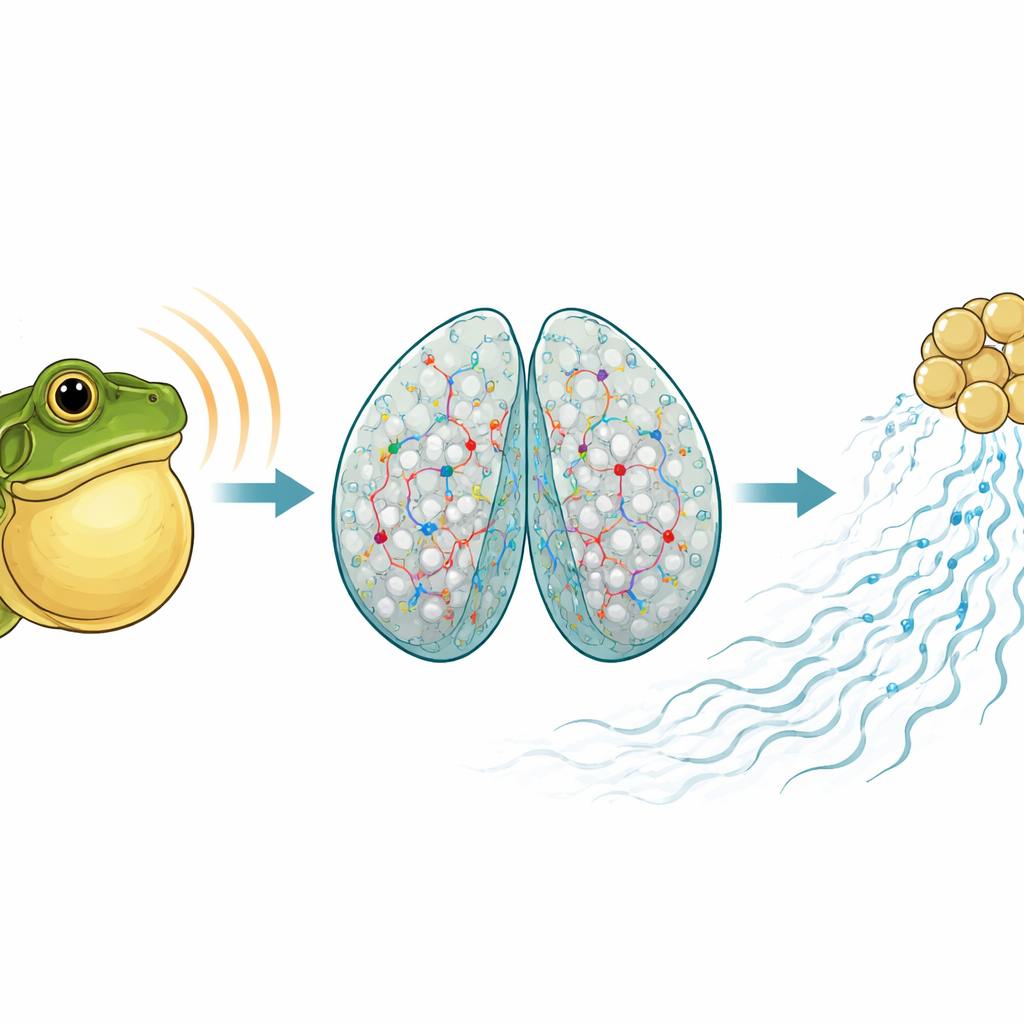
Listening In Changes the Testes from Within
To find out what was happening inside the males, the researchers examined gene activity in the testes after frogs spent hours listening to different soundscapes. Some males heard no calls, only wind and insect sounds. Others heard a small chorus, while a third group experienced a loud, dense chorus that mimicked a crowded breeding pond. Within only six hours of exposure to the large chorus, thousands of genes in the testes had shifted their activity. Many belonged to pathways involved in building steroid hormones, forming and maturing sperm, and developing and maintaining the testes themselves. A small chorus produced similar changes, but they appeared later, as if a minimum level of calling must be reached before the testes fully respond.
Sound Versus Hormones: Different Paths, Shared Targets
The team then compared these sound-driven changes with those triggered by hormone injections commonly used to induce spawning in captive frogs. Males given a mix of a brain hormone and a drug that lifts hormonal brakes also showed strong shifts in testicular gene activity, again in genes tied to hormone production and sperm formation. Many of the same genes lit up in both the hormone-treated frogs and those hearing a large chorus. This overlap suggests that social sounds and direct hormone signals converge on the same reproductive machinery, acting through the brain–pituitary–gonad axis to boost sperm production and testis function.
Why These Findings Matter Beyond the Pond
For nonspecialists, the key message is that reproduction is not just governed by internal chemistry or coarse environmental cues like day length. In these frogs, the social environment—the simple fact of hearing neighbors call—reaches all the way down to the level of genes in the testes and measurably improves fertility. That helps explain how breeding in nature becomes synchronized and efficient: when enough males join the chorus, their shared calls may collectively raise the reproductive readiness of the whole group. The work also hints that in many vertebrates, from frogs to birds and perhaps even mammals, social signals may fine-tune fertility more directly than previously realized.
Citation: Ethier, J.P., Lee, H., Robinson, S.A. et al. Reception of conspecific cues alters testicular gene expression and improves fertility in boreal chorus frogs (Pseudacris maculata). Sci Rep 16, 13073 (2026). https://doi.org/10.1038/s41598-026-43613-6
Keywords: frog communication, social cues, fertility, gene expression, reproductive ecology