Clear Sky Science · en
New design of a high-efficiency rectenna for wireless power transfer in 5G applications
Why power from thin air matters
Billions of small gadgets—from environmental sensors to smart tags—are joining the internet every year. Powering them with disposable batteries is expensive, inconvenient, and wasteful. This study explores a different route: using the very 5G signals already filling the air to power low‑consumption devices. The authors design and test a compact circuit, called a rectenna, that can capture 3.5 GHz 5G waves and turn them into usable direct‑current electricity, aiming at practical, low‑cost energy harvesting for the Internet of Things.
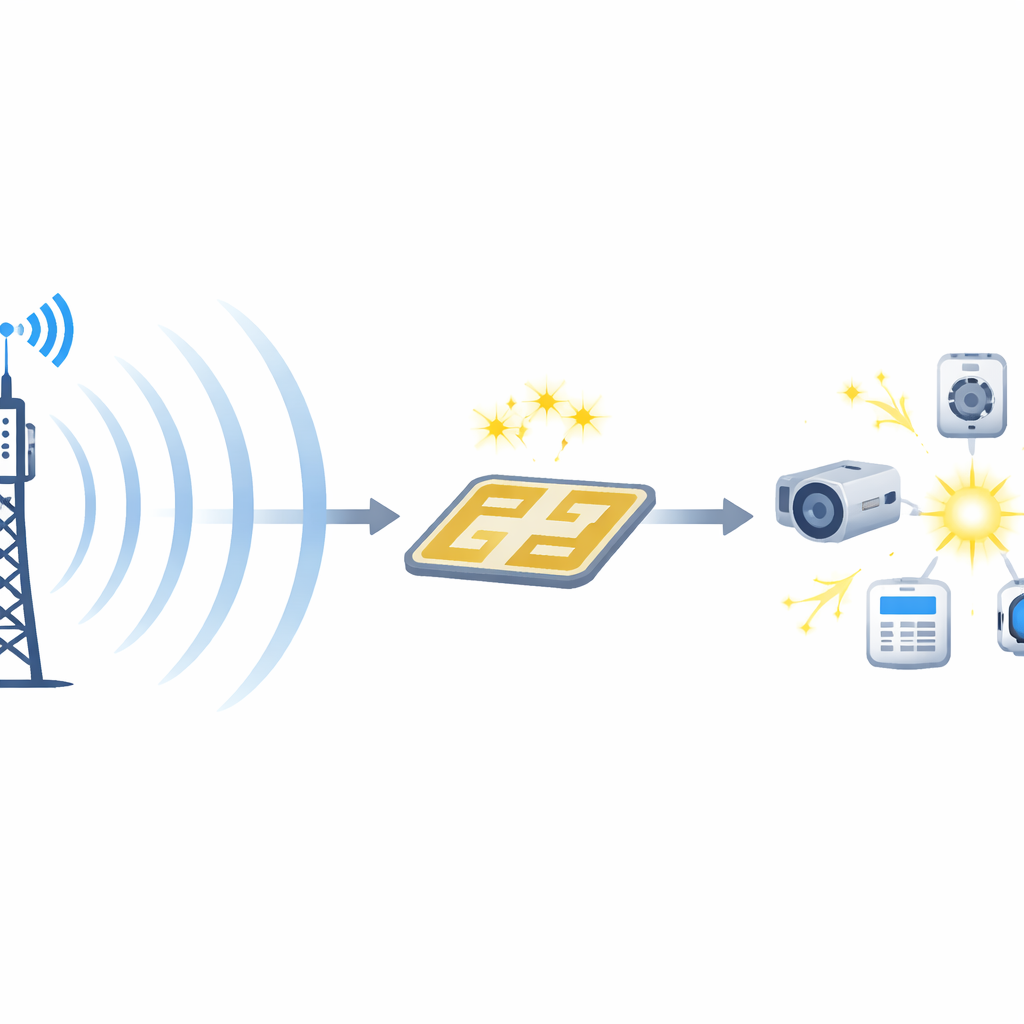
Turning 5G signals into usable power
The heart of the work is a small system that combines an antenna with an electronic rectifier so that incoming radio waves are directly converted into DC voltage. The antenna is tuned to the 3.5 GHz band widely used by 5G networks, while the rectifier is built around a fast Schottky diode, chosen because it can respond to high‑frequency signals with minimal energy loss. The researchers co‑designed these two parts together rather than separately, paying particular attention to how well the antenna hands power to the diode. Getting this electrical “handshake” right is essential: even a well‑designed antenna will waste most of the captured energy if it is poorly matched to the rectifier.
Shaping a tiny antenna for a noisy world
Designing an antenna for energy harvesting is not the same as for high‑speed data links. Here, the priority is a stable response around the target frequency, small size, and good behavior when connected to a nonlinear rectifying circuit. Starting from a simple rectangular patch on a standard low‑cost circuit board (FR‑4), the team progressively modified the shape. They added a central slot to pull the working frequency up toward 3.5 GHz and then placed a diamond‑shaped metal region above the original patch, connected with curved lines that smooth the flow of current. Extra slots carved into this diamond allowed fine tuning of the antenna’s electrical length and suppression of unwanted resonances. Measurements on a fabricated prototype confirmed that the final design remains well tuned over an 11 percent bandwidth around 3.5 GHz and radiates in patterns suitable for mobile 5G environments.
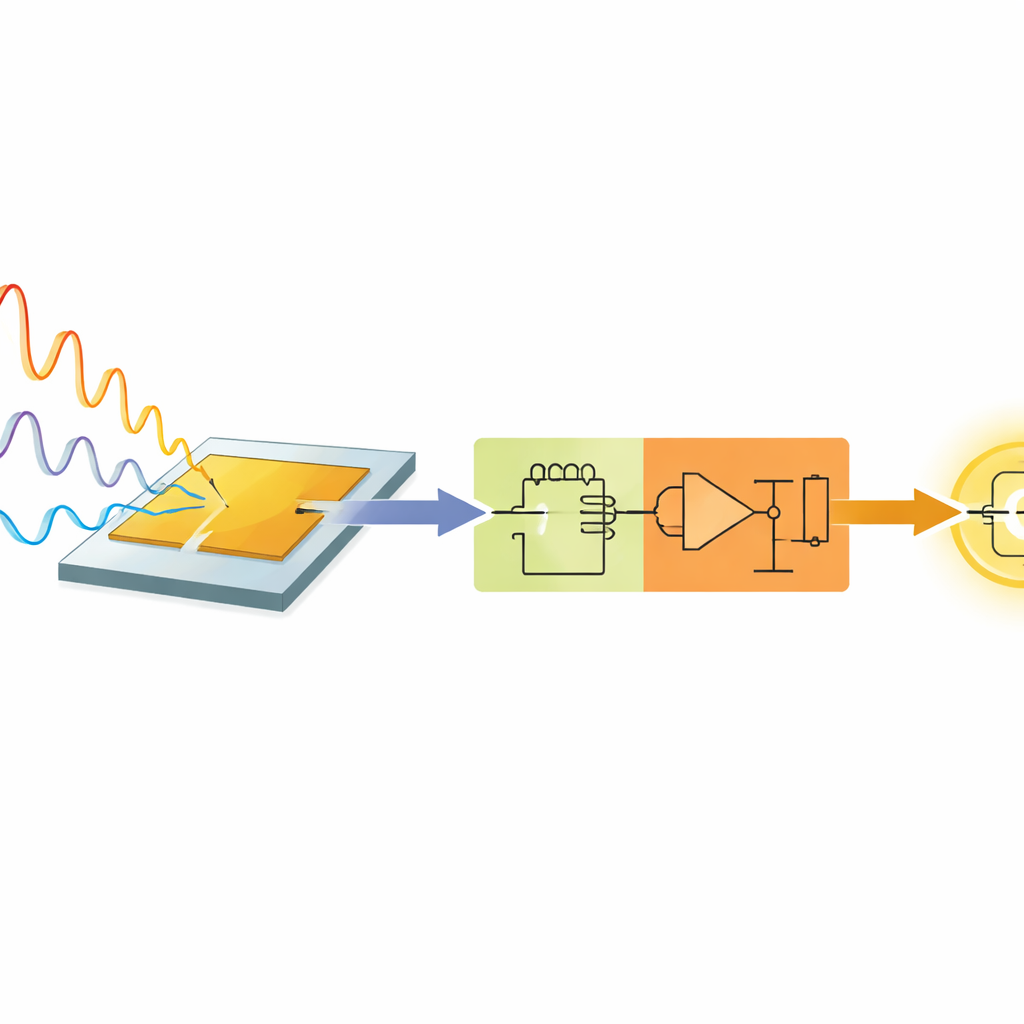
Fine‑tuning the power converter
On the circuit side, the authors first estimated how the Schottky diode behaves at 3.5 GHz, then refined the details using advanced simulations that account for its nonlinear behavior. They added a matching network—essentially a carefully sized set of metal traces—to cancel out the diode’s reactive part so that the antenna “sees” almost a perfect 50‑ohm load at the operating frequency. A low‑pass filter then blocks leftover high‑frequency components while passing the harvested DC power to an output load. Experiments showed that, at the target frequency, the incoming power is very efficiently delivered to the rectifier, with reflections reduced to almost negligible levels, a key requirement for getting the most electricity out of weak ambient signals.
Finding the sweet spot for real devices
Because the rectenna must ultimately power real electronics, the team studied how the load at the output affects performance. They varied a simple resistor between 3 and 9 kΩ, a range typical of ultra‑low‑power IoT circuits, and measured both voltage and conversion efficiency over a wide span of input powers. A value of 5 kΩ emerged as the best compromise, giving the highest overall efficiency once the incoming power rises above very weak levels (about −15 dBm). Under these conditions, the prototype delivered up to 0.91 V at 0 dBm input in measurements—lower than the idealized simulations but following the same general trend. The remaining gap is explained by unavoidable real‑world imperfections such as board losses, soldering tolerances, and the detailed behavior of the diode package.
What this means for future gadgets
The work demonstrates that a simple, low‑cost rectenna built on standard circuit material can reliably tap into 3.5 GHz 5G signals and turn them into useful DC power for tiny electronics. While the efficiency still drops at extremely low signal levels, the design offers a balanced trade‑off between performance, size, and manufacturability, and it operates under conditions that resemble realistic 5G networks rather than ideal laboratory setups. For everyday users, this points toward a future where many small connected objects may quietly recharge themselves from existing wireless infrastructure, reducing battery changes and helping large sensor networks run more sustainably.
Citation: hamadi, H.B., Ghnimi, S., Karoui, M.S. et al. New design of a high-efficiency rectenna for wireless power transfer in 5G applications. Sci Rep 16, 12573 (2026). https://doi.org/10.1038/s41598-026-43603-8
Keywords: wireless power transfer, 5G energy harvesting, rectenna, Internet of Things, RF-to-DC conversion