Clear Sky Science · en
Sustainable assessment of process–reinforcement interaction effects on mechanical strength of FSW Al 7475 hybrid composites
Making Tough Metals Last Longer
Airplanes, cars, and military vehicles rely on strong but lightweight aluminum parts that must survive years of stress, vibration, and harsh weather. One weak link is often the joints and outer surfaces, where damage, cracking, and wear start first. This study explores a cleaner, more efficient way to strengthen the surface of a widely used high‑strength aluminum alloy (Al 7475) by using a solid‑state process that avoids melting and by mixing in tiny hard particles to create a tougher skin on the metal.
Stirring Strength into Aluminum
Instead of traditional welding, which melts metal and can leave behind large, brittle regions, the researchers use friction stir welding, a process where a rotating tool is pressed into the metal and moved along the surface. The friction softens the metal without fully melting it, while the tool stirs the softened region like a spoon in thick batter. Into a shallow groove on the aluminum plate, they pack a mixture of two types of ceramic particles—silicon nitride and titanium dioxide—each much smaller than a grain of sand. As the rotating tool passes over, it drags and mixes these particles into a thin surface layer of the aluminum, forming what is known as a surface composite. 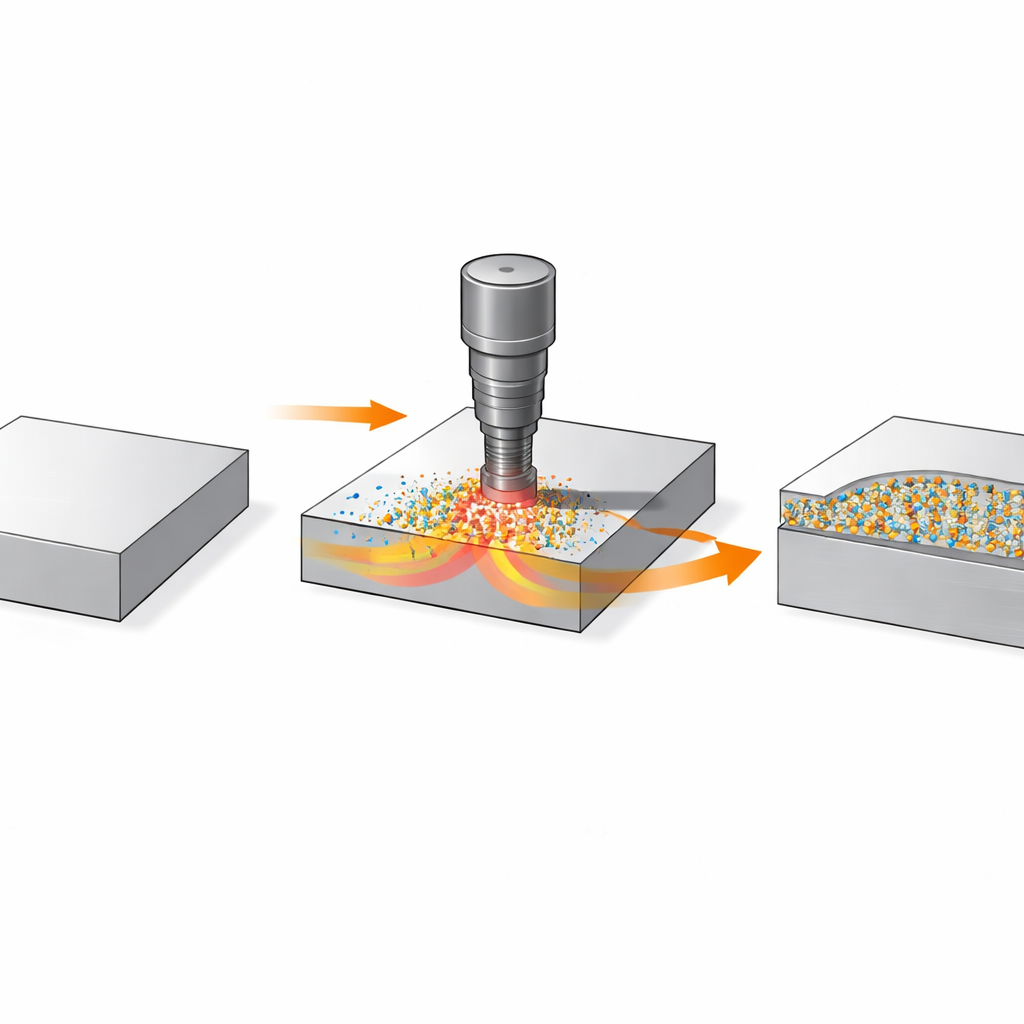
Balancing the Knobs on the Process
Creating a strong, defect‑free surface layer depends on several controllable “knobs”: how fast the tool spins, how hard it is pressed into the metal, how quickly it travels, and how much ceramic reinforcement is added. The team systematically varied these four factors across 24 different trials using a structured statistical plan. They then measured two key properties that matter for real components: the ultimate tensile strength (how much pulling force the material can take before breaking) and the Brinell hardness (a standard measure of resistance to indentation and wear). By applying modern optimization methods, they could not only find which combinations performed best, but also build mathematical models that predict strength and hardness for other settings without having to test every possibility.
What Happens Inside the Metal
To understand why some settings produced better results, the researchers looked closely at the broken surfaces and microstructure using scanning electron microscopy. When the amount of ceramic particles was higher and the stirring conditions were tuned correctly, the aluminum grains in the processed zone became very fine and evenly distributed, and the hard particles were well bonded to the surrounding metal. The fracture surfaces showed many small, deep “dimples,” a hallmark of ductile, energy‑absorbing failure. In contrast, samples with too few particles or poorer mixing showed clustered particles, small voids, and river‑like fracture features linked to more brittle behavior and lower strength. 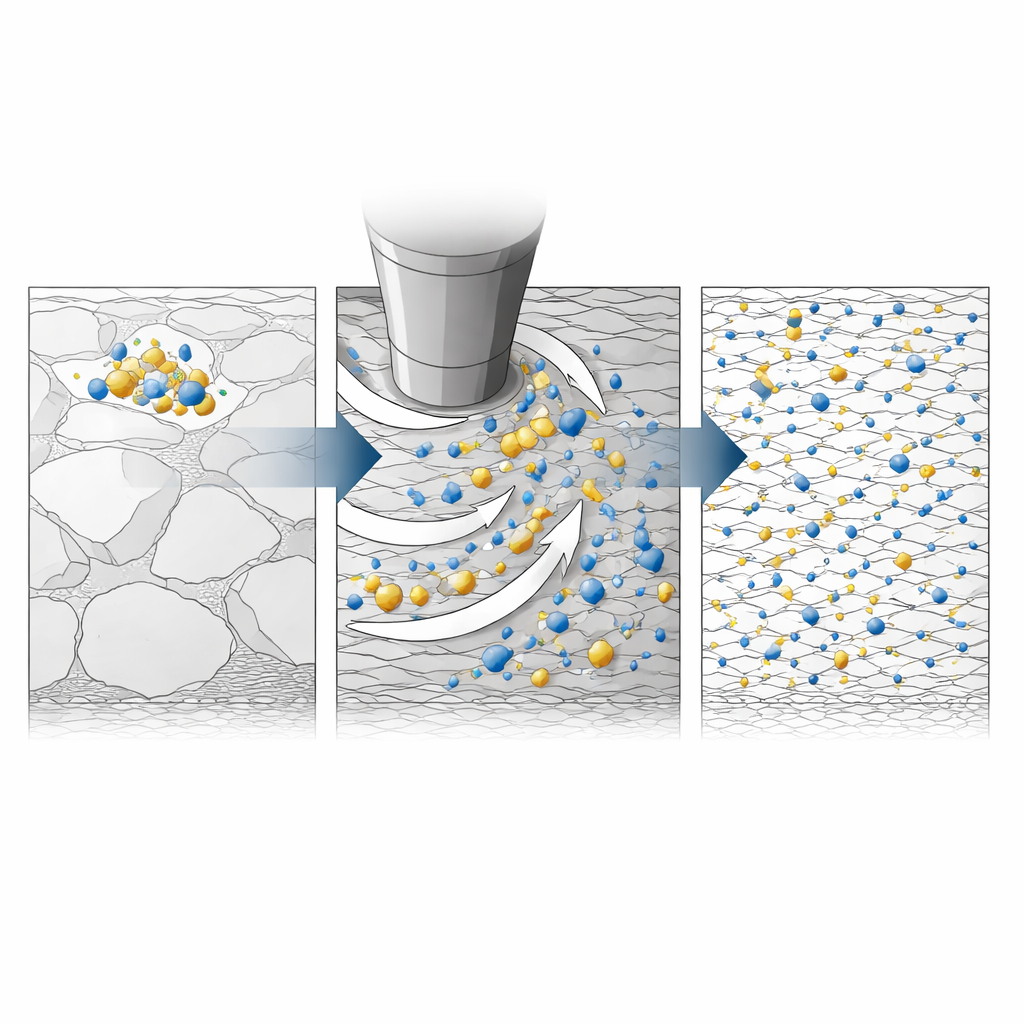
Finding the Sweet Spot
By combining experimental data with two optimization approaches—one based on a composite desirability function and another on response surface methodology with a Box–Behnken design—the team identified conditions that jointly maximize strength and hardness. Under the best settings, the ultimate tensile strength of the surface‑modified alloy increased by about 9% compared with the untreated base metal, and hardness rose by roughly 24%. Both optimization routes pointed to similar “sweet spots”: relatively high tool rotation, moderate pressing force, slower travel speeds, and a high proportion of the hybrid ceramic particles. The more advanced response‑surface approach offered slightly better predictions and a more balanced trade‑off between strength and hardness.
Why This Matters for Real‑World Use
For non‑specialists, the key message is that this solid‑state “stirring” method can create a tougher outer layer on high‑performance aluminum using less energy and with fewer defects than melting‑based techniques. The improved surface composite combines higher strength and hardness with good ductility, meaning parts can carry more load, better resist wear, and are less likely to crack prematurely. Because the process is efficient, adaptable, and compatible with existing aluminum grades, it offers a practical route to longer‑lasting components in aerospace, automotive, and defense applications, while also reducing material waste and supporting more sustainable manufacturing.
Citation: Budavarthi, I.B., Kumar, K.A., Sait, A.S. et al. Sustainable assessment of process–reinforcement interaction effects on mechanical strength of FSW Al 7475 hybrid composites. Sci Rep 16, 13930 (2026). https://doi.org/10.1038/s41598-026-43595-5
Keywords: friction stir welding, aluminum composites, ceramic reinforcement, surface engineering, materials optimization