Clear Sky Science · en
SLM-based PAPR reduction for improved performance of DCO-OFDM LiFi using blind estimation for healthcare monitoring system
Health Checks Through Light
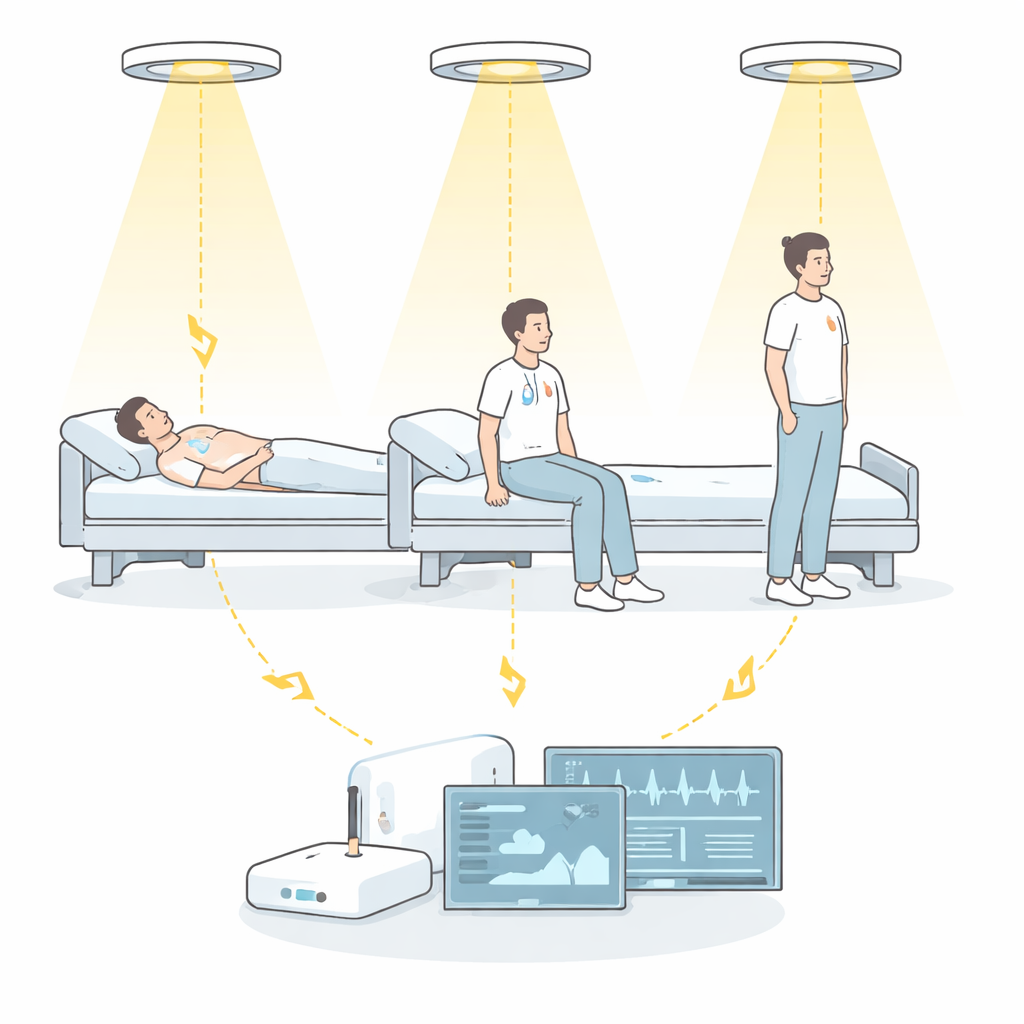
Imagine your hospital room lights quietly keeping track of your heartbeat or oxygen level, sending data to doctors without wires, Wi‑Fi, or risk of radio interference with sensitive machines. This paper explores just that idea: using visible light from LED lamps as a safe, high‑speed data link for continuous healthcare monitoring, and shows how to make that link both reliable and energy‑efficient even as patients move around.
Why Switch From Radio Waves to Light
Traditional wireless monitors rely on radio waves, which face crowded spectrum, possible interference with medical equipment, and security concerns. Visible light communication (often called LiFi) turns ordinary LEDs into data transmitters. Because light does not pass through walls, it naturally keeps signals inside a room, boosting privacy, and it avoids electromagnetic interference in intensive‑care or operating rooms. However, pushing high data rates through LEDs is tricky: the signals tend to form occasional very large peaks compared to their average power. These peaks stress the LED electronics, waste energy, and can distort the medical data, so reducing them is essential for a practical system.
How the Light-Based Link is Built
The authors design a hospital‑room system where a wearable device on the patient sends health measurements upward to a ceiling receiver using a method called DCO‑OFDM. In simple terms, this breaks data into many small sub‑signals that are transmitted together using the LED’s brightness. The team tests two data “alphabets” (4‑QAM and 16‑QAM) that trade off speed versus resilience to noise. Because light bounces off walls and equipment, the signal arrives along many paths with different delays, which can blur the information. To correct this, the receiver uses four types of equalization strategies—block‑type, comb‑type, superimposed training, and a “blind” method—to undo the room’s distortions under three common patient positions: different locations and lighting conditions that mimic sitting, lying down, or moving within the room.
Taming Power Spikes Without Hurting Data
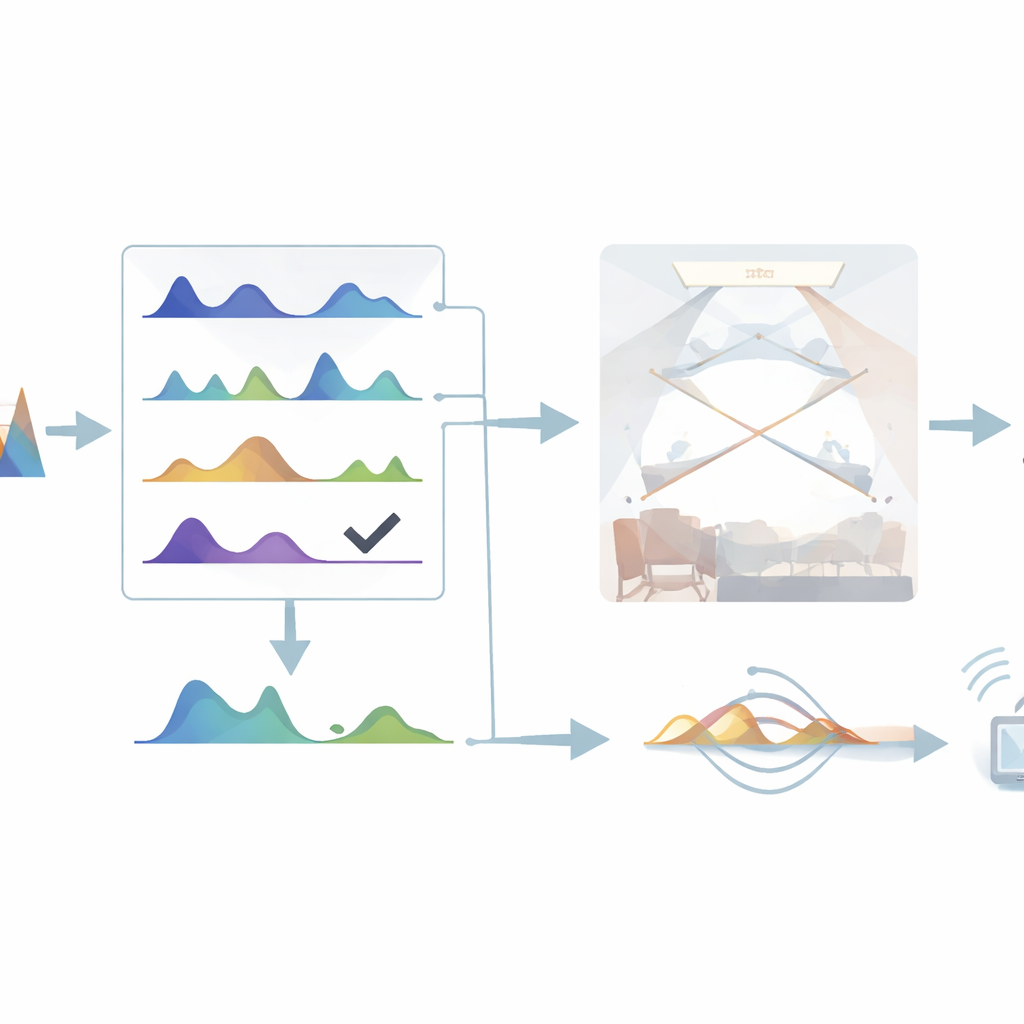
A central problem is the high peak‑to‑average power ratio, which the authors find can reach around 15 dB with standard processing—far from ideal for LED hardware. To smooth these peaks, they adopt a technique called Selected Mapping. Instead of sending the first version of the outgoing signal, the transmitter creates several mathematically equivalent versions that carry the same medical data but differ in how their energy is arranged over time. It then chooses the version with the gentlest peaks before driving the LED. The paper compares using both real and complex phase patterns to generate these candidate signals and shows that complex patterns squeeze out about 1 dB of additional improvement. Overall, this strategy trims the problematic power spikes by up to 4 dB while keeping the underlying error rate of the health data unchanged.
Letting the Receiver Learn the Room
While some equalizers rely on known “pilot” patterns sprinkled into the data, the blind equalization method lets the receiver infer how the room is distorting signals directly from the incoming stream itself. This is particularly attractive in healthcare, where every extra symbol devoted to pilots steals capacity from patient data and where movement constantly changes the channel. Simulations using a realistic indoor optical model—covering room size, reflections from walls and equipment, patient distance and angle, and ambient light—show that blind equalization consistently achieves the lowest bit errors and highest spectral efficiency. For instance, at a signal‑to‑noise ratio of 28 dB, the blind method delivers noticeably fewer errors than block, comb, or superimposed approaches, and maintains strong performance even when there are many reflected paths.
What This Means for Future Smart Rooms
Together, lower power peaks and smarter equalization produce a LiFi link that can move vital signs swiftly and accurately using nothing more than room lighting. The study demonstrates that combining Selected Mapping with blind channel estimation creates a robust, energy‑aware optical connection that keeps working as patients change posture or position. For patients, this could translate into fewer wires, less clutter, and more comfortable long‑term monitoring; for hospitals, it promises secure, interference‑free data networks built into the lighting itself. The authors suggest next steps such as testing with real medical signals, expanding to multi‑room wards, exploring other precoding methods, and using deep learning to further refine how the system adapts to complex indoor environments.
Citation: Sharaf, A.A., Seleem, H., Sarhan, A. et al. SLM-based PAPR reduction for improved performance of DCO-OFDM LiFi using blind estimation for healthcare monitoring system. Sci Rep 16, 10565 (2026). https://doi.org/10.1038/s41598-026-43583-9
Keywords: LiFi healthcare monitoring, visible light communication, OFDM signal processing, PAPR reduction, wireless patient monitoring