Clear Sky Science · en
High-throughput adult Caenorhabditis elegans viability monitoring system
Watching tiny worms to understand aging
Many scientists study aging by watching the lives of tiny worms called Caenorhabditis elegans, because these animals grow old in just a few weeks and share many basic biology traits with humans. But following hundreds of worms by eye on Petri dishes is slow, tiring work that can introduce mistakes. This study describes a fully automated system that keeps worms in a stable environment, photographs them clearly, and uses computer vision to decide which worms are alive, making large aging and drug tests much easier to run.
A new way to keep track of many worms
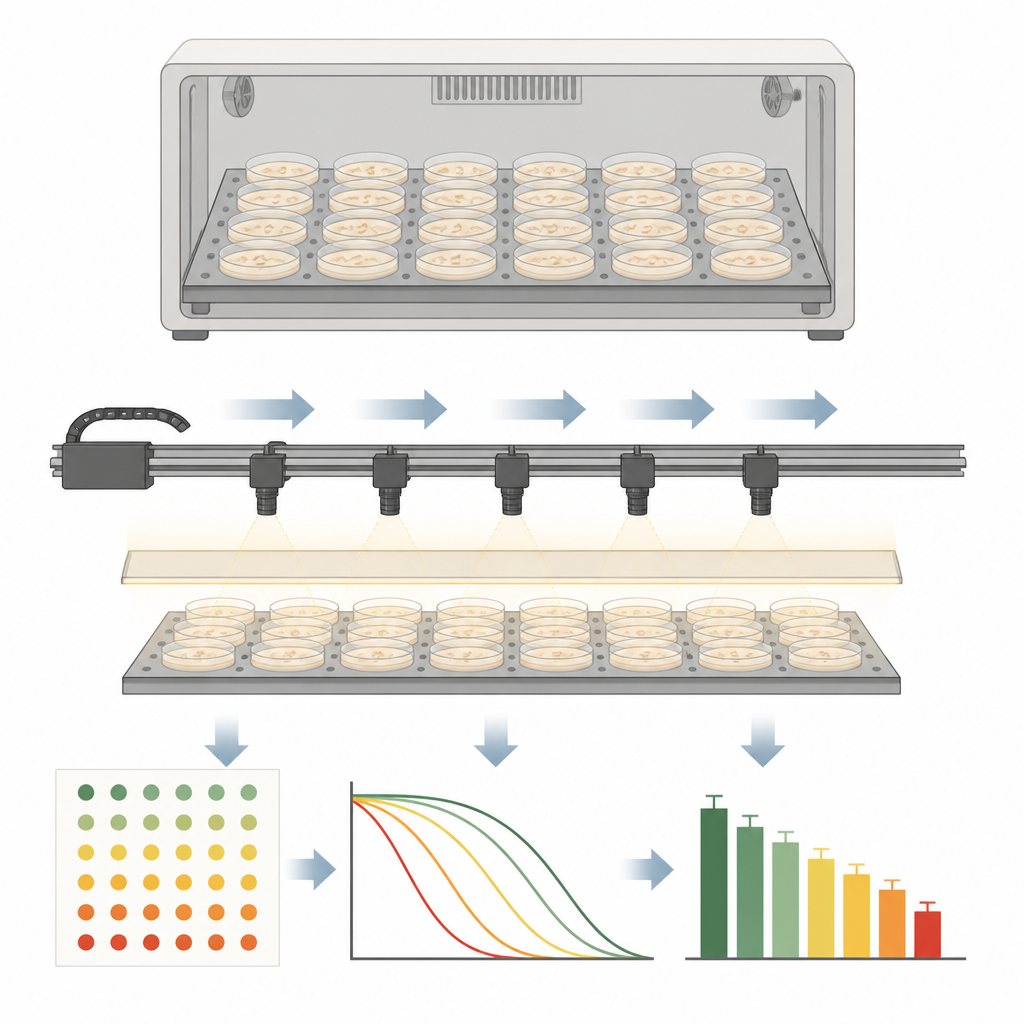
The researchers set out to solve two big problems that limit current automated worm setups: blurry, uneven pictures and confusion between worms and background clutter such as mold or bubbles. Their solution is an integrated hardware and software platform that can watch adult worms around the clock. A modified lab incubator holds dozens of Petri dishes in controlled temperature and humidity, while built in cameras and lights scan each dish on a schedule. Together, these parts turn what was once a hands on task for one or two trained people into a largely hands off process that can run for a month or more.
Smart hardware for clear and gentle imaging
On the hardware side, the team started from a commercial incubator and reworked it for worm care and imaging. They added baffled fans to prevent airflow from drying out the dishes, swapped in ultraviolet lamps for periodic disinfection, and installed blue lights for experiments that need specific light cues. The key upgrade is a flat collimated light panel beneath a perforated plate that holds up to 36 dishes. This type of lighting bathes each dish in even, cool light, avoiding glare and blur. Tests showed that pictures taken with the collimated light were much sharper than those with ordinary lamps, giving the computer a crisp view of each worm.
Teaching software to tell worms from clutter
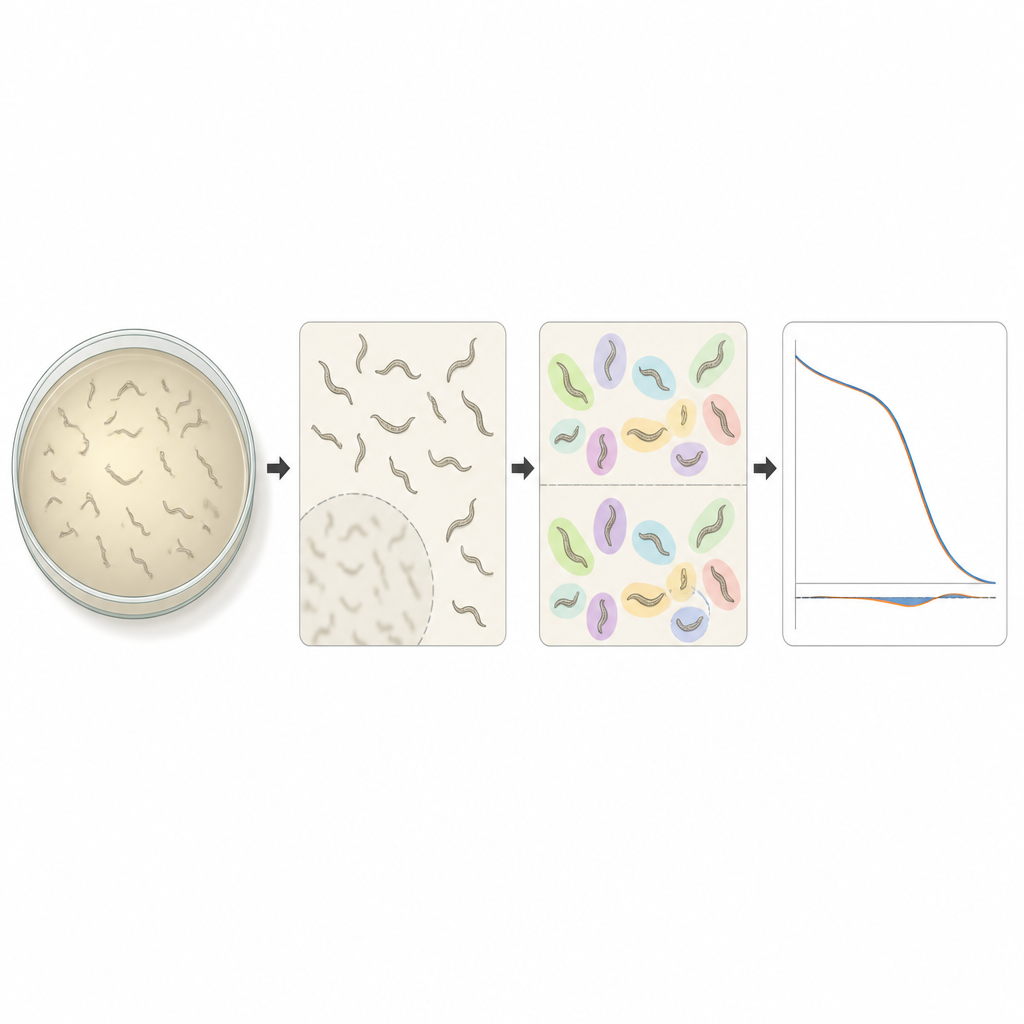
The software controls both image capture and image analysis. A row of six industrial cameras rides on a simple linear rail inside the incubator, so each pass can photograph six columns of dishes quickly without complex motion. The images are then passed to a deep learning model based on the YOLOv5 object detection family. The team trained this model on more than twelve thousand images, not only marking worms but also labeling common look alikes, including ring shaped marks, bits of mold, and air bubbles. By recognizing these separate categories, the system is far less likely to mistake debris for animals when counting.
Finding missed worms with a second look
Even a strong detector can occasionally miss worms, especially dark ones that blend into the background. To address this, the authors added a second pass that focuses the model on what it overlooked the first time. After the first round of detection, the software paints over all found worms with plain white patches and runs the detector again. Without the obvious animals competing for attention, the model can pick up the faint, previously hidden worms. In tests spanning ten days and 36 dishes, this two step approach cut the missed detection rate from 1.75 percent to 0.8 percent, at the cost of some extra computing time.
Fast, accurate counts over an entire life
To see how well the system performs in real experiments, the team compared it with careful human counting. For a batch of 36 dishes containing 15 to 30 adult worms each, two trained researchers needed about two and a half to three hours to finish, while the automated setup needed only 36 to 60 minutes. The automatic live worm counts matched manual tallies to better than 95 percent accuracy, with very low false alarms and misses. In a 30 day trial that followed 96 worms from adulthood to death, the daily survival curves from the system were almost identical to those from human observers, with statistical tests showing extremely strong agreement and no meaningful bias.
What this means for aging and drug studies
In simple terms, the researchers have built a reliable robot lab helper for worm aging studies. It can look after hundreds of worms at once in a gentle, well controlled home, take clear pictures of them, and use trained software to decide which worms are still moving. The system greatly reduces the time and effort humans must spend at the microscope while keeping results in line with the accepted manual standard. Although future work is needed to handle younger life stages and to tell paralyzed but living worms from truly dead ones, this platform already offers a strong, practical tool for studying how genes, environment, and candidate drugs affect lifespan.
Citation: Lin, Q., Weng, J., Cheng, Z. et al. High-throughput adult Caenorhabditis elegans viability monitoring system. Sci Rep 16, 15014 (2026). https://doi.org/10.1038/s41598-026-43579-5
Keywords: C. elegans, lifespan monitoring, automated imaging, deep learning, aging research