Clear Sky Science · en
Lightweight and interpretable edge intelligence AI with intrusion detection for trustworthy cardiac arrhythmia in medical IoT
Why smart heart monitors need more than just accuracy
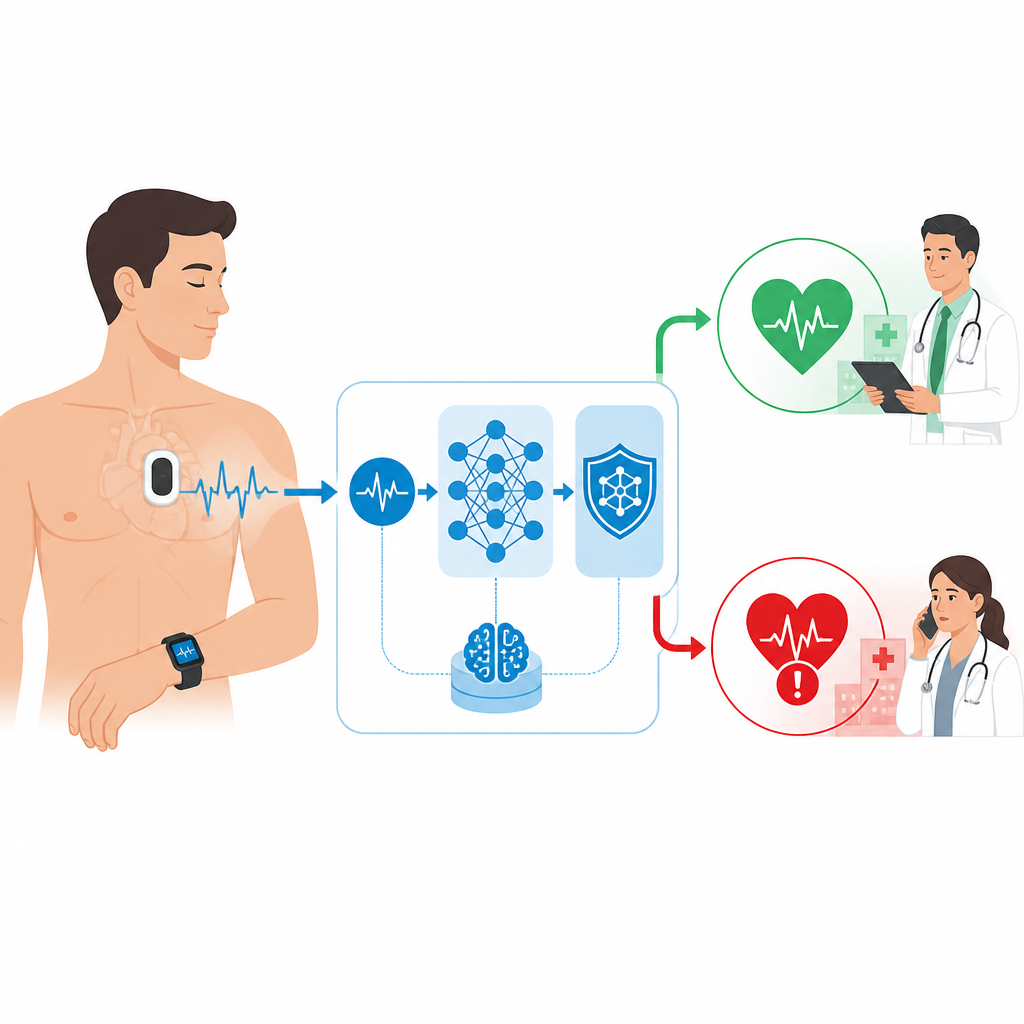
Wearable devices that watch our hearts around the clock are changing how doctors find dangerous rhythm problems, but today’s systems have three big weaknesses: they often rely on heavy-duty cloud computing, they cannot explain their decisions, and they can be fooled by cyber-attacks that tamper with the signals. This paper introduces CLARITY-AI 2.0, a heart rhythm monitoring approach designed to be small enough for simple electronics, clear enough for doctors to understand, and cautious enough to warn when the data itself looks untrustworthy.
From hospital machines to everyday wearables
Heart rhythm disorders, or arrhythmias, are a leading warning sign of serious heart trouble. Traditional monitoring uses bulky multi-lead recorders worn for limited periods, which can easily miss rare but dangerous events. In contrast, medical Internet of Things (MIoT) devices, such as smart patches and watches, can stream electrocardiogram (ECG) signals continuously. Many research groups have turned to deep learning to read these signals, reaching impressive accuracy but at the cost of large models that need powerful hardware and act like black boxes. They give answers such as “abnormal beat” without showing which parts of the heartbeat mattered or whether the underlying signal was trustworthy.
A lighter, more transparent way to read heartbeats
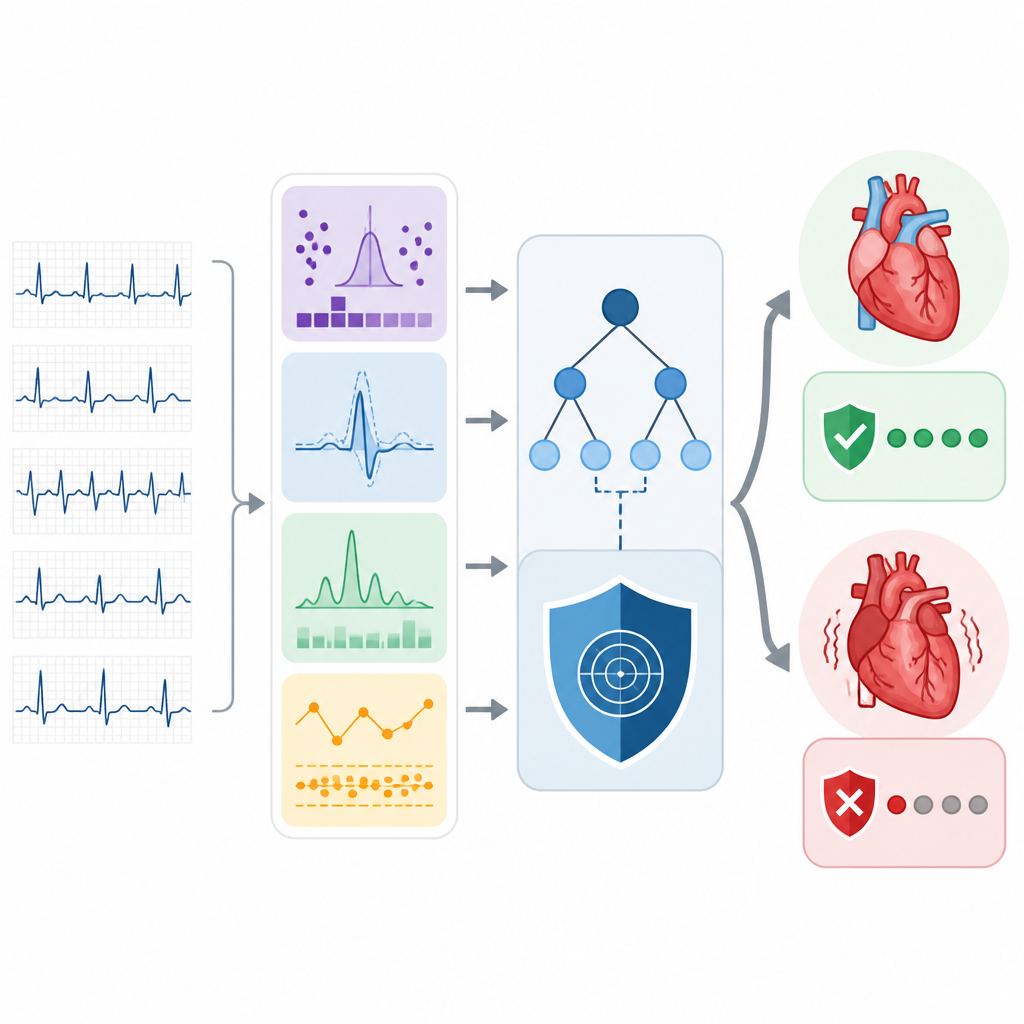
CLARITY-AI 2.0 takes a different route. Instead of feeding raw ECG traces into a giant neural network, it first squeezes each heartbeat into a compact set of 40 numbers that describe simple, clinically familiar properties. These include how wide the main spike of the beat is, how tall the main peaks are, how the beat’s energy is spread across different frequency bands, and how evenly spaced recent beats have been over time. A lean machine-learning model then combines these features to decide whether the beat looks normal or suspicious. Because each feature has a clear meaning, doctors can relate the model’s reasoning to the same measurements they already use in practice.
Building trust with explanations and attack awareness
To show its work, the system uses a popular explanation method that scores how much each feature pushed a decision toward “normal” or “abnormal.” These scores are then turned into short, structured text reports by a language model, so a clinician sees statements like “the beat was flagged due to a very wide main spike and an unusual recovery wave,” grounded in the actual numbers. The authors also recognize that real-world devices operate in hostile networks where attackers can inject fake signals or drain batteries. CLARITY-AI 2.0 therefore includes a built-in intrusion detector that examines both network behavior and signal patterns to estimate how likely it is that the incoming data has been tampered with. The system outputs both a rhythm verdict and a trust score, so a doctor can treat a low-trust result with extra caution.
Proving it works on tiny hardware
The team tested their approach on standard ECG databases and compared it with deep-learning models. On a classic arrhythmia benchmark, CLARITY-AI 2.0 nearly matched a strong neural network in detecting abnormal beats, while outperforming earlier lightweight methods. Crucially, when deployed on a very modest microcontroller often used in hobby electronics, the new system used around one-twelfth of the storage, one-tenth of the memory, and ran more than ten times faster than the neural network, all while consuming far less energy. Additional tests showed that the same model, trained on one dataset, still worked well on other large ECG collections it had never seen before, suggesting that its hand-crafted features capture general patterns of heart behavior rather than quirks of a single study.
How doctors responded to the explanations
Because a transparent system only helps if experts find the explanations credible, the authors ran a small user study with practicing cardiologists. The doctors reviewed example reports for both normal and abnormal beats. Most rated the explanations as clear and in line with how they themselves would interpret the ECG, and many said that seeing which features drove each decision made them more comfortable considering the system as a diagnostic aid. In parallel, the intrusion module was benchmarked on dedicated security datasets, where it detected simulated attacks quickly and with low error rates while still fitting the constraints of simple edge hardware.
What this means for everyday heart monitoring
In plain terms, CLARITY-AI 2.0 shows that it is possible to build a wearable-friendly heart monitor that is fast, frugal with battery life, able to justify its decisions in language a doctor can understand, and aware of when the data itself looks suspicious. While the framework still needs larger clinical trials before it could guide treatment on its own, it points toward a future in which everyday heart sensors do not just sound alarms, but also explain why they are ringing and how much their readings can be trusted.
Citation: Khalid, M.I., Hussain, A., Hussain, N. et al. Lightweight and interpretable edge intelligence AI with intrusion detection for trustworthy cardiac arrhythmia in medical IoT. Sci Rep 16, 14843 (2026). https://doi.org/10.1038/s41598-026-43578-6
Keywords: cardiac arrhythmia, medical IoT, wearable ECG, explainable AI, intrusion detection