Clear Sky Science · en
Study on the influence of time-varying characteristics of mud cake on the safe density window of drilling fluid
Why a thin layer of mud matters deep underground
When engineers drill deep wells for oil and gas, they must keep the hole from collapsing while also avoiding cracks that leak precious fluid into the rock. This paper explores how a thin, often overlooked layer of mud that builds up on the borehole wall can quietly reshape the safe operating range for the heavy fluid used to keep wells stable.
A narrow path between collapse and cracking
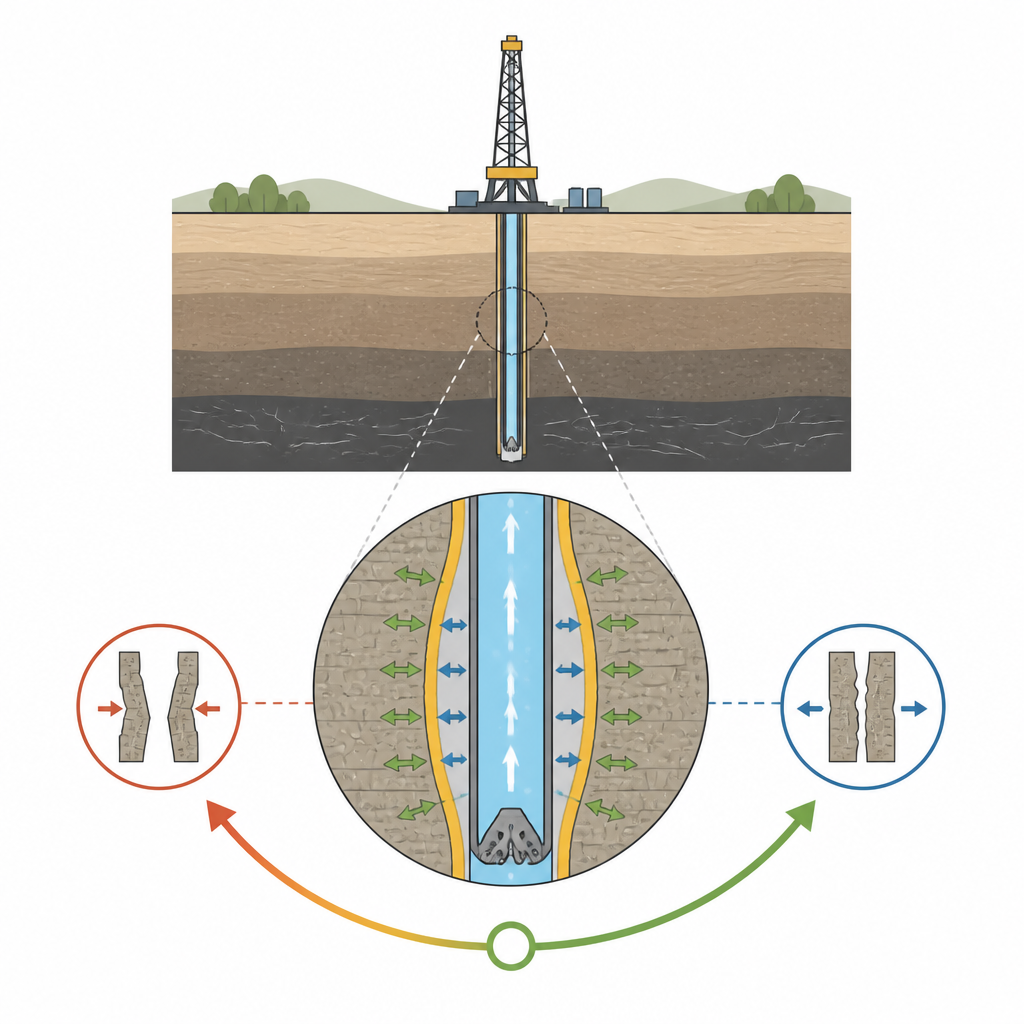
In drilling, a dense liquid called drilling fluid is pumped down the well to balance the pressure of the surrounding rock. If this fluid is too light, the wellbore can cave in; if it is too heavy, it can fracture the rock and cause serious losses. The range of safe fluid densities is known as the safe density window. In many deep or complex formations, this window is very narrow, which makes it difficult to design fluids that protect the well without damaging the reservoir or slowing operations.
How mud cake builds and changes over time
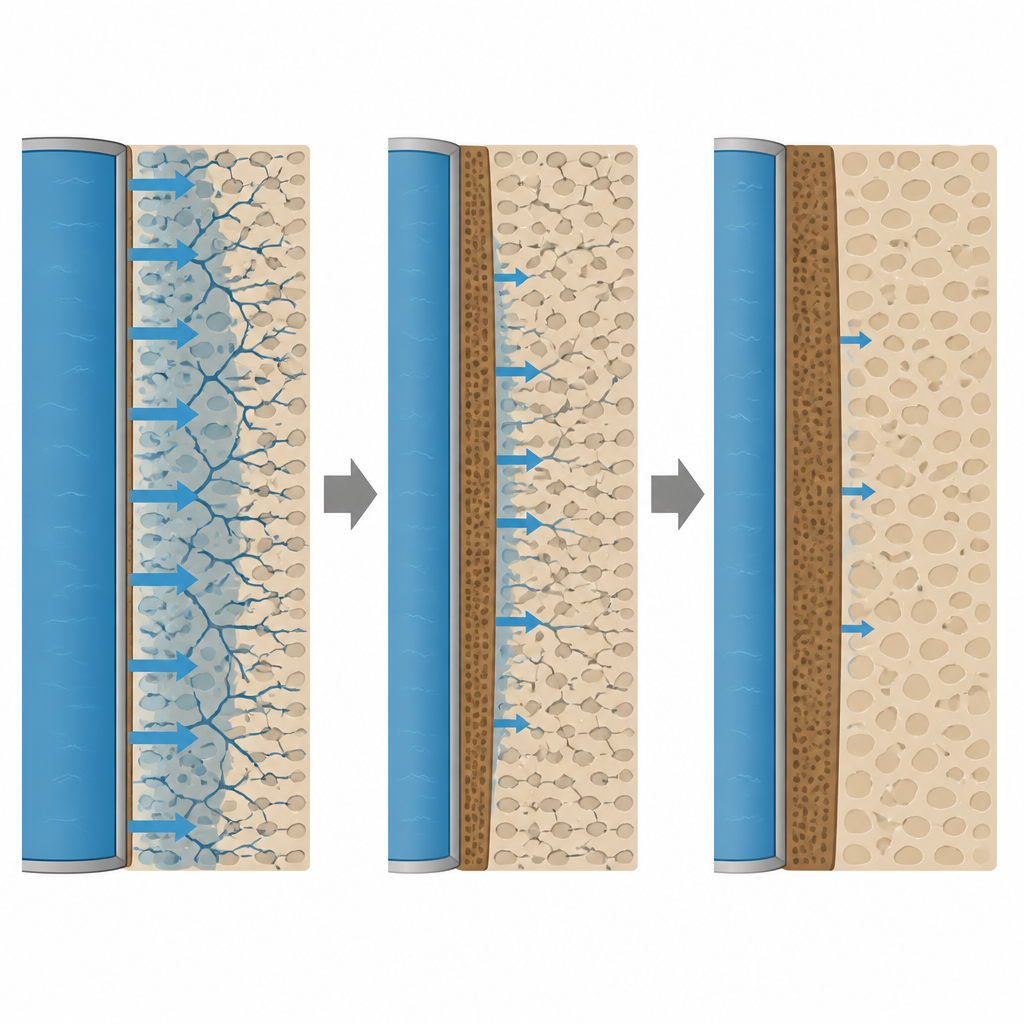
As drilling fluid circulates, its liquid part seeps into the surrounding rock while solid particles pile up on the borehole wall, forming a thin layer called mud cake. The authors use a time based model to describe how this layer thickens and becomes less permeable as drilling continues. By combining this mud cake model with standard flow laws for fluids moving through porous rock, they simulate how pressure and water content around the well evolve as the cake grows and gradually blocks fluid invasion.
Shielding the rock from pressure and water
The simulations show that once the mud cake starts to build, it acts like a pressure cushion. Initially, the full column of drilling fluid pushes directly on the rock, but as the cake thickens, it absorbs part of that load. In the study’s example, the pressure at the borehole wall drops from about the original liquid column pressure to roughly 84 percent of that value after the cake stabilizes. At the same time, less water from the fluid reaches the surrounding rock, which slows the weakening of water sensitive minerals that would otherwise lose strength and become more likely to crumble.
Widening the safe operating window
Because the rock stays drier and better supported, the model predicts that the wellbore is less prone to both collapse and cracking when a high quality mud cake is present. After about 30 hours of drilling in the simulated case, the minimum fluid density needed to prevent collapse falls from 1.42 to 1.33 grams per cubic centimeter, while the density that would trigger fractures climbs from 1.71 to 1.87 grams per cubic centimeter. In other words, the safe density window becomes wider, giving engineers more room to reduce fluid weight, lessen bottom hole pressure, and increase drilling speed without sacrificing safety.
Evidence from a real drilling operation
The researchers compare their model with data from a field well drilled through a porous, permeable reservoir using a viscous, solids rich fluid. In this case, a dense, continuous mud cake formed on the borehole wall. Traditional models that ignore this cake predicted a higher minimum safe density than what was actually used without incident. When the new time based mud cake model is applied, the calculated lower limit moves closer to the real operating density, helping to explain how the well could be drilled safely with lighter fluid than standard theory would suggest.
What this means for future drilling
To a non specialist, the key message is that the thin mud skin lining a wellbore is not just a by product of drilling but an important safety feature. By accounting for how this layer forms and changes over time, engineers can more accurately predict the pressures that keep a well open yet unbroken. Designing drilling fluids that quickly build a strong, low leak mud cake can expand the safe density window, allowing wells to be drilled more efficiently and with lower risk of collapse or fluid loss.
Citation: Zhang, J., Tian, S., Feng, F. et al. Study on the influence of time-varying characteristics of mud cake on the safe density window of drilling fluid. Sci Rep 16, 14846 (2026). https://doi.org/10.1038/s41598-026-43575-9
Keywords: drilling fluid, mud cake, wellbore stability, pore pressure, safe density window