Clear Sky Science · en
Prediction of ship bulkhead deflection under internal explosion
Why ship walls under blasts matter
When an anti-ship weapon explodes inside a vessel, the greatest danger often comes not from holes torn in the hull but from the way interior walls, or bulkheads, bend and crumple. These metal partitions help a ship stay afloat and protect crew and equipment. If they deform too much, flooding and cascading damage can follow. This study asks a practical question for naval designers and safety engineers: can we quickly and reliably predict how much a ship’s bulkhead will bend in an internal explosion, without relying on time‑consuming supercomputer simulations?
How blasts behave inside a closed box
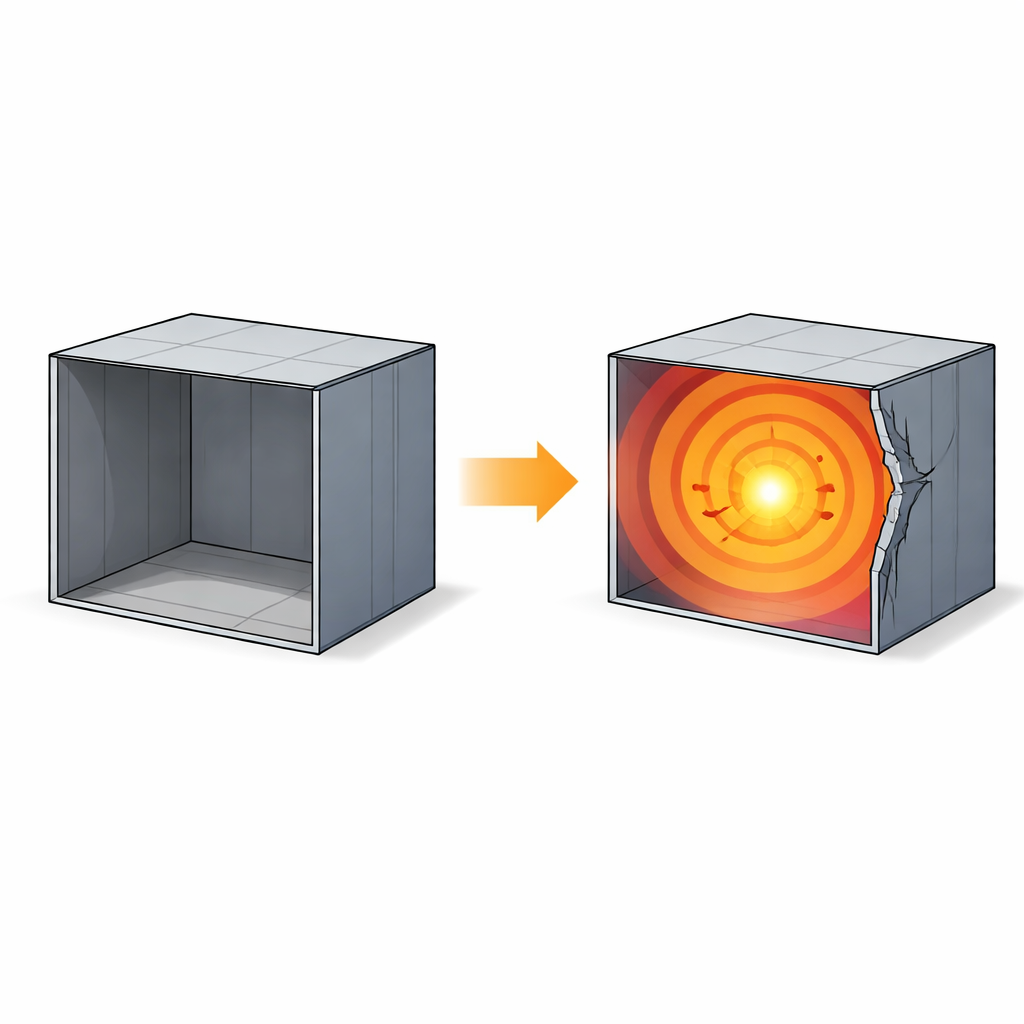
An explosion in an enclosed compartment is very different from one in open air. Right after detonation, a sharp shock wave rushes outward and slams into the walls. It then bounces back and forth, overlapping with itself, especially in the corners where several walls meet. After these rapid pulses, the hot gases left behind keep pushing more slowly and evenly on all surfaces, creating what engineers call a quasi‑static pressure. The authors first built a detailed computer model of a steel cabin filled with air and a small charge of TNT at its center. By comparing the simulated pressures on the walls with earlier experiments, they showed that the model could reproduce the timing and size of the pressure spikes with an error of less than 8 percent.
Turning complex blast patterns into simple rules
Because the pressure inside a cabin is far from uniform, the team next analyzed how it varies over a square bulkhead. They divided the wall into three zones: the central area, regions near two‑wall corners, and regions near three‑wall corners, where pressure tends to concentrate. Using many simulation runs with different cabin sizes and explosive masses, they fitted simple formulas that relate peak pressure to the scaled distance from the charge. To make the problem manageable for design calculations, they then converted the complicated pressure history—many sharp pulses plus the slower, longer push—into an equivalent, simpler loading that delivers the same overall impulse, or “kick,” to the plate. This step rests on the idea that, for large permanent bending of a ductile metal plate, the total energy delivered matters more than the finest details of the pressure shape.
Following the energy from blast to bent steel
With the loading simplified, the authors constructed a theoretical model for how the bulkhead deforms. They treated the wall as a square steel plate clamped at its edges and assumed that the blast gives it an initial velocity. As the plate bulges outward, that motion energy is gradually converted into permanent stretching and bending of the metal. Using a carefully chosen mathematical shape to approximate the bulged form, they calculated how much energy is absorbed in bending along “hinge” lines near the edges and within the plate, and how much goes into stretching the surface like a membrane. Applying energy conservation—equating the blast‑imparted kinetic energy to the sum of these deformation energies—they derived a compact equation for the maximum bulge at the plate’s center.

Putting the model to the test
To see whether their formulas match reality, the researchers performed their own cabin‑blast experiments and also drew on independent tests from other groups. In their setup, square steel plates of different thicknesses were bolted tightly over the ends of a welded steel box, and bare TNT charges were suspended at the center of the cavity. After each detonation, the permanent bulge in the plate was measured. Across four different cases, involving plates from 1.8 to 4 millimeters thick, cabin sizes from 0.5 to 0.6 meters, and charge masses of 80 and 135 grams of TNT, the predicted central deflections agreed with measurements to within about 14 percent. The model captured not only the absolute values but also how deflection changes with plate thickness and charge size.
What this means for ship safety
The study shows that it is possible to move from a complex, three‑dimensional internal blast to a simple set of equations that estimate how much a ship’s bulkhead will permanently bend. By combining verified computer simulations, compact pressure formulas, and an energy‑based description of plate bending and stretching, the authors provide a quick prediction tool that is accurate enough for engineering decisions. For designers of naval vessels and other structures with internal compartments—such as armored vehicles, storage bunkers, or offshore platforms—this approach offers a practical way to screen layouts, choose plate thicknesses, and plan reinforcements long before detailed simulations or full‑scale tests are carried out.
Citation: Chen, Qh., Tao, Yg. & Liang, Zg. Prediction of ship bulkhead deflection under internal explosion. Sci Rep 16, 13465 (2026). https://doi.org/10.1038/s41598-026-43574-w
Keywords: internal explosion, ship bulkhead, blast loading, structural deformation, naval protection