Clear Sky Science · en
A comprehensive assessment of solar still productivity enhancement using novel wick and energy storage material
Turning Sunlight into Drinking Water
Across much of the world, sunlight is abundant but clean drinking water is scarce. Solar stills—simple devices that use the sun to evaporate and then condense water—offer a low-tech way to turn salty or dirty water into something safe to drink. Yet most solar stills make water slowly, limiting their real-world impact. This study explores how to coax more fresh water from the same patch of sunshine by adding a special cloth wick made from bamboo and blocks of common metals that store heat, comparing two simple still designs side by side.
Simple Boxes That Make Fresh Water
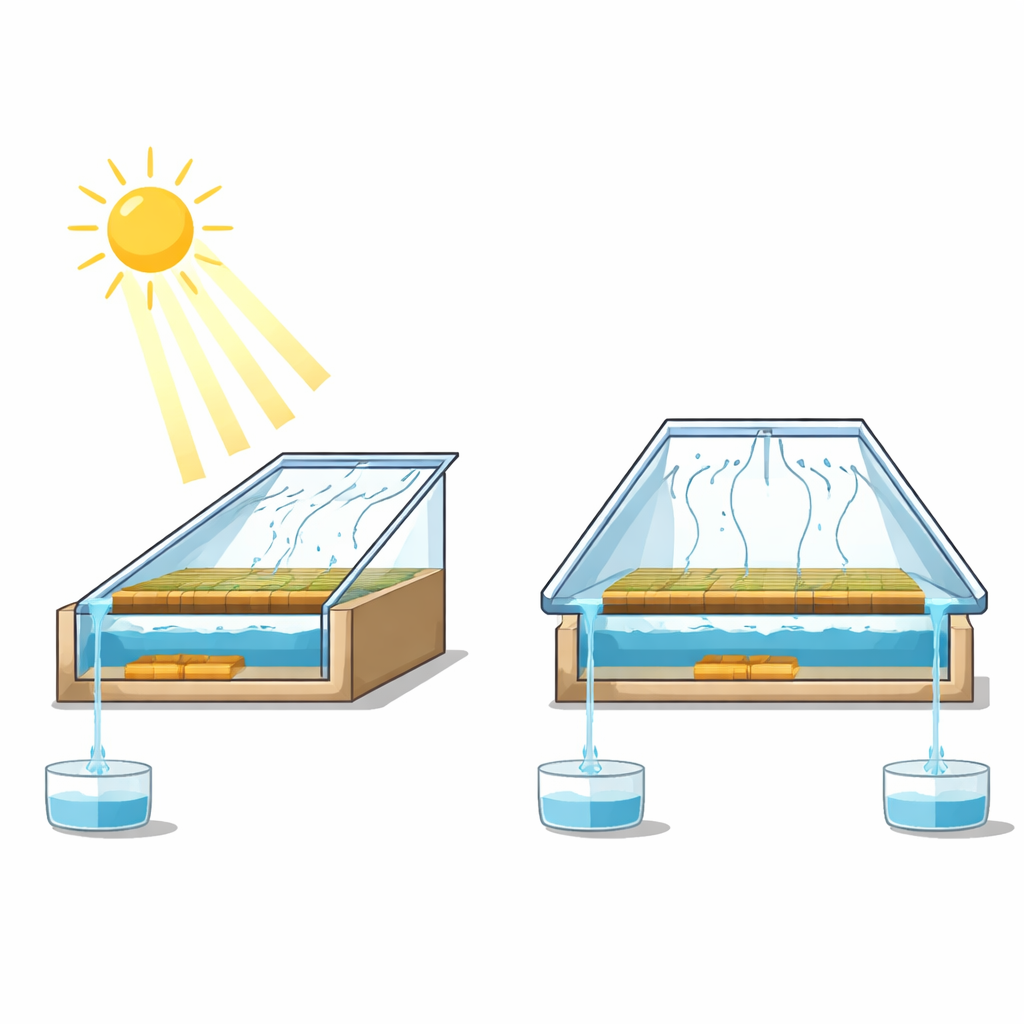
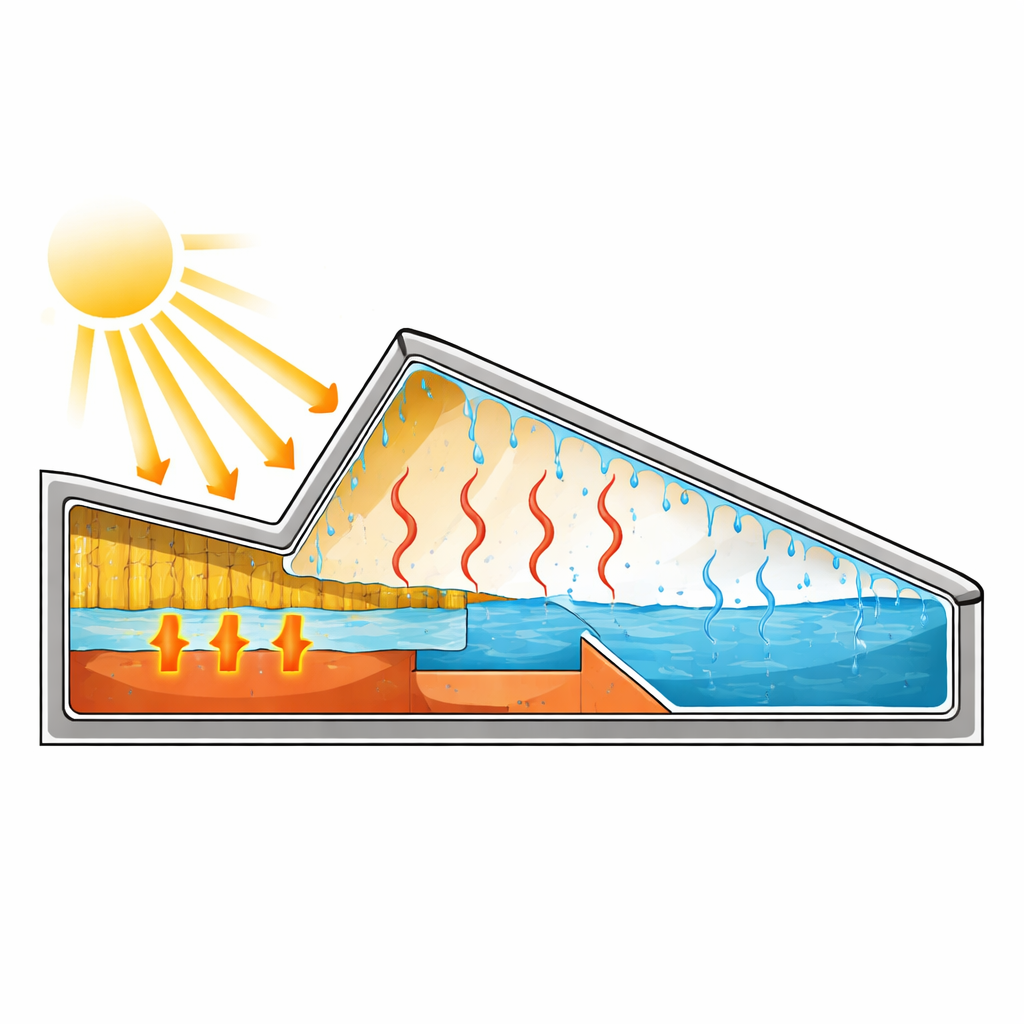
A basic solar still looks like a shallow box with a dark metal floor, a thin layer of water, and a transparent glass lid set at an angle. Sunlight heats the dark surface and the water, which then turns to vapor. That vapor rises, touches the cooler glass, condenses into droplets, and runs down to a gutter where it is collected as distilled water. The researchers built two common versions: a single-slope still with one slanted glass cover, and a double-slope still with glass sloping on two sides. Both were made from the same materials and had the same floor area so that any performance differences would come from the design and internal additions, not from size.
Using Cloth and Metal to Speed Up Evaporation
To boost output without adding complex machinery, the team focused on two low-cost tweaks: a wick and heat storage blocks. The wick was a bamboo cloth dyed black so it could soak up more sunlight. Because bamboo fibers naturally pull water upward, the cloth spread a thin film of water across a larger surface, helping it heat quickly and evaporate faster. Beneath this, the researchers placed metal pieces made of mild steel, cast iron, or copper. These metals act like thermal sponges, soaking up heat when the sun is strong and releasing it later, keeping the water warm even as sunlight fades. Five setups were tested: a bare “conventional” still, a still with only the bamboo wick, and three more with the wick plus each type of metal storage.
Measuring Heat, Sun, and Every Drop
The experiments took place in southern India over clear April days, from early morning until evening, with both still types sitting side by side so they received the same weather and sunlight. Instruments tracked solar intensity, wind speed, and temperatures at key points: the absorber plate, the water and vapor inside, the glass cover, and the collected condensed water. The researchers weighed the distilled water every hour to see how productivity changed throughout the day and into the night. They also calculated how efficiently each design turned incoming sunlight into useful evaporation, and how much of that energy could be considered truly “available” to do work—a concept known as exergy, which highlights energy losses inside the system.
Which Design and Materials Worked Best
Both the bamboo wick and the metal blocks made a noticeable difference, but one combination stood out. Across all five test cases, the double-slope still consistently produced more water than the single-slope still because it offered a larger glass surface for condensation and better use of captured heat. Adding the bamboo wick alone already raised water temperature and vapor production. When the wick was paired with copper blocks—the best heat conductor among the tested metals—both temperature and output climbed further. In this top-performing case, the double-slope still reached an average thermal efficiency of about 41.7% and an exergy efficiency of 3.1%, higher than any other setup. Over a full day, the fresh water yield rose from about 3.4 liters for the single-slope copper-and-wick still to about 3.8 liters for the double-slope version.
Environmental and Cost Benefits
Because the improved stills harvest more water from the same sunlight and materials, the researchers also examined long-term environmental and economic effects. Both designs had similar energy payback times, meaning they repay the energy used to build them in just over a year and a half of operation. However, the double-slope still produced slightly more useful energy and reduced climate-warming emissions more over its lifetime, earning more potential “carbon credits.” Economically, the added performance made each liter of distilled water from the double-slope still cost a bit less than from the single-slope version, even though both systems have the same basic construction cost.
What This Means for Thirsty Communities
For people living in sunny regions with limited access to clean water, this work shows that a simple change in shape and a clever use of everyday materials can make small solar stills significantly more productive. A double-slope box fitted with a black bamboo cloth wick and copper heat storage blocks can provide more fresh water per day, use solar energy more effectively, and remain affordable and environmentally friendly. While the tests were short-term and local to one climate, the approach points toward robust, low-tech desalination systems that may help remote communities, farms, and households turn abundant sunlight into a more reliable trickle of safe drinking water.
Citation: Rajkumar, D., Vijayakumar, R., Madhu, P. et al. A comprehensive assessment of solar still productivity enhancement using novel wick and energy storage material. Sci Rep 16, 14324 (2026). https://doi.org/10.1038/s41598-026-43571-z
Keywords: solar desalination, freshwater production, bamboo wick, thermal energy storage, double-slope solar still