Clear Sky Science · en
Sensitivity-informed framework for enrichment distribution in MNR for thermal performance enhancement
Why tiny reactors matter far from home
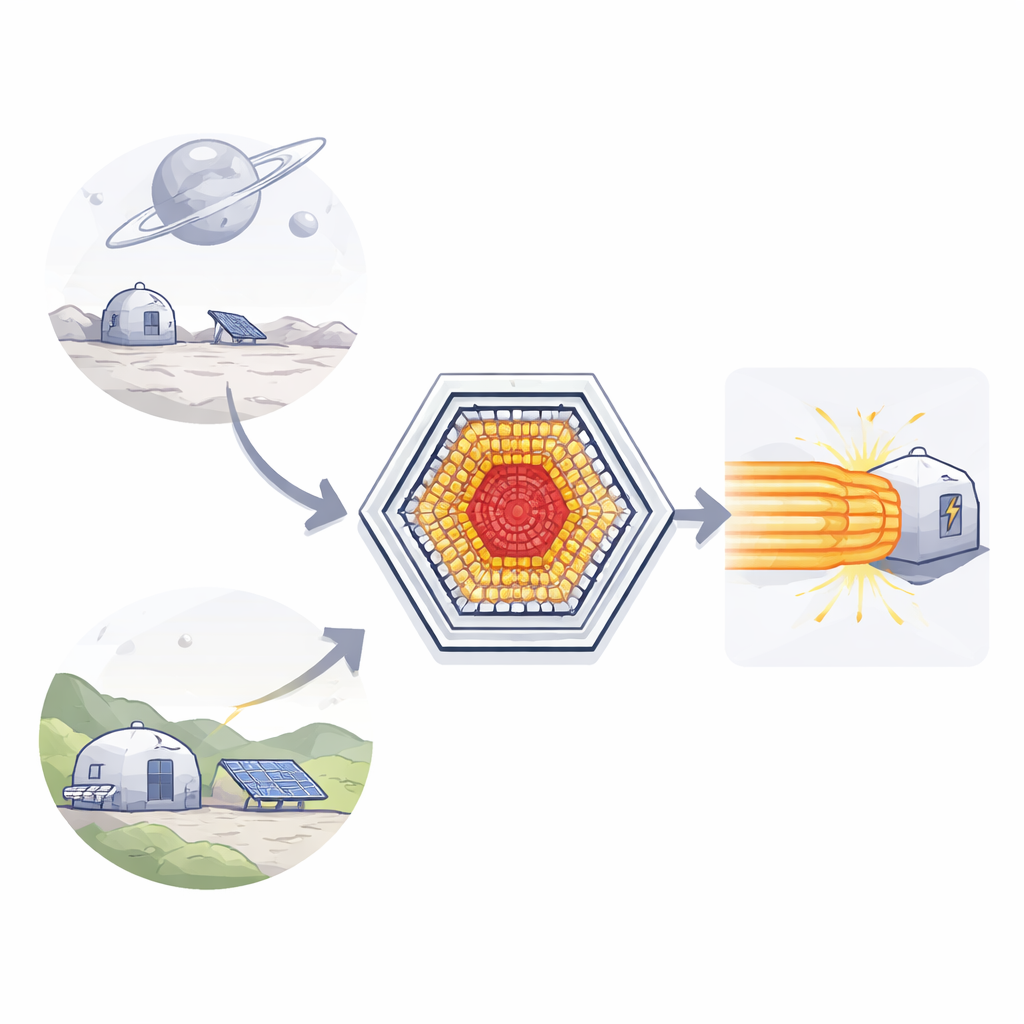
Powering a remote research station, a disaster zone, or a base on the Moon is far from simple. Diesel fuel runs out, solar panels go dark at night or during dust storms, and sending repair crews can be risky or impossible. Micro nuclear reactors promise a compact, long‑lived alternative that can quietly deliver electricity and heat for years without refueling. This paper explores how to make such tiny reactors not only powerful, but also safer and more reliable by smoothing out dangerous hot spots inside their cores.
The challenge of hot spots in tiny cores
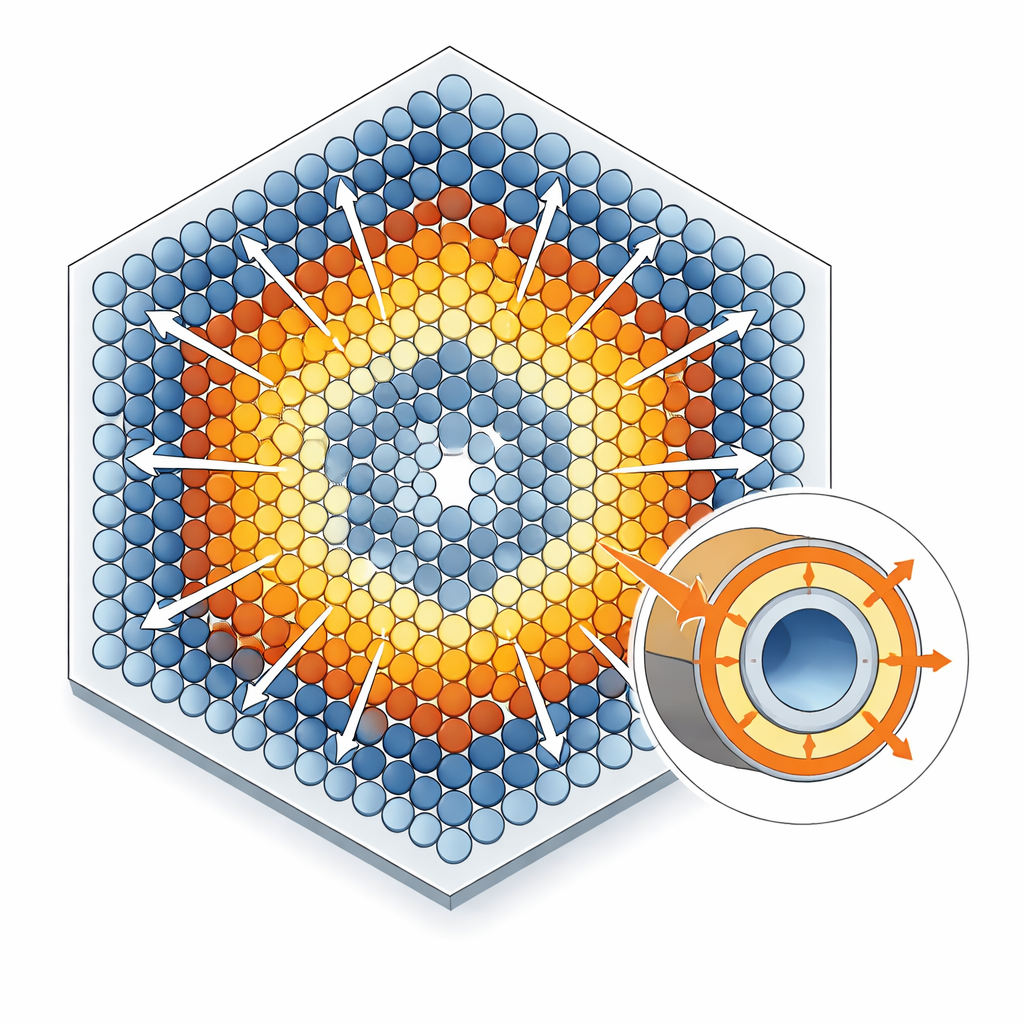
In a nuclear reactor, energy comes from fission events triggered by wandering neutrons. These neutrons are not spread evenly, so some fuel rods work harder than others. In the micro nuclear reactor studied here—a compact, fast‑spectrum, gas‑cooled design meant for remote and space applications—this unevenness shows up as "radial power peaking." Fuel rods near the center and near the outer edge of the core run hotter than those in between. Because the reactor must operate autonomously for about ten years, these hot spots pose a serious concern: they can make the fuel pellets expand until they push against the surrounding metal tube, or cladding, a situation called fuel‑clad mechanical interaction.
When extra power limits total power
The authors modeled a one‑megawatt‑thermal core filled with annular fuel rods—hollow cylinders that let coolant flow through both the center and around the outside. This design removes heat efficiently, but the simulations revealed a maximum power peaking factor of 1.28: the most stressed fuel rod produced about 28% more power than the average. Using detailed heat‑transfer and solid‑mechanics calculations, the team showed that at the intended power level the outer surface of that rod’s fuel would expand just beyond the tiny gap to the cladding. To avoid long‑term rubbing, creep, and material damage during unattended operation, they treated any contact as an operational limit. The result is counterintuitive: to keep that single hottest rod within safe bounds, the whole reactor must be derated from 1 megawatt to about 738 kilowatts of usable thermal power.
Redistributing fuel instead of redesigning hardware
Instead of changing the hardware—such as the number of fuel rods, the size of the core, or the reflector material—the researchers asked a different question: can they simply rearrange where the fissile atoms are, while keeping the total amount the same? Using a Monte Carlo neutron transport code, they quantified how sensitive each concentric ring of fuel rods is to changes in enrichment, the fraction of uranium that can undergo fission. Rings that have a big impact on the chain reaction when enrichment is tweaked receive a high sensitivity score. The team also accounted for how many rods sit in each ring, then combined these factors into a weight that tells how strongly each ring should be adjusted.
How a smarter fuel map tames the hot spots
With these weights in hand, the authors derived a one‑time, non‑uniform enrichment pattern for the six fuel rings. In simple terms, the least influential inner and outer rings give up some fissile content, while the more influential middle rings are enriched slightly more. This keeps the reactor just as critical overall but redistributes where fission events occur. New simulations with this pattern showed that the worst power peak drops from 1.28 to 1.07—a 75% reduction in peaking. Thermal‑mechanical analysis confirmed that fuel expansion now stays within the protective gap, and no new hidden hot spots appear. Because the limiting fuel rod is cooler and less strained, the whole core can safely operate at roughly 950 kilowatts instead of 738 kilowatts, a gain of nearly 29% in usable power without any physical redesign.
What this means for future tiny reactors
For non‑specialists, the key idea is that the authors used smart fuel placement, not new hardware, to turn a conservative, power‑limited micro reactor into a stronger yet still safe power source. By tailoring the enrichment of different regions in the core according to how much they influence the chain reaction, they flattened the heat map, protected the fuel‑clad gap, and recovered much of the originally intended power. Their step‑by‑step framework—baseline modeling, stress and temperature checks, sensitivity mapping, enrichment adjustment, and re‑verification—can be applied to many single‑batch micro reactor designs. As demand grows for dependable, low‑maintenance power far from the grid, such strategies could help make small reactors both more practical and more trustworthy.
Citation: Aziz, U., Khan, H., Hussain, Z. et al. Sensitivity-informed framework for enrichment distribution in MNR for thermal performance enhancement. Sci Rep 16, 13046 (2026). https://doi.org/10.1038/s41598-026-43564-y
Keywords: micro nuclear reactor, radial power peaking, fuel enrichment zoning, thermal performance, space power systems