Clear Sky Science · en
Towards cross-domain few-shot modulation classification: a feature transformation graph neural network approach
Why smarter radios matter
Modern life depends on invisible radio waves, from mobile phones and Wi‑Fi to radar and satellite links. In crowded airwaves, devices must quickly figure out what kind of signal they are hearing so they can decode it, avoid it or jam it. This task, called modulation recognition, becomes especially hard when only a handful of examples are available and when real-world conditions differ from those seen during development. This paper introduces a new way for machines to learn how to recognize radio signal types reliably, even when data are scarce and conditions shift.
How radios "speak" in different accents
Every wireless system "speaks" using a modulation style – a way of imprinting information onto a carrier wave by changing its amplitude, phase, or frequency. Traditional algorithms tried to identify these styles using hand-crafted formulas, but those methods are cumbersome and often fail in today’s busy, noisy spectrum. Deep learning has improved matters by letting neural networks learn patterns directly from raw in‑phase and quadrature (I/Q) samples. However, these networks usually demand millions of labeled examples and tend to falter when they encounter new types of signals or new channel conditions that differ from their training data.
Learning from only a few examples
To mimic how humans can learn a new concept from just a few sightings, the authors build on the idea of few-shot learning. Instead of training one big classifier once, the system is trained through many small "episodes" that each resemble a tiny recognition problem: a small support set of labeled signals and a query set of unlabeled ones. By repeatedly solving such miniature tasks drawn from known modulation types, the model learns how to adapt quickly to new types it has not seen before. The catch is that, in radio, new signal categories often look statistically different from the old ones, creating a built‑in mismatch, or domain shift, that standard few‑shot methods are not designed to handle well.
Turning radio waves into pictures
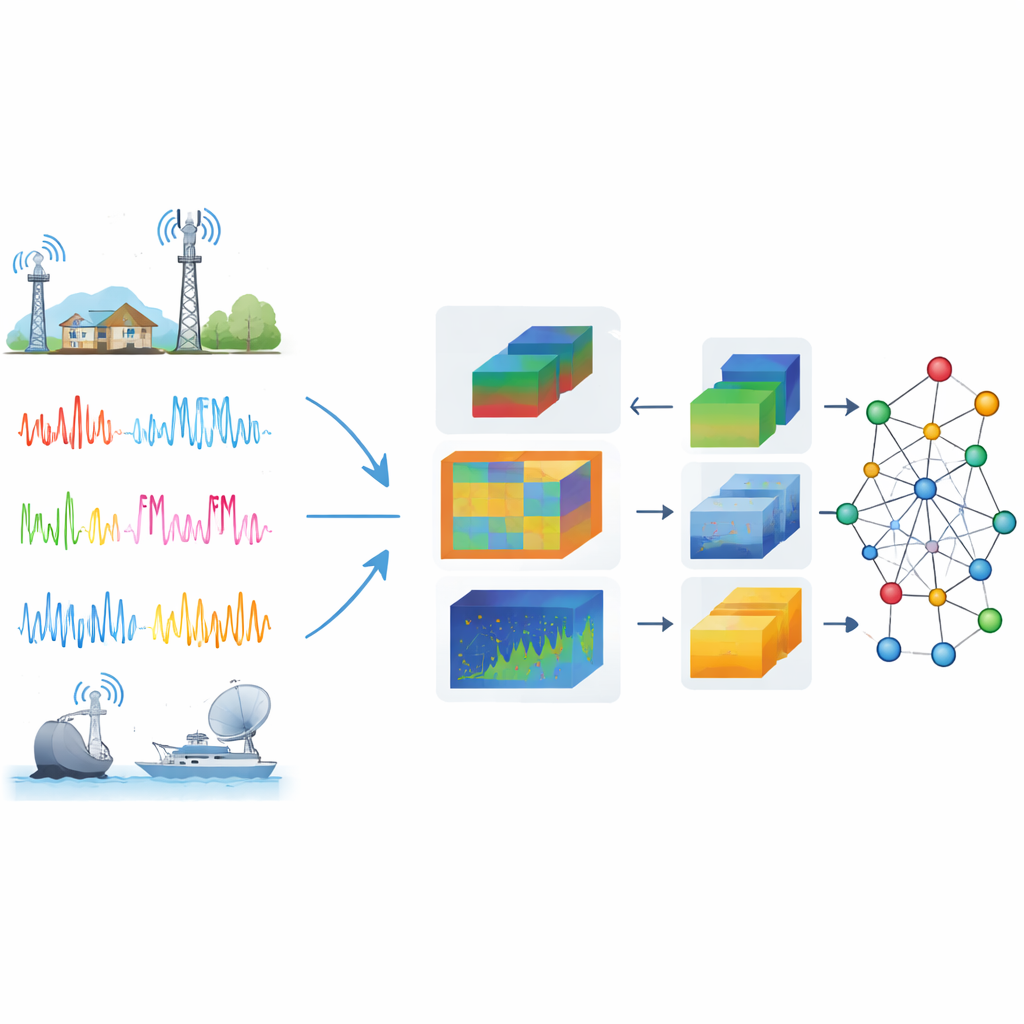
The first key idea in this work is to convert one‑dimensional signal traces into rich, image‑like representations that are easier for neural networks to separate. Instead of feeding raw I/Q samples directly, the authors combine three complementary views: a polar constellation view that emphasizes how points cluster in amplitude and phase, a Gramian view that highlights long‑range relationships over time, and a Markov view that captures how signal states tend to follow one another. Each of these produces a square pattern; stacked together like color channels in a photograph, they form a composite image for each short burst of radio data. This design magnifies differences between modulation styles so that simpler neural networks can tease them apart.
Gently reshaping features across changing conditions
The second innovation is a set of feature‑wise transformation layers inserted into a compact convolutional feature extractor. As signals from new environments pass through, these layers can gently rescale and shift entire feature maps, nudging them into alignment with the patterns the network has already learned from familiar signal types. During training, the known classes are further split into "pseudo‑seen" and "pseudo‑unseen" subsets. The core extractor and a graph‑based classifier are tuned on the pseudo‑seen part, while the transformation layers are tuned specifically to fix performance on the pseudo‑unseen part. This meta‑training scheme teaches the network not just to recognize particular modulations, but to repair its own features when the label set changes.
Letting signals help classify one another
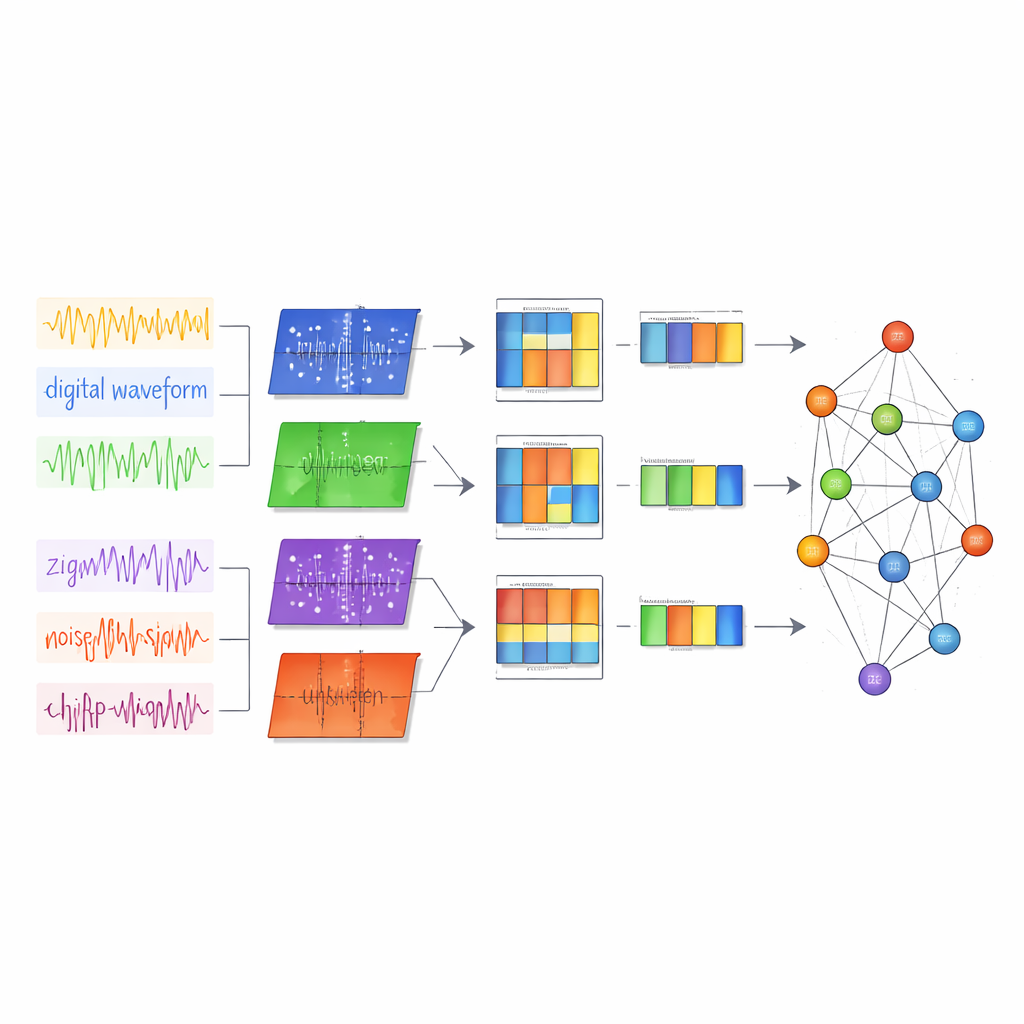
Finally, the method uses a graph neural network to exploit relationships among the few labeled and many unlabeled samples in each episode. Each signal becomes a node, connected more strongly to other signals with similar features. Through rounds of message passing along these connections, label information spreads from the support set to the query set, so that unlabeled signals that sit among a tight cluster of a known type are nudged toward that category. Tests on two standard benchmark collections of synthetic radio data show that this combined approach – image‑like inputs, adjustable feature layers, and graph‑based reasoning – consistently beats several popular few‑shot baselines and recent specialized competitors, often by several percentage points of accuracy while using only a handful of labeled examples per class.
What this means for future wireless systems
In plain terms, this work shows how to build a radio "listener" that can quickly learn new signal dialects and stay reliable when the wireless environment changes, without retraining on massive fresh datasets. By cleverly transforming waveforms into images, adjusting internal features to bridge old and new conditions, and letting signals vote for one another through a graph, the proposed system comes closer to human‑like adaptability. Such techniques could make spectrum monitoring, electronic warfare, and next‑generation cognitive radios more flexible and resilient as the airwaves grow busier and more unpredictable.
Citation: Shi, Y., Xu, H., Qi, Z. et al. Towards cross-domain few-shot modulation classification: a feature transformation graph neural network approach. Sci Rep 16, 8706 (2026). https://doi.org/10.1038/s41598-026-43563-z
Keywords: wireless signals, few-shot learning, graph neural networks, modulation recognition, domain shift