Why tiny bubbles from friendly bacteria may matter
Many people hope to stay active, sharp, and comfortable in their own skin as they grow older. This study looks at an unexpected helper in that quest: microscopic bubbles released by a common probiotic bacterium. The researchers asked whether these bubbles could ease signs of aging in cells and in mice exposed to a chemical that accelerates age-like changes, hinting at new ways to support healthier aging in the future.
Small messengers from a helpful microbe
The team began by isolating a new strain of a well-known friendly bacterium, Limosilactobacillus fermentum, from fermented food. Under the microscope, they showed that this microbe releases nanosized, membrane-wrapped particles called extracellular vesicles. These tiny spheres carry mixtures of proteins, fats, and genetic material from the parent bacterium. Careful measurements confirmed that the vesicles were uniform in size and carried the electrical charge expected for this type of particle, suggesting they are stable and able to interact with animal cells.
Protecting blood vessel cells from early aging
To test how these vesicles affect living cells, the scientists exposed human umbilical vein endothelial cells, a common model for blood vessel linings, to high levels of D-galactose, a sugar that drives cells into a tired, slow-growing state that resembles aging. Cells treated with the bacterial vesicles survived better and showed far fewer classic “old cell” features, such as enlarged shape and a distinctive blue staining pattern. At the most effective dose, the vesicles performed as well as, or better than, resveratrol, a plant compound often used as a positive control in anti-aging studies. These results suggest that the bacterial bubbles help blood vessel cells resist stress and delay the shift into a senescent state.
Helping aging-like mice move, think, and look better
Next, the researchers moved to a mouse model in which repeated D-galactose injections trigger whole-body changes that mimic aspects of aging. Some mice received only the sugar, while others also received either nicotinamide mononucleotide (a well-known anti-aging supplement) or different doses of the bacterial vesicles by mouth. Mice given the sugar alone lost weight, became less active, and performed poorly in a memory test. Their fur turned dull and patchy, and several organs shrank relative to body size. In contrast, mice treated with the vesicles or with nicotinamide mononucleotide showed more normal movement, better learning and memory, healthier-looking coats, and less shrinkage of key organs such as the heart and spleen.
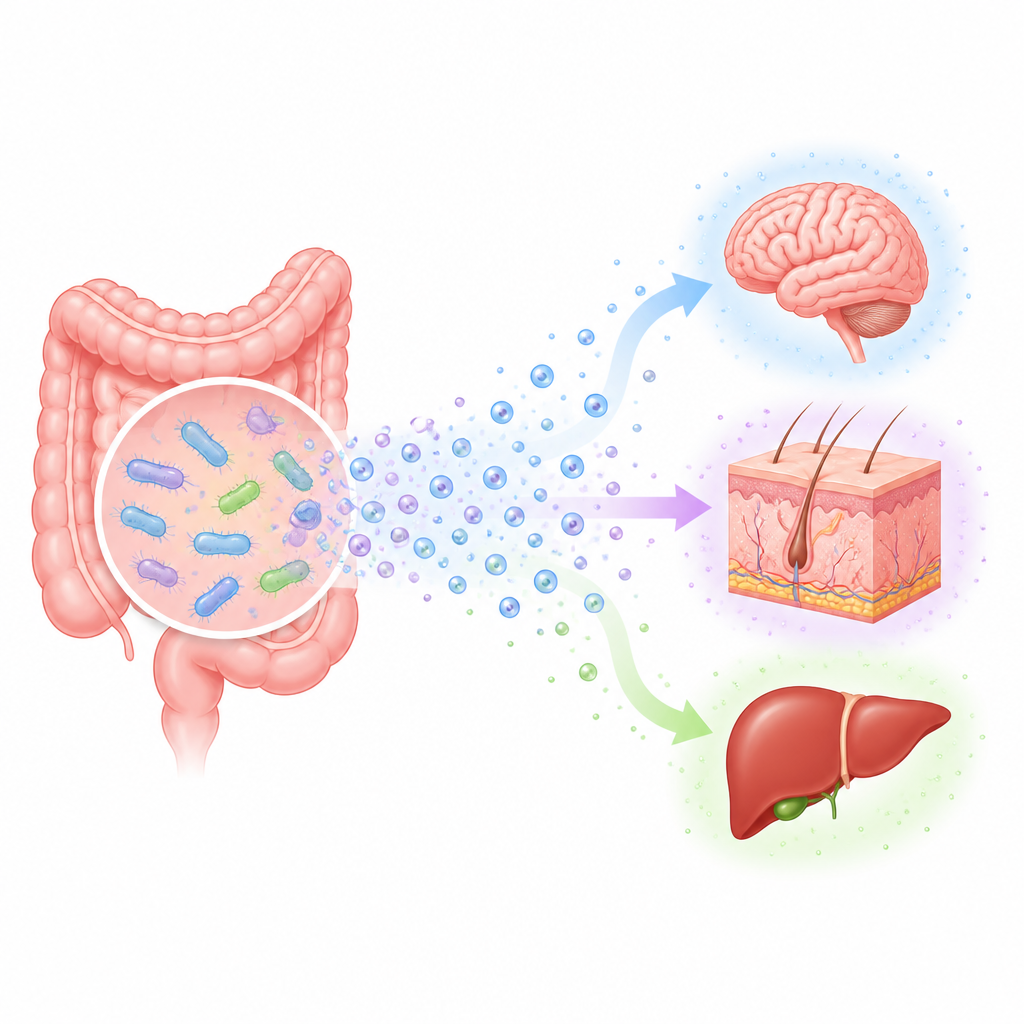
Skin, liver, and brain signs of relief Figure 1. Friendly gut bacteria send tiny vesicles that help protect brain, skin, and liver from aging-like stress in mice.
The team then examined tissues in detail. In the skin, D-galactose caused dryness, breakdown of collagen fibers, and an increase in enzymes that chew up the skin’s support structure, along with a jump in the inflammatory signal IL-6. Vesicle-treated mice had moister skin, higher collagen, lower levels of these damaging enzymes, and reduced IL-6, returning close to normal. Blood tests showed that sugar-treated mice had elevated liver enzymes that signal injury, while vesicle treatment brought these markers back down. In the brain, the sugar lowered antioxidant activity and boosted an enzyme linked to altered nerve signaling; the vesicles largely reversed these shifts. Thin tissue slices from skin and the memory-related hippocampus revealed that vesicle-treated mice had smoother, less inflamed skin layers and better-preserved brain cell structure with fewer senescent and damaged neurons.
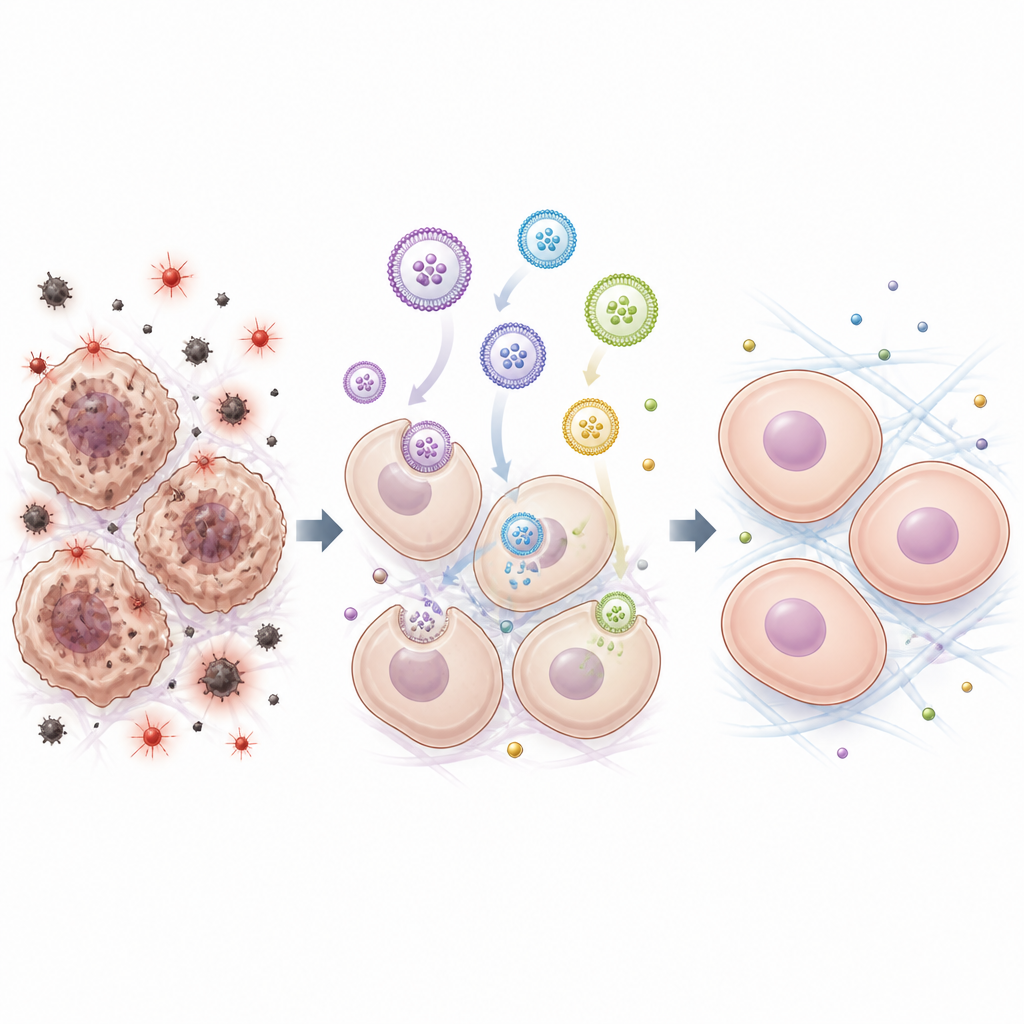
Dialing down aging markers in key organs Figure 2. Tiny vesicles enter stressed cells and shift them from damaged, inflamed states toward healthier, less aged ones.
At the molecular level, the researchers measured genes commonly switched on in aging cells, including p16, p19, and p21, as well as the inflammatory messenger IL-6. D-galactose sharply increased these markers in the liver, brain, skin, and blood. Giving mice the bacterial vesicles consistently reduced these signals, in some cases nearly to the levels seen in untreated control animals. Interestingly, the lower vesicle dose often worked as well as, or better than, the higher dose, hinting that there may be an optimal range rather than a simple “more is better” effect. Together with the behavior and tissue findings, these gene patterns support the idea that vesicles from this probiotic strain help quiet inflammation, oxidative stress, and cellular wear and tear across several organs.
What this could mean for healthy aging
In plain terms, this study shows that tiny packages released by a friendly bacterium can soften many aging-like changes in stressed cells and in mice, from skin quality to movement, memory, and organ health. The work stops short of revealing the exact ingredients inside the vesicles that are responsible, and it was done in a special mouse model rather than in naturally aged animals or people. Still, it offers early evidence that purified products from probiotics, not just the live microbes themselves, might one day become part of a broader toolkit to help bodies cope with the strains of aging.
Citation: Wang, Z., Zhang, S., Li, X. et al. Anti-aging potential of Limosilactobacillus fermentum F-B9-1-2 extracellular vesicles in D-galactose–induced cellular and organ senescence .
Sci Rep16, 15681 (2026). https://doi.org/10.1038/s41598-026-43553-1