Clear Sky Science · en
3D scan-based classification of Chinese young female hand morphology
Why the shape of our hands matters
From winter gloves and sports gear to medical braces and VR controllers, many everyday products must fit our hands. Yet most sizing charts were built decades ago, before lifestyles and body shapes shifted. This study looked closely at the hands of young Chinese women using modern 3D scanning, asking a simple question with big practical consequences: have their hands changed enough that we need to rethink how we size gloves and other hand-worn products?

Looking at hands in three dimensions
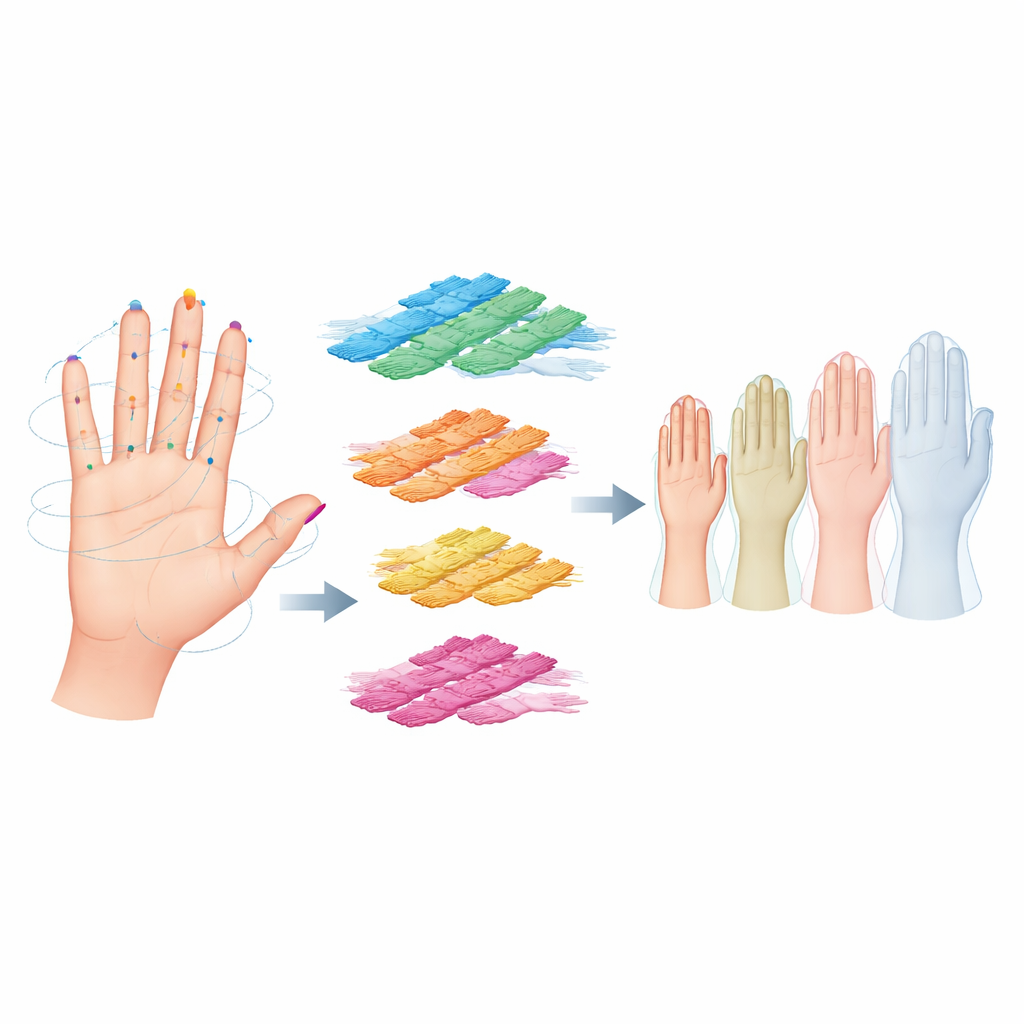
Instead of using tape measures or flat photos, the researchers used a handheld 3D scanner to capture detailed models of the right hands of 111 healthy women aged 20 to 26. With the hand gently pressed against a transparent plate, the scanner swept around it to build a complete digital surface. Small sticky markers at key points on the palm, fingers, and wrist helped the team measure 32 precise dimensions, including lengths, widths, and circumferences around the fingers and palm. Each distance was measured three times on the 3D model to ensure reliability.
Finding simple patterns in complex shapes
A human hand is a complicated structure, so the team used statistical techniques to simplify the picture. They first checked that their measurements behaved in a regular, “bell-curve” way, which allows standard analyses. Then they grouped the 32 measurements into families that tended to vary together. Four main dimensions emerged: finger width, finger circumference, finger length, and overall hand length. From these, they identified four especially informative indicators that capture most of the variation in shape: overall hand length, the width of the middle finger, the circumference near the base of the index finger, and the length of the ring finger.
Five main hand types among young women
Using these key indicators, the team applied clustering methods to see whether natural groupings of hand shapes appeared in the data. They found that the hands of young Chinese women could be sorted into five main types: short and thin, short and wide, standard, long and thin, and long and wide. The “standard” type was most common, covering about 63% of participants and reflecting average lengths with relatively slender fingers. About one-third fell into the “long and wide” category, with longer fingers and broader palms, while the other three types were less frequent. This five-type system offers a clearer and more realistic picture of how hand shapes vary in this group.
Today’s hands versus older standards
The study also compared its measurements to China’s existing national hand-size standard, which is based on older data collected with tape measures. The differences were striking: on average, hand length had increased by around 3%, and the breadth across the knuckles by more than 8%. Fingers, especially the index finger, tended to be longer but slightly slimmer than before. In other words, modern young women generally have somewhat longer, wider hands with thinner knuckles compared with the women whose measurements underpinned the current standard.
Designing better-fitting gloves and devices
Armed with this updated picture, the authors proposed a new “5-size-5-fit” system tailored to young Chinese women. It focuses sizing on the most common range of hand lengths (about 170–190 mm) and widths, and chooses a new central reference size that better reflects today’s typical hand. Prototype gloves made using this new sizing showed visibly better conformity and comfort than those based on the older standard. The study also derived simple mathematical relationships linking overall hand length to other key measures, providing manufacturers with shortcuts to estimate detailed dimensions from a few basic ones.
What this means for everyday users
For non-specialists, the takeaway is clear: the hands of young Chinese women are not the same shape they were a generation ago, yet many products still rely on outdated sizing rules. By using 3D scanning and smart data analysis, this research maps out how hand shapes have changed and organizes them into five practical types. That information can guide the design of gloves, tools, medical supports, and other hand-related products that feel more natural, protect better, and reduce the risk of strain or injury—bringing everyday objects a step closer to truly fitting the people who use them.
Citation: Zhai, Y., Bian, Y., Shen, Y. et al. 3D scan-based classification of Chinese young female hand morphology. Sci Rep 16, 13491 (2026). https://doi.org/10.1038/s41598-026-43547-z
Keywords: 3D hand scanning, hand shape classification, ergonomic glove design, Chinese young women, anthropometric data