Clear Sky Science · en
Comparative evaluation of deep learning models for cardiovascular disease diagnosis and classification
Why smarter heart checks matter
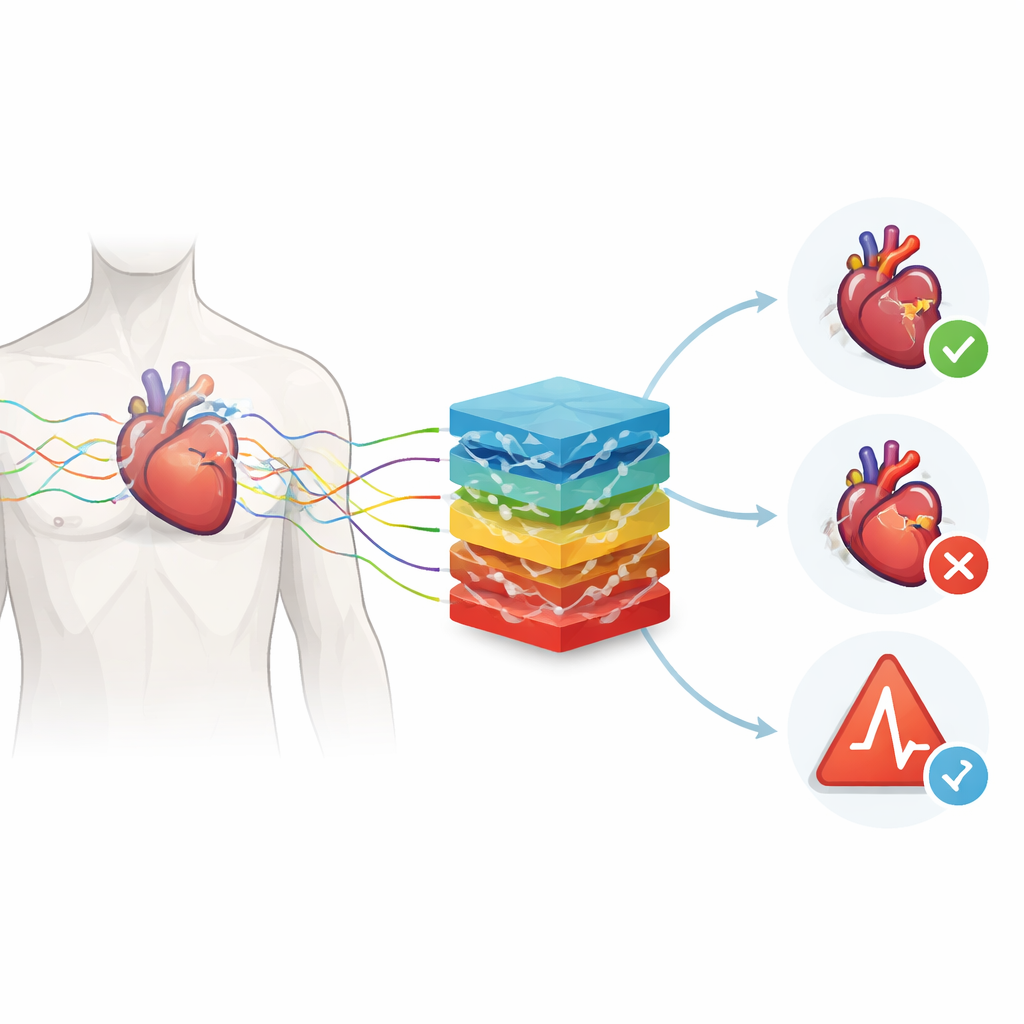
Heart disease is still the world’s top killer, but the signals that warn of trouble often hide in tiny wiggles of an electrocardiogram (ECG). Doctors can read these traces, yet doing so by eye is slow, tiring, and prone to missed details—especially when thousands of heartbeats stream in from hospital monitors or wearable devices. This study explores whether artificial intelligence can not only match expert performance in reading ECGs, but do so with such low computing demands that it could run in real time on everyday clinical machines and even compact gadgets.
Reading the heartbeat in a digital age
Cardiovascular diseases cover a wide range of problems, from heart attacks and heart failure to rhythm disorders and valve defects. Together, they cause about a third of all deaths worldwide. ECGs are one of medicine’s cheapest and most widely available tools for spotting these conditions early, because they record the heart’s electrical activity in real time. Yet modern healthcare now produces more ECG data than human experts can comfortably review. The authors argue that intelligent computer systems are needed to sift through this flood of signals, highlight early warning signs, and support doctors without replacing them.
Teaching machines to recognize sick hearts
The researchers turned to a public ECG collection known as the PTB-ECG dataset, which contains recordings from 290 people aged 17 to 87 with a variety of heart conditions. Each record is linked to detailed clinical information, and the ECGs are labeled into eight disease groups, such as heart attack, heart failure, rhythm problems, and valve disease, along with healthy cases. Instead of converting signals into images, the team fed the ECG waveforms directly into several types of deep learning models, including convolutional networks, memory-based networks, and hybrids that combine these strengths. All models faced the same task: decide, from the electrical pattern alone, which type of heart problem a patient likely has.
Making powerful models light enough to travel
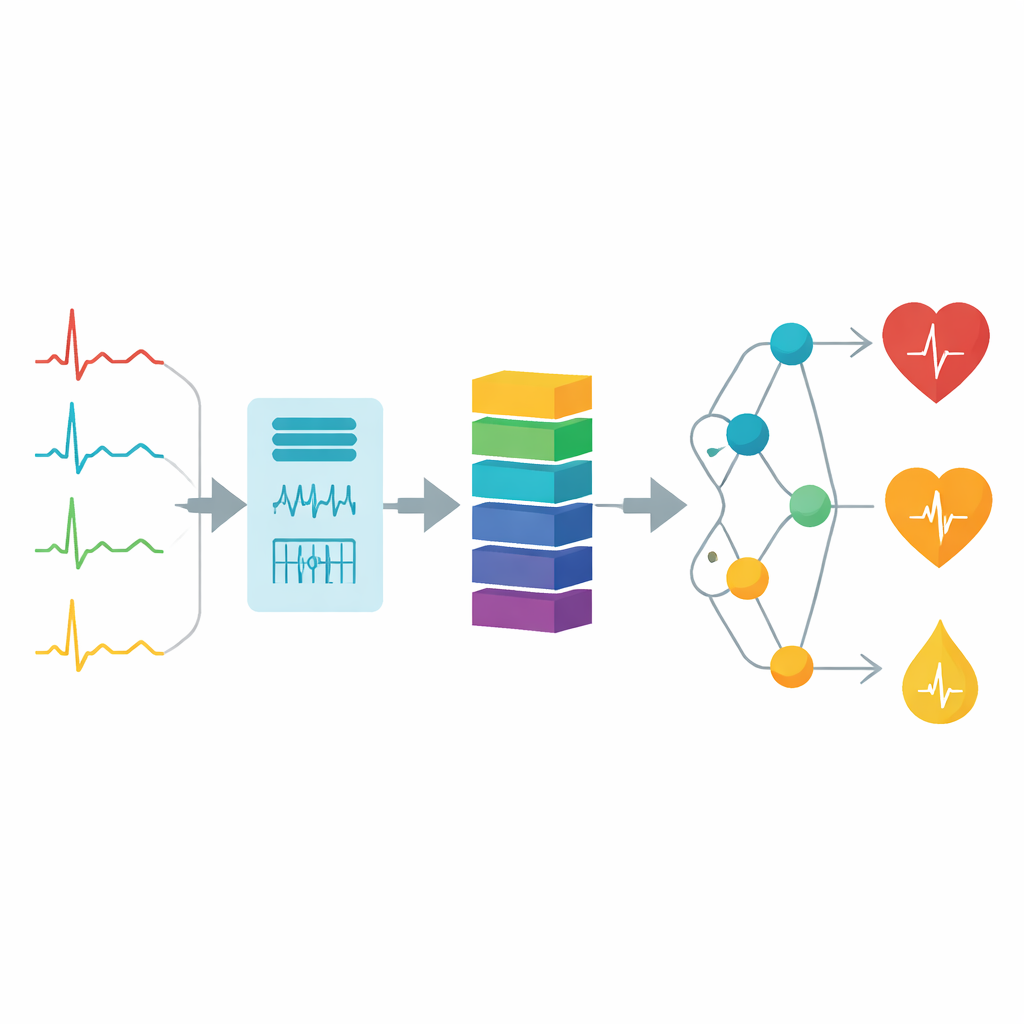
A key challenge was not just to be accurate, but to stay lean. Many high-performing AI models demand heavy computing power, which is impractical for bedside monitors, ambulances, or wearable devices. To trim the workload, the authors first cleaned the ECGs, filtered out slow drifts and noise, and reduced the sampling rate. They then used a mathematical technique called wavelet transformation to distill each heartbeat into compact numerical features that still preserve important details. They also corrected for imbalanced data—where some diseases were rarer than others—by creating carefully synthesized examples of underrepresented conditions in the training set. This combination of signal cleaning, smart feature extraction, and data balancing allowed the models to work with a much smaller, more informative input.
Which digital reader did best?
The team compared five model families: a convolutional network tuned for one-dimensional signals, a classic multi-layer perceptron, a long short-term memory (LSTM) network that specializes in time sequences, and two hybrids that chain convolutional layers to either a perceptron or an LSTM. They judged each approach using familiar measures such as accuracy, precision, recall, and the F1 score, and, crucially, by counting how many mathematical operations the model needed per input. All models reached very high accuracy—above 99%—but the LSTM stood out. It combined near-perfect precision in identifying diseased hearts with the lowest computational load among the contenders, showing that tracking how the heartbeat evolves over time can be both smart and efficient.
What this means for everyday care
In simple terms, the study shows that a carefully designed AI system can read ECGs with exceptional reliability without being a power-hungry supercomputer. By shrinking the calculations needed three orders of magnitude, the authors demonstrate that fast, battery-friendly algorithms can still capture the subtle signatures of different heart diseases. Among them, the LSTM-based model offered the best balance between brain and brawn, making it a strong candidate for use in real-time hospital monitoring, portable scanners, and wearable heart patches. With further testing on larger and more varied patient groups, such lean yet accurate tools could help bring expert-level heart screening to more clinics, ambulances, and homes around the world.
Citation: Bhia, I., Soltanizadeh, S. & Shafik, W. Comparative evaluation of deep learning models for cardiovascular disease diagnosis and classification. Sci Rep 16, 12522 (2026). https://doi.org/10.1038/s41598-026-43543-3
Keywords: cardiovascular disease, electrocardiogram, deep learning, medical diagnosis, wearable health