Clear Sky Science · en
Rolling predictive optimal scheduling of reservoirs for flood control and power generation under prediction uncertainty
Why smarter dams matter for everyday life
When heavy rain hits a river basin, a reservoir can be both a shield and a power plant: it protects people downstream from floods while also generating electricity. Yet these two jobs can conflict. If the water level is kept low for safety, there is less power. If it is kept high for power, flood risk rises. This study looks at Xiajiang Reservoir in China and shows how better short-term forecasting and step-by-step planning can help operators steer a safer middle course between flood control and energy production.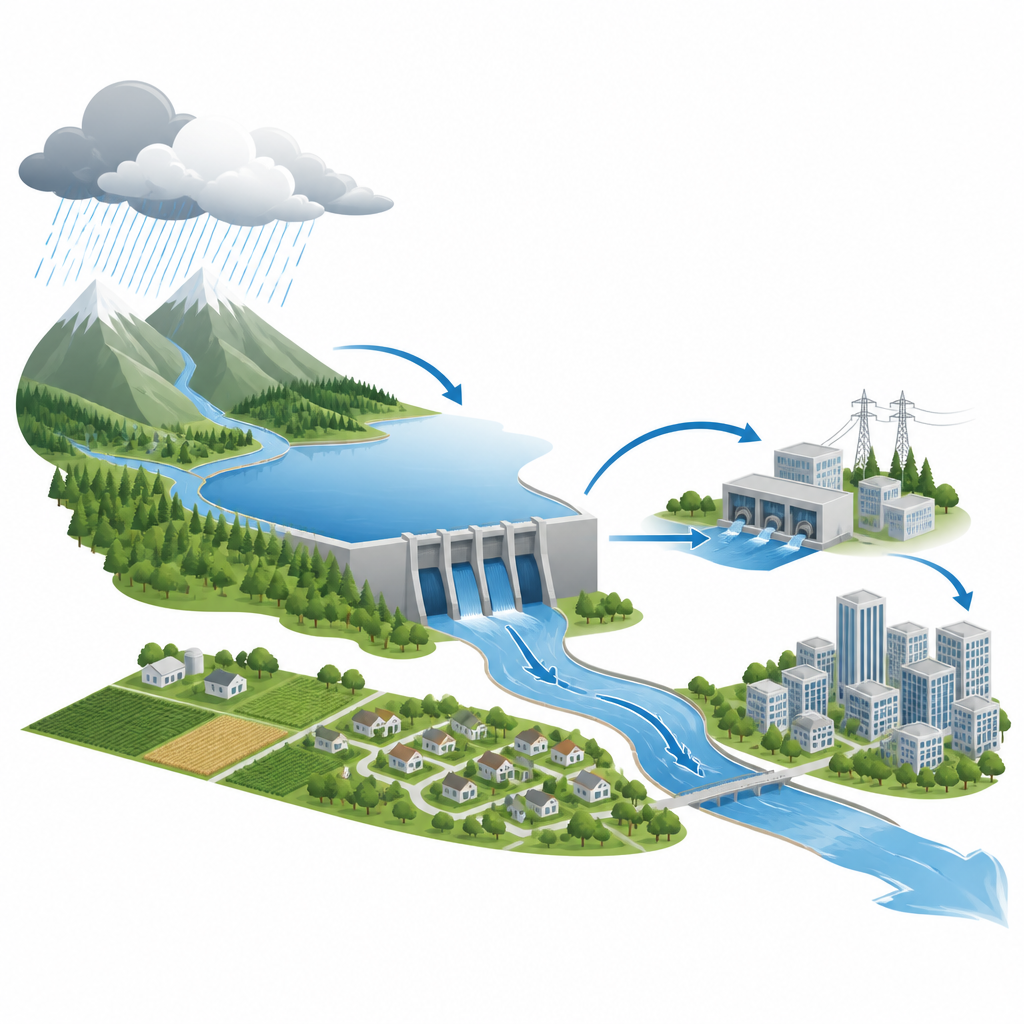
How a river and its dam work together
Xiajiang Reservoir sits on the Ganjiang River, a major tributary of the Yangtze. It holds nearly 12 billion cubic meters of water, protects towns and farmland downstream, and feeds a hydropower station that supplies electricity and irrigation. During the rainy season, operators must decide in real time how much water to release and how much to store. Those choices depend heavily on how much water they expect to flow in over the next few days. Traditional scheduling often leans on past records and offers limited guidance when rare, very large floods occur or when conditions shift with climate and land use changes.
New ways to look ahead at river flows
The researchers built a modern inflow prediction system that combines several data-driven models rather than relying on a single favorite method. These models, which include different styles of statistics and machine learning, each have strengths and weaknesses. In a parallel setup, the study blends their individual forecasts using optimized weights, much like averaging the opinions of experts who see different parts of the problem. Tests on nearly nine years of data showed that this parallel blend produced the most accurate short-term forecasts, outperforming both the best single model and more complicated chained schemes that tried to correct errors in sequence.
Rolling plans that adjust as new data arrive
Forecasts are only useful if they drive better decisions. The team linked their inflow predictions to a rolling scheduling model that revises reservoir releases every six hours. Instead of planning the entire flood season at once, the model repeatedly looks ahead over a limited forecast window, then updates the plan as fresh rainfall and river data come in. Within each window, it balances two goals: keeping the peak outflow as low as possible to reduce flood risk, and maximizing electricity output. A priority rule makes sure safety comes first by minimizing rule violations and peak discharges before seeking more power generation.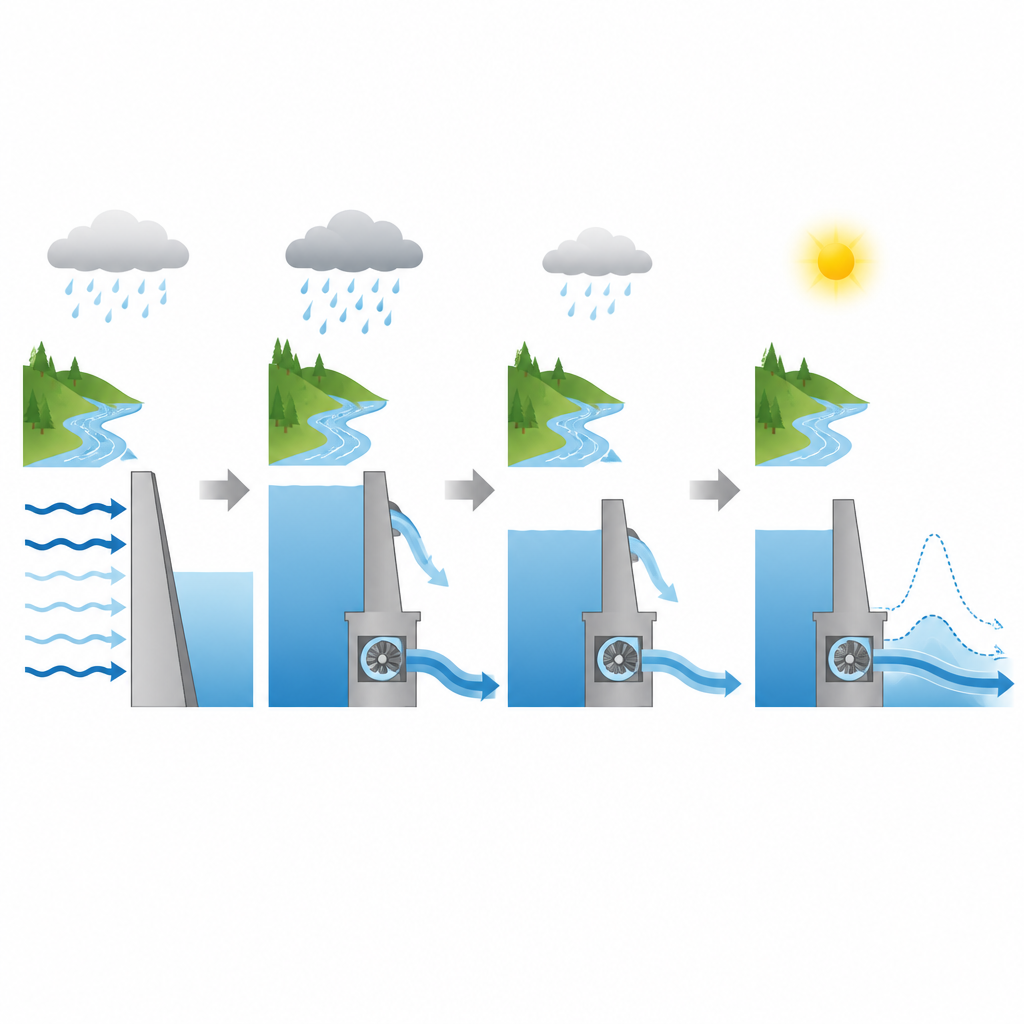
Finding the sweet spot in time and water level
Using 16 typical design floods of different sizes, the researchers explored how far ahead operators should try to look and how high they can safely let the reservoir rise before a storm. They found that for large floods, extending the forecast horizon to about 24 hours sharply improves the ability to shave down peak flows, but looking much further ahead adds little benefit. At the same time, modestly raising the allowed water level in the flood season can boost power generation by more than 30 percent while barely reducing the ability to cut peak flows. The study also shows that predictions are more reliable for ordinary, low-flow periods than for rare, extreme floods, because there are many more examples in the historical record to learn from.
What this means for rivers, energy, and safety
In simple terms, the study shows that a dam like Xiajiang can do a better job of both guarding against floods and producing electricity if it uses a well-tuned blend of forecasting tools and continuously updated plans. The parallel prediction model offers more trustworthy short-term inflow estimates, and the rolling scheduling method turns those estimates into actions that keep flood peaks in check while squeezing more useful energy from the same water. While the approach still struggles with very rare, intense floods and could be improved by adding more extreme-event data and climate factors, it provides a practical roadmap that other reservoirs can adapt to manage water more safely and efficiently.
Citation: He, Z., Guo, J., Cao, Z. et al. Rolling predictive optimal scheduling of reservoirs for flood control and power generation under prediction uncertainty. Sci Rep 16, 14851 (2026). https://doi.org/10.1038/s41598-026-43532-6
Keywords: reservoir operation, flood control, hydropower, runoff forecasting, water resources management