Clear Sky Science · en
Investigation on porous media coating plus effect of carbon quantum dots and graphite nanoparticles on tubular solar still (TSS) productivity
Turning Sunlight into Drinking Water
In many sunny regions, clean drinking water is scarce even though sunlight is abundant. This study looks at a simple device called a tubular solar still—a clear plastic tube that turns salty or dirty water into fresh water using only the sun’s heat. The researchers asked a practical question: can we boost the amount of fresh water this tube produces by changing just the inner surface, using low-cost coatings made from tiny carbon particles and everyday porous materials like sponges and loofahs?
Why a Simple Tube Matters
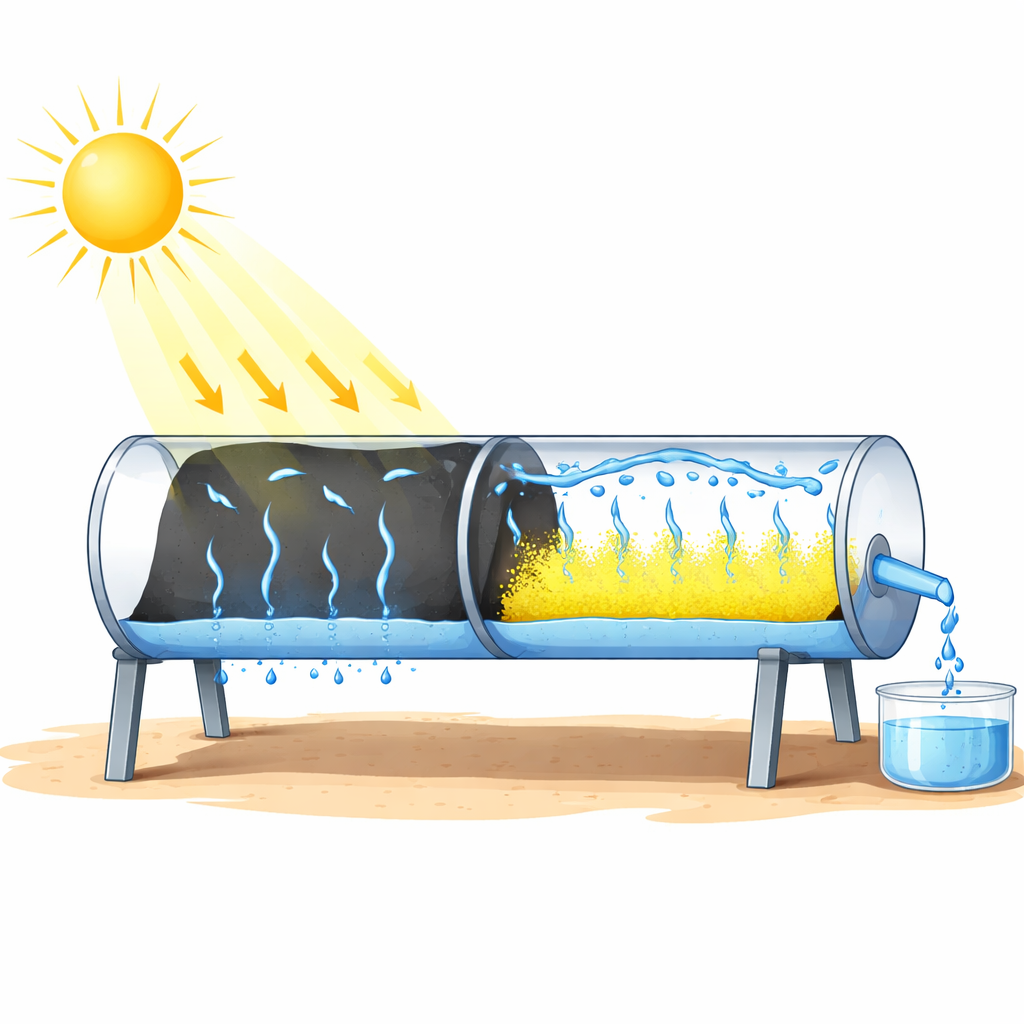
A tubular solar still works a bit like a greenhouse laid on its side. Sunlight passes through the clear outer tube and warms a dark inner plate that holds a shallow layer of salty water. As the water heats, it evaporates, leaving salts and impurities behind. The water vapor rises, touches the cooler inside of the tube, condenses as droplets, and runs down to a collection channel as clean water. This design is attractive for remote villages because it is simple, runs on free sunlight, and can be built from common materials. The challenge is that ordinary versions make too little water per day to be widely used, so improving their productivity without adding complexity or high cost is crucial.
Tiny Carbon Particles as Sun Catchers
The first set of experiments focused on replacing ordinary black paint on the inner metal plate with coatings that included carbon quantum dots (extra-small carbon particles only billionths of a meter across) and slightly larger graphite nanoparticles. These particles act as powerful sun catchers: they absorb a broad range of sunlight and quickly turn it into heat. The team built three identical tubular stills and coated one plate with standard black paint, one with black paint plus graphite particles, and one with black paint plus carbon quantum dots. Under the same outdoor conditions, the plate with carbon quantum dots produced about 30% more fresh water than the plain black coating and reached the highest thermal efficiency, meaning more of the incoming sunlight ended up driving evaporation instead of being lost.
Everyday Sponges as Water Spreaders
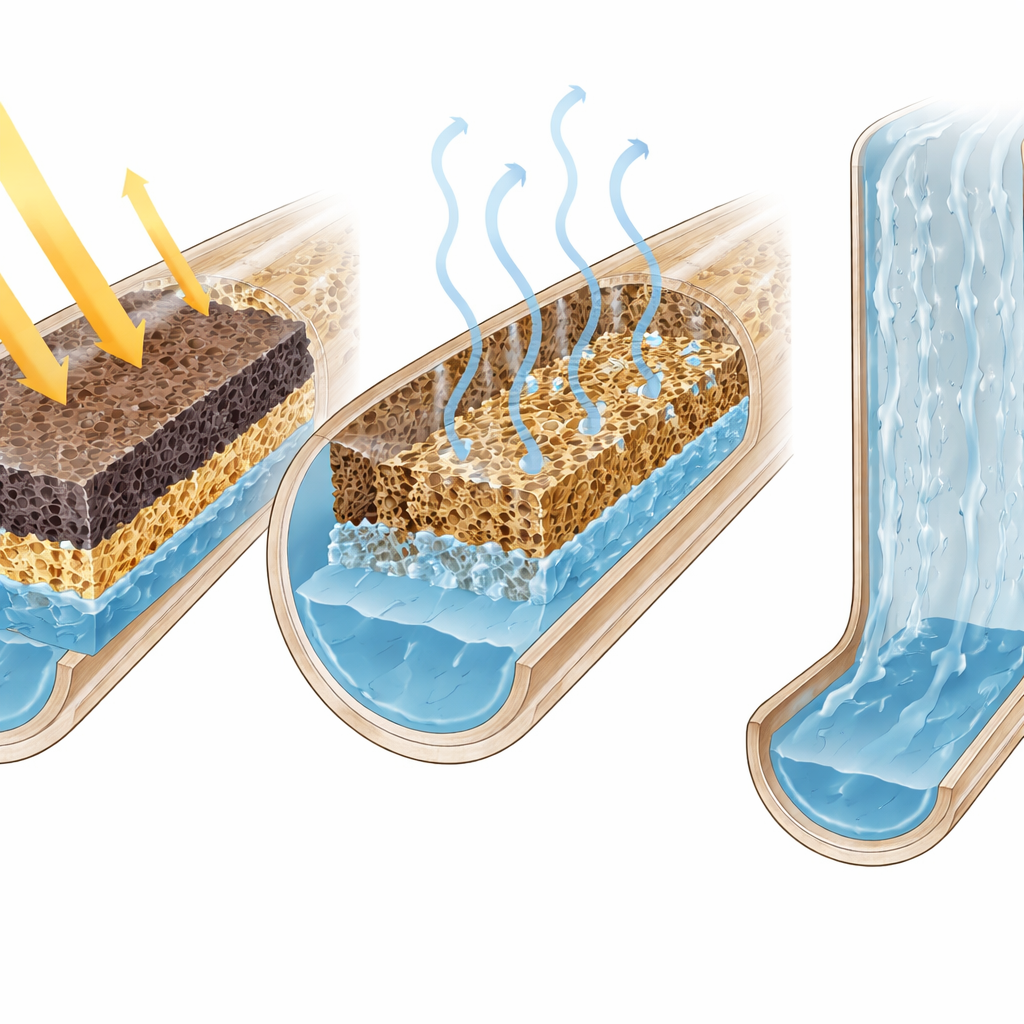
Next, the researchers tested what happens when the plate is covered not with special particles but with common porous materials—a kitchen-type sponge and a natural loofah. These materials soak up water and spread it through a network of tiny pores, greatly increasing the wet surface area from which water can evaporate. In this second scenario, the sponge-covered plate clearly outperformed both the loofah and the simple black-painted plate. Even though the black paint sometimes ran slightly hotter, the sponge turned that heat into more evaporation, delivering the highest hourly and total fresh water production during the day. The loofah, while less effective than the sponge, still showed that low-cost plant-based materials can improve performance.
Combining Sun Catchers and Sponges
The most promising test combined the strengths of both ideas: the porous structure of a sponge with the strong light absorption of carbon quantum dots. In this hybrid design, the sponge was coated or mixed with the tiny carbon dots and placed on the absorber plate. This configuration produced the best results of all. The still with the hybrid sponge–quantum-dot surface delivered a cumulative output of 3.66 liters of fresh water per square meter of absorber area during the test day, roughly 38% more than the conventional black-painted still. Its peak thermal efficiency also rose markedly, confirming that the special coating helped capture and distribute solar energy more effectively while the sponge kept thin water films in close contact with the warm surface.
What This Means for Thirsty Communities
For non-specialists, the takeaway is straightforward: by smartly redesigning the inner surface of a simple solar still—using tiny carbon particles to catch sunlight and everyday sponges to spread and wick water—one can significantly increase the amount of drinkable water produced without adding moving parts, pumps, or electricity. The study shows that such hybrid surfaces can make solar distillation more efficient and more attractive for villages, farms, and coastal communities that lack centralized water treatment. With further work on durability and nighttime operation, this approach could help turn more of the world’s strong sunlight into a steady trickle of safe, low-cost drinking water.
Citation: El-Fakharany, M.K., Elbrashy, A., Rashad, M. et al. Investigation on porous media coating plus effect of carbon quantum dots and graphite nanoparticles on tubular solar still (TSS) productivity. Sci Rep 16, 11235 (2026). https://doi.org/10.1038/s41598-026-43530-8
Keywords: solar desalination, tubular solar still, nanomaterials, porous sponge, freshwater scarcity