Clear Sky Science · en
Facilitating the spread prediction of public health emergencies based on spatio-temporal neural network
Why predicting outbreaks matters
When a new disease spreads, officials must decide quickly where to send masks, medicines, and doctors. Yet the virus moves in complex ways, shaped by travel, local policies, and time. This paper presents a new computer model that better predicts how an epidemic will unfold across many places at once, helping governments respond faster and more precisely during public health emergencies.

Seeing outbreaks as a moving network
The authors start from a simple idea: an epidemic is not just a list of daily case counts, but a living network of connected regions. People travel between cities and countries, carrying infections with them. Traditional prediction tools often treat each place separately, or connect only neighboring areas on a map. That misses hidden links, such as strong travel ties between distant cities, and it struggles with the ups and downs seen during COVID-19 waves. To capture this richer picture, the researchers design a model that looks at space and time together, instead of treating them as separate problems.
Finding hidden connections between regions
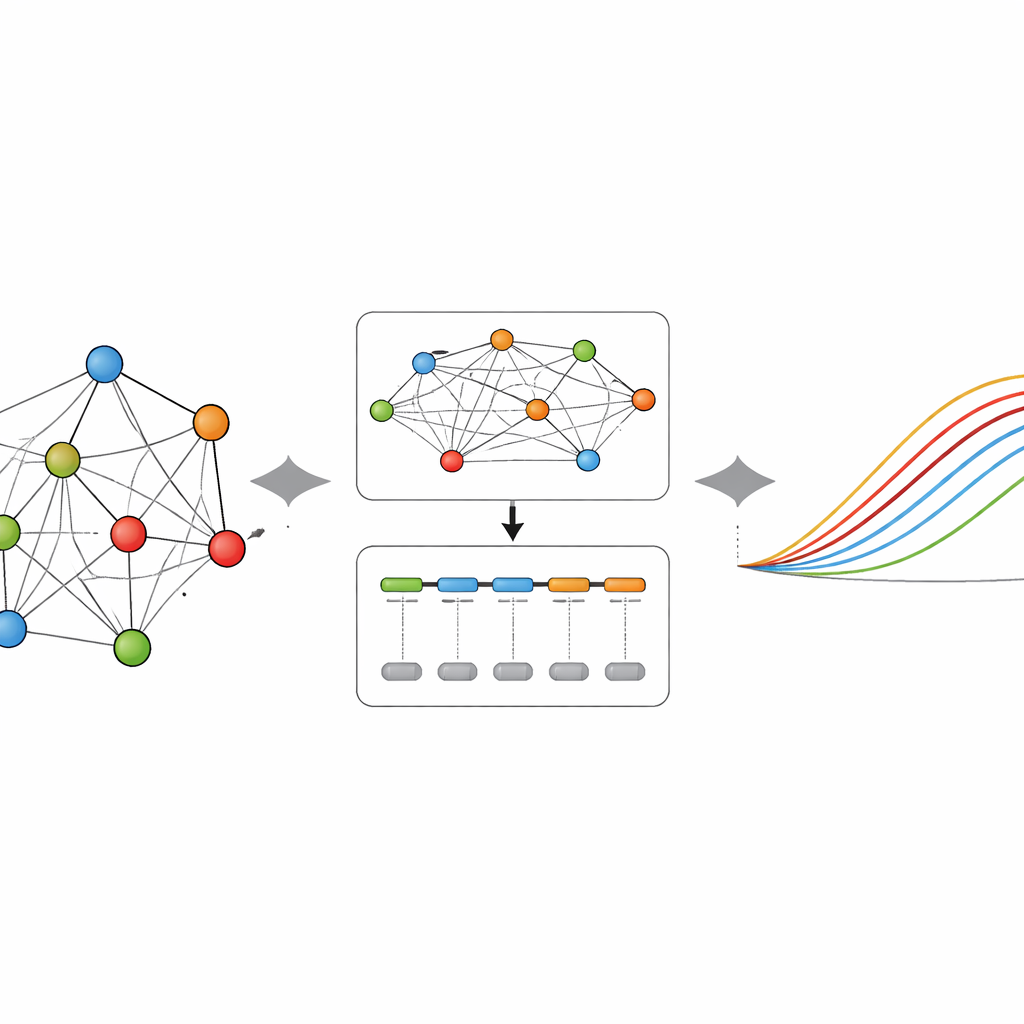
A key innovation is how the model discovers which regions influence each other. Rather than assuming that only nearby areas interact, the authors let the data speak. They use a measure called “mutual information” to see how strongly the case trends of any two regions move together over time, whether the relationship is simple or complicated. If the case curves of two places tend to rise and fall in sync, the model connects them more strongly, even if they are far apart. These data-driven connections form a network that feeds into graph-based layers, which are designed to learn patterns that spread across such linked nodes.
Combining space-aware and time-aware learning
The full system, called MI–GCN–LSTM, weaves together three ingredients. First, the mutual-information step builds the network of relationships among regions. Second, graph convolution layers scan this network to extract how infections spread across connected places at each point in time. Third, a memory-based time series component tracks how these spatial patterns evolve day by day, learning long-term trends and repeated waves. Before training, the researchers clean missing data, slide a moving window through the timelines to form input sequences, and then teach the model to predict future infections, adjusting its internal settings to reduce prediction errors.
Testing the model on real COVID-19 data
To see how well their approach works, the team tests it on two real-world COVID-19 datasets. One covers daily new infections in several European countries over more than two years; the other tracks city-level cases in China’s Hubei Province during 2020. They compare their method against a range of alternatives, from classic statistical tools to modern deep-learning models that focus only on time or only partly on space. Across both datasets, their model produces smaller errors and better fits to the observed data than all competitors, especially outperforming a similar model that uses simple geographic neighbors instead of data-based links.
What the results mean for public health
The findings show that learning realistic connections between regions and modeling space and time together can noticeably sharpen epidemic forecasts. In Europe, the new method cut key error measures by around ten percent compared with the next-best approach; in Hubei, the gains were even larger, with some errors reduced by more than a quarter. While the model still struggles with sudden shocks such as new variants that were unseen in the training data, it provides a stronger foundation for estimating future case loads, planning hospital capacity, and positioning supplies. In plain terms, this work suggests that smarter, network-aware forecasting tools can help societies react faster and more fairly when the next public health emergency arrives.
Citation: Cai, Z., Wang, H. & Tan, F. Facilitating the spread prediction of public health emergencies based on spatio-temporal neural network. Sci Rep 16, 13162 (2026). https://doi.org/10.1038/s41598-026-43524-6
Keywords: epidemic forecasting, public health emergencies, COVID-19, neural networks, spatiotemporal modeling