Clear Sky Science · en
Seasonal variation in particulate organic carbon sequestration in subarctic and subtropical gyres of the western North Pacific
Why the Sinking of Tiny Particles Matters
Carbon dioxide from the air does not just stay in the atmosphere. In the ocean, microscopic plants turn this gas into organic matter, some of which sinks into the deep sea and is locked away for decades to centuries. This study looks at why that natural "carbon elevator" works differently in two regions of the western North Pacific: a cold, nutrient‑rich subarctic area and a warm, nutrient‑poor subtropical gyre. By tracking the chemistry and makeup of sinking particles through the seasons, the authors show how shifts in marine life and mineral content control how much carbon actually makes it into the deep ocean.
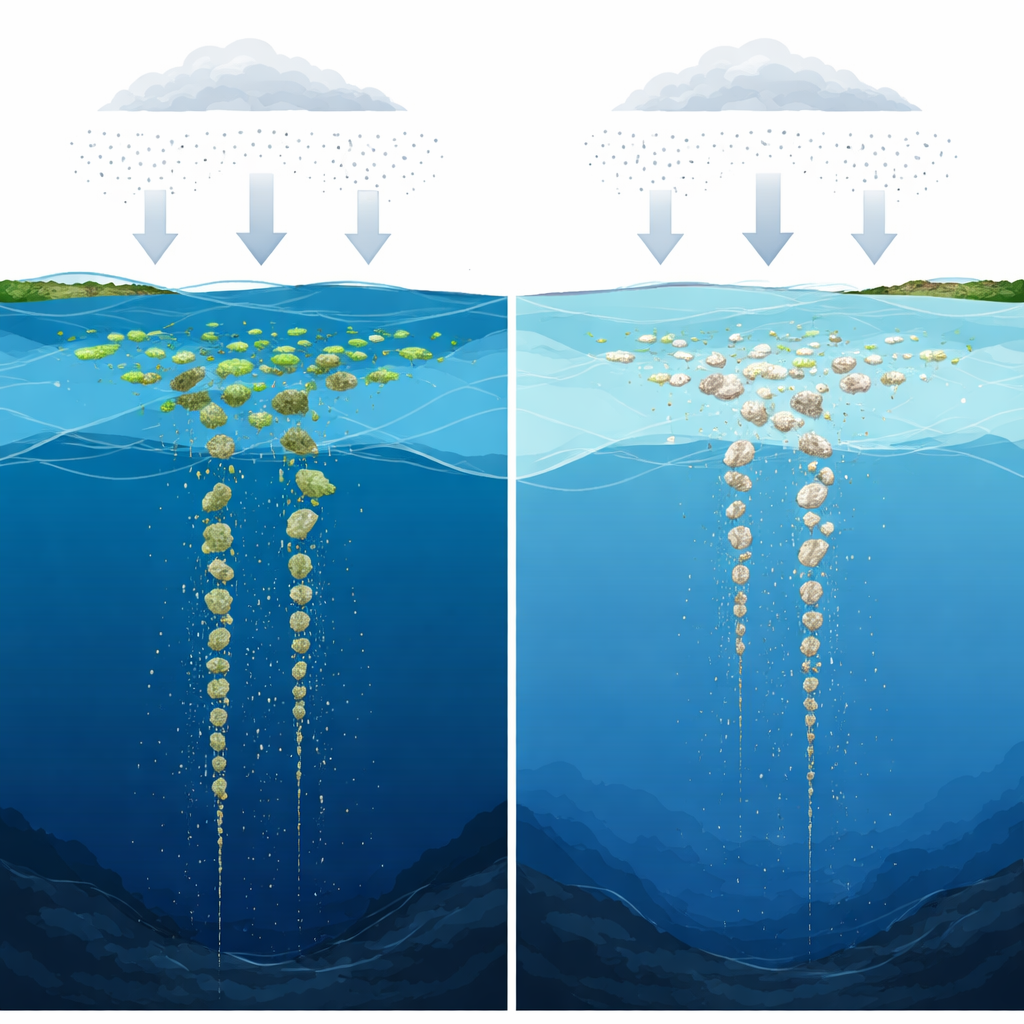
Two Very Different Ocean Neighborhoods
The researchers focused on two long‑term monitoring sites. Station K2 lies in the chilly, subarctic North Pacific, where nutrients are plentiful but light and iron limit growth for much of the year, leading to strong summer blooms dominated by silica‑shelled diatoms. Station S1 sits in the warm subtropical gyre, where surface waters are chronically starved of nutrients and tiny phytoplankton, including calcium‑carbonate‑forming coccolithophores, dominate. These contrasting “silica ocean” and “carbonate ocean” settings naturally produce different types of sinking particles, setting up an ideal comparison of how ecosystem structure shapes deep‑ocean carbon storage.
Reading Productivity from Nitrogen Fingerprints
Directly measuring how much carbon the surface ocean produces every month is difficult. Instead, the team used a clever chemical shortcut: the ratio of heavy to light nitrogen (δ15N) in the sinking particles themselves. Earlier work had shown that when productivity is high, the particles carry a lower δ15N signature, and when productivity is low, δ15N is higher. By collecting sinking material with sediment traps at 500 meters depth over four years and calibrating the δ15N signal against ship‑based productivity measurements, the authors reconstructed seasonal cycles of both net primary production and the fraction of that production that is still present as particulate organic carbon at 500 meters.
How Efficiently Carbon Reaches the Twilight Zone
Using these reconstructions, the study quantified a key metric: sequestration efficiency at 500 meters, defined as the share of surface production that survives as sinking organic carbon to that depth. On average, the subarctic K2 site sent a larger fraction of its surface production downward than the subtropical S1 site. At K2, this efficiency stayed remarkably stable through the year, hovering around eight percent despite strong seasonal swings in blooms. In contrast, S1’s efficiency almost doubled between its low and high seasons, ranging from about three to seven percent, with the most effective export during winter–spring blooms when deeper mixing brings up nutrients and larger, more heavily mineralized particles are formed.
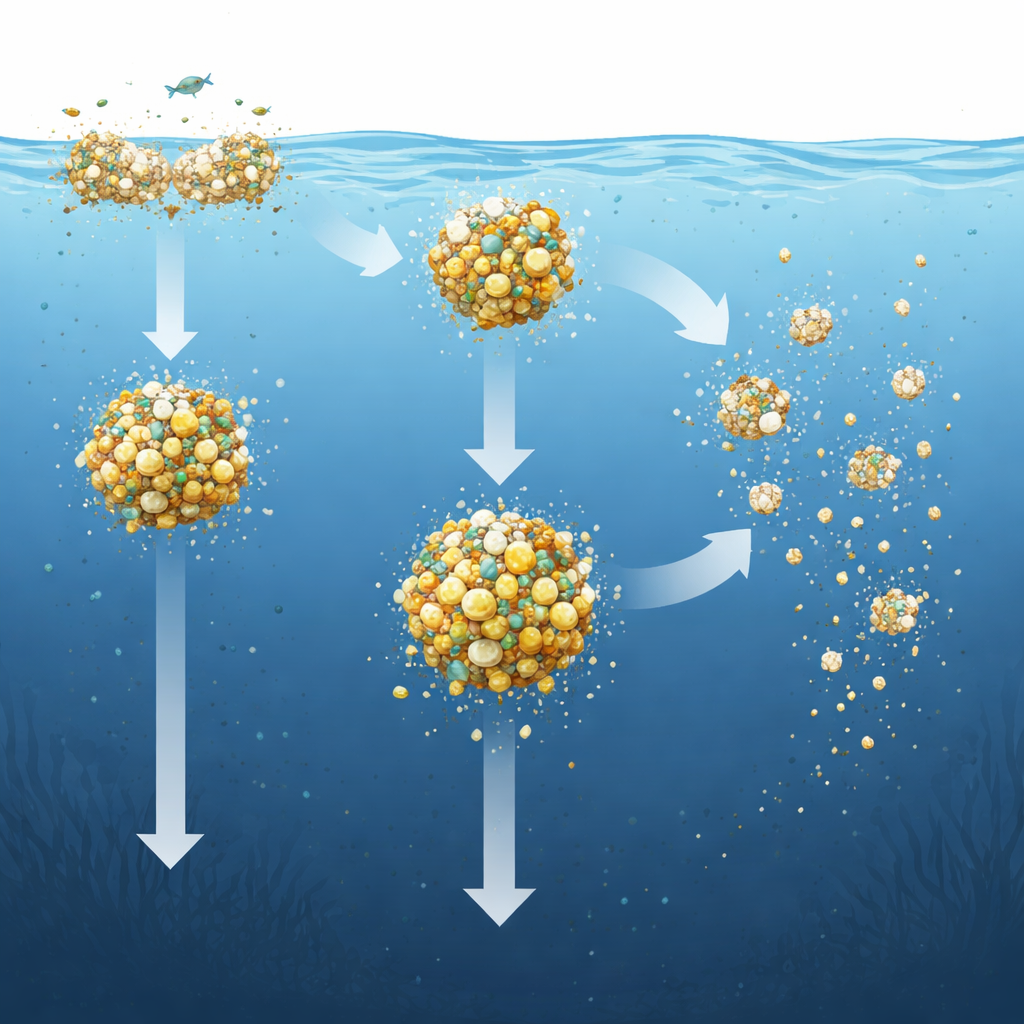
Minerals, Stickiness, and the Fate of Sinking Particles
The key to these differences lies not only in how much organic matter is produced, but in what else is packaged with it. At K2, sinking particles contain a high and relatively steady share of minerals overall, with a see‑saw pattern between silica (opal) and calcium carbonate. At S1, calcium carbonate dominates and varies strongly with the seasons. The authors argue that these minerals change both how fast aggregates sink and how strongly their components stick together. Where particles are rich in sticky, polymer‑rich material associated with diatoms, they are more resistant to being broken apart as they fall. Where calcium carbonate content is high, particles tend to sink faster. The study’s nitrogen data suggest that most of the loss of sinking carbon is due to physical breakup into smaller bits, rather than microbes slowly “eating away” the particles, so changes in sinking speed and aggregate strength directly affect how much carbon reaches depth.
What This Means for Climate and Ocean Change
For a non‑specialist, the main message is that the ocean’s ability to store carbon at depth depends on more than just how much algae grow at the surface. The type of plankton that bloom, the minerals they build into their shells, and how sticky their waste and detritus become all help decide whether carbon‑rich particles arrive at the deep ocean intact or are shredded and recycled higher up. In the subarctic site, opposing seasonal effects on particle speed and stickiness balance each other, keeping sequestration efficiency steady. In the subtropical site, both speed and stickiness rise together during winter blooms, making that season especially important for locking carbon away. As climate change alters nutrient supply, plankton communities, and mineral composition of sinking particles, these subtle physical traits of marine “snow” will play a central role in how much of our emissions the ocean can continue to hide in its twilight depths.
Citation: Mino, Y., Sukigara, C., Matsumoto, K. et al. Seasonal variation in particulate organic carbon sequestration in subarctic and subtropical gyres of the western North Pacific. Sci Rep 16, 14557 (2026). https://doi.org/10.1038/s41598-026-43514-8
Keywords: biological carbon pump, sinking particles, North Pacific gyre, ocean carbon sequestration, phytoplankton communities