Clear Sky Science · en
Diagenesis as the main control of clayrock brittleness
Why underground clay matters for future energy
As societies search for cleaner energy and safer waste disposal, more attention is turning to the deep underground as a place to store carbon dioxide, hydrogen, compressed air, and long‑lived nuclear waste. These projects rely on thick layers of clay‑rich rock acting as tight, natural lids that keep fluids and gases from leaking upward. But if these rocks crack too easily, their seal can fail. This study asks a simple yet crucial question: what really makes these clayrocks tough and crack‑prone, or soft and leak‑resistant?
From soft mud to hard stone
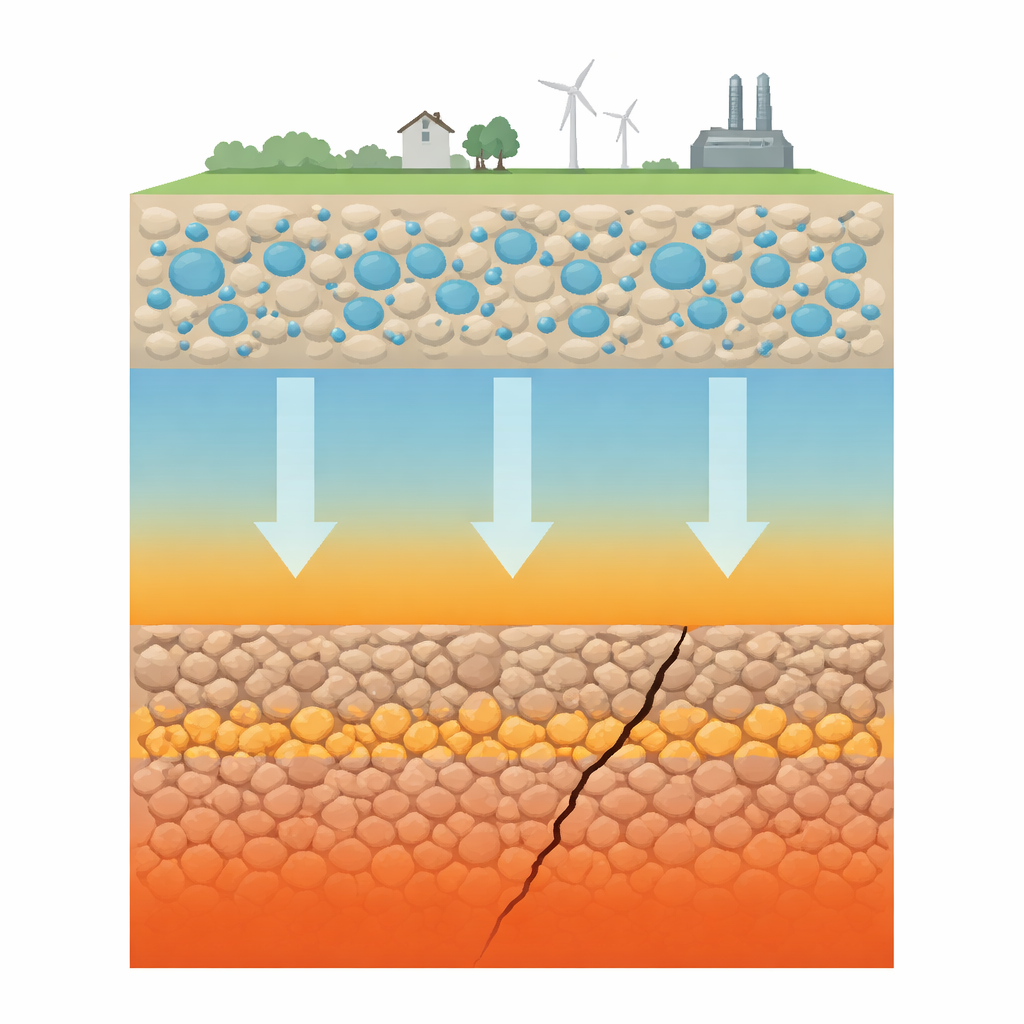
Clayrocks begin life as mud on the seafloor or in ancient lakes. Over millions of years, new sediments pile on top, squeezing and heating the mud as it is slowly buried deeper. The authors compiled measurements from 25 sites worldwide, drawing on oil and gas wells, underground research labs, and laboratory tests. For each site they gathered rock strength, mineral makeup, pore space, and burial history. They focused on a standard measure called unconfined compressive strength, which tells how much squeezing a rock can resist before it breaks. By comparing this strength to how deep the rocks were once buried, they uncovered a surprisingly consistent pattern that previous studies had missed.
Why simple rules based on ingredients fall short
Engineers often estimate brittleness using shortcuts: if a rock has more stiff minerals such as quartz and carbonates, or if it has been lifted closer to the surface and the surrounding pressure has dropped, it is assumed to be more likely to crack. However, when the authors plotted strength against mineral mix and against a standard exhumation measure, they saw no clear trend. Clayrocks with very similar proportions of clay, quartz, and carbonates could differ in strength by factors of ten. Likewise, rocks that had been exhumed to different degrees but shared similar maximum burial depths often showed similar strengths. These results suggest that neither mineral recipe alone nor present‑day pressure conditions are enough to explain how prone a clayrock is to brittle failure.
Deep burial and hidden chemical changes
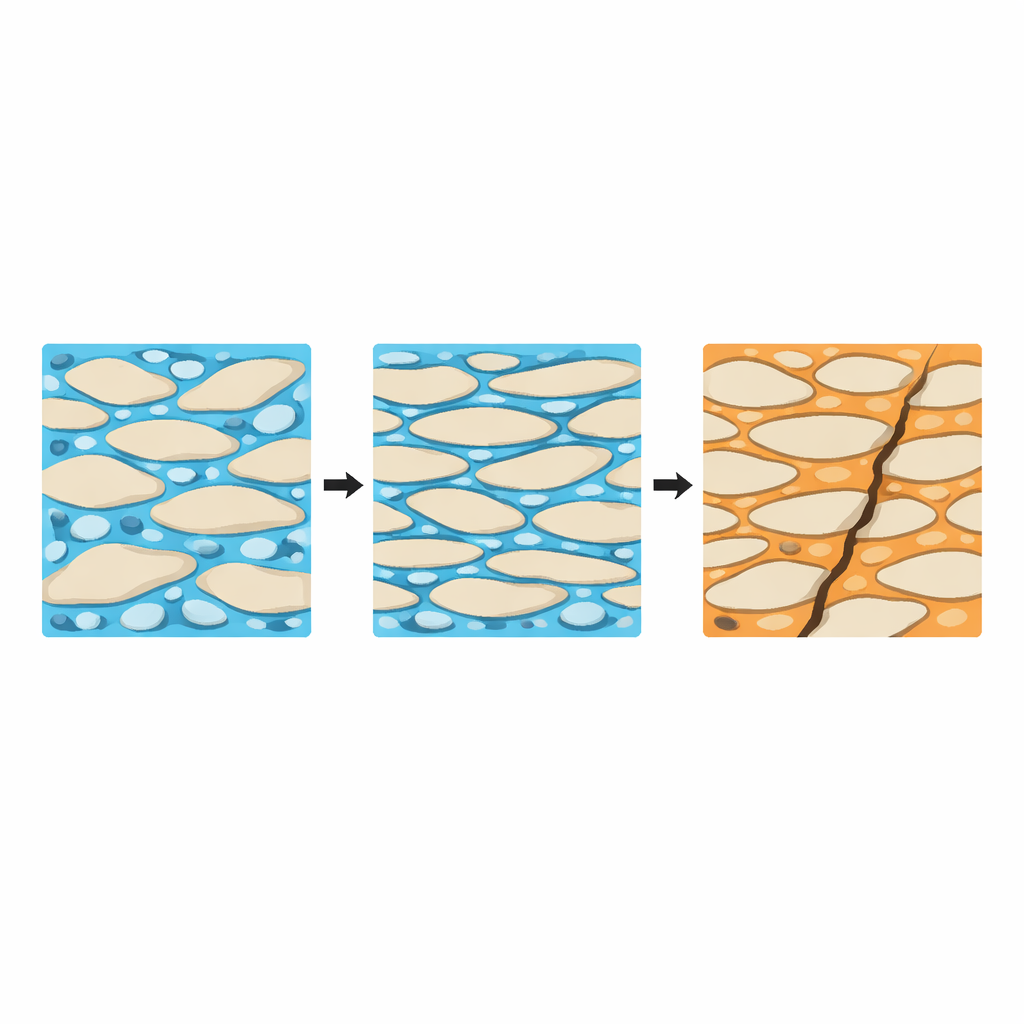
The key turned out to be how deep the rocks had once been buried, and what that long burial had done to their internal fabric. Up to roughly three kilometers of maximum burial, the rocks mainly compact mechanically: grains are rearranged and packed more tightly, and their porosity drops from about thirty percent to less than ten percent. In this zone, strength rises steadily but remains modest, and the rocks tend to deform in a ductile, clay‑like manner as long as the surrounding pressure stays high. Beyond about three kilometers, temperatures become hot enough to trigger chemical reactions. Certain clay minerals transform into a more compact form called illite while new quartz grows to cement grains together. The data show that once this chemical stage begins, rock strength can jump from a few tens of megapascals to well over a hundred, and behavior shifts toward brittle cracking if the rock is not sufficiently confined.
When strong rocks become risky seals
The study highlights an important paradox for storage safety. The same chemical changes that make clayrocks strong also make them easier to fracture when stress conditions change. Normally buried clayrocks that have experienced only mechanical squeezing, and never progressed into the deeper chemical stage, are likely to stay ductile at their greatest burial depth. They remain good seals as long as pressures do not drop too far. But if such rocks are lifted upward, or if fluid pressures inside them rise and effectively reduce the weight they feel, they can cross into conditions where brittle fractures open. For chemically cemented clayrocks that are already very strong, this risk is even greater: once the effective stress falls below their high strength, they may crack suddenly and create new leakage pathways.
Guiding safer choices for underground storage
By tying clayrock brittleness mainly to its burial‑driven makeover rather than to simple mineral counts, the authors propose a practical tool for screening storage sites. Using information already collected from exploration wells—such as maximum burial depth, temperature history, and basic mineral data—geoscientists can infer whether a candidate clay layer is likely to be mechanically compacted and ductile, or chemically cemented and brittle. The work suggests that the safest seals are those that never passed the threshold where chemical changes dominate, and that any project must pair rock strength estimates with careful stress modeling to avoid pushing even ductile clayrocks into brittle behavior. In short, understanding the hidden history of mud turned to stone can help keep tomorrow’s underground storage both effective and secure.
Citation: Damon, A., Soliva, R., Wibberley, C. et al. Diagenesis as the main control of clayrock brittleness. Sci Rep 16, 14053 (2026). https://doi.org/10.1038/s41598-026-43512-w
Keywords: clayrock brittleness, geological storage, burial diagenesis, caprock integrity, subsurface sealing