Clear Sky Science · en
Modeling and analysis of stochastic quantum magnetohydrodynamics equations with energy estimates
Why random quantum plasmas matter
Many of the universe’s most extreme environments—from the hearts of neutron stars to next-generation fusion devices—are filled with hot, electrically conducting gases threaded by magnetic fields. At very high densities and low temperatures, these plasmas begin to behave in a distinctly quantum way: particles act like waves, and subtle quantum pressure competes with magnetic and thermal forces. At the same time, these systems are constantly buffeted by random disturbances. This paper develops a rigorous mathematical and numerical framework to understand how such "noisy" quantum plasmas evolve and how their overall energy stays under control.
From classical flow to quantum and random effects
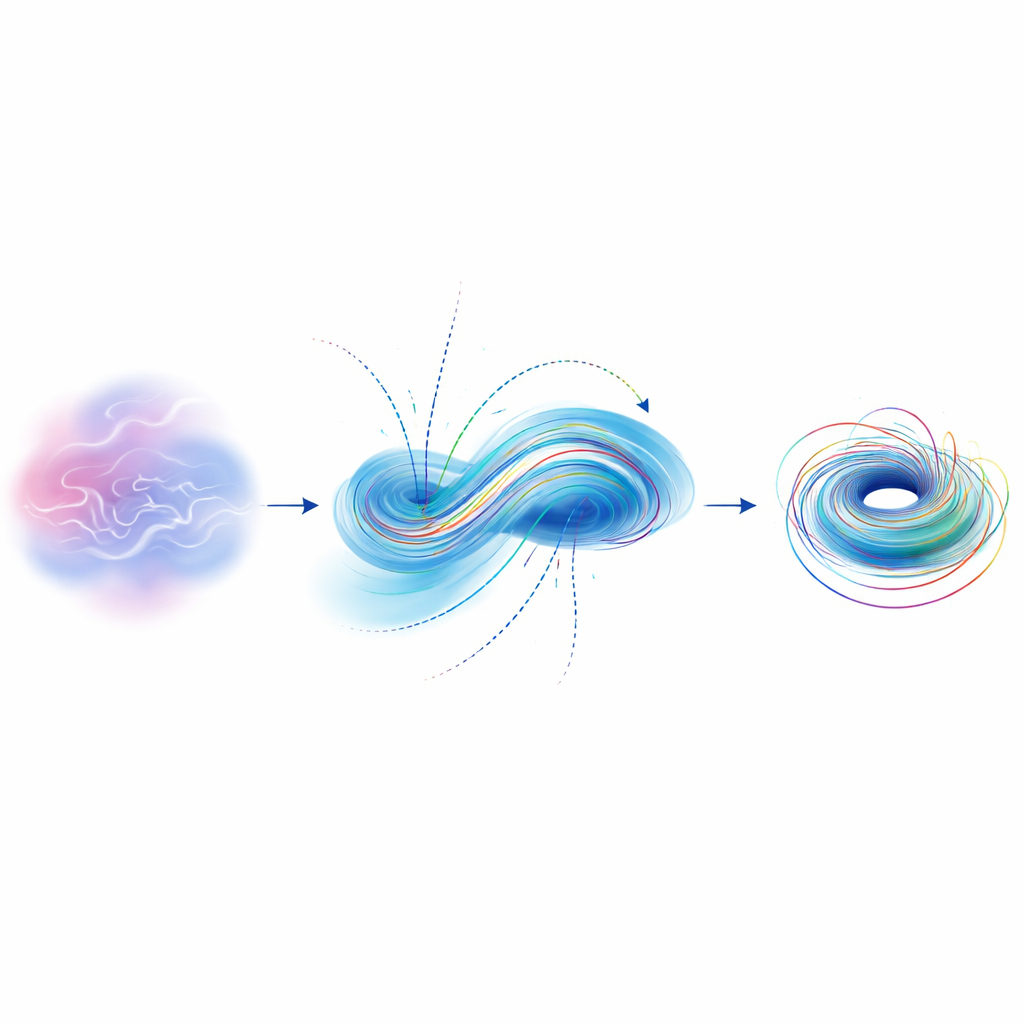
Classical magnetohydrodynamics views plasma as a smooth fluid coupled to magnetic fields, a theory that underpins models of solar flares, power-generating MHD channels, and space weather. The authors extend this picture to quantum magnetohydrodynamics, where an extra term called the Bohm potential captures the wave-like nature of particles. This term acts like a quantum pressure that resists sharp changes in density and becomes crucial in dense astrophysical plasmas and ultra-cold laboratory systems. On top of this, the model includes stochastic external forces—idealized as Brownian motions—that mimic random electromagnetic kicks and turbulent fluctuations from the surrounding environment.
Building a trustworthy mathematical model
To treat such a complex system, the authors focus on whether the equations admit physically meaningful solutions that respect conservation of mass, respond to magnetic forces, and remain stable under random forcing. They adopt a notion called a martingale solution, which fits naturally with probabilistic influences. Starting from the full three-dimensional quantum magnetohydrodynamic equations, they construct a hierarchy of approximate problems using the Faedo–Galerkin method. In essence, the infinite-dimensional plasma is projected onto a finite but increasingly rich set of modes, turning the equations into a large system of stochastic ordinary differential equations that can be analyzed more directly.
Tracking energy to keep solutions under control
A central achievement of the work is the derivation of detailed energy estimates. These estimates express how kinetic energy, magnetic energy, and quantum pressure evolve in time and how viscous and magnetic dissipation counteract the continual injection of randomness. By carefully bounding these quantities, the authors show that the approximate solutions do not blow up and remain uniformly controlled. They then use compactness arguments, along with the Jakubowski–Skorokhod representation theorem, to pass to the limit as the number of modes grows and as certain regularizing parameters are removed. This step-by-step limiting process proves the existence of a genuine martingale solution to the original stochastic quantum equations over a finite time interval.
From theory to computer experiments
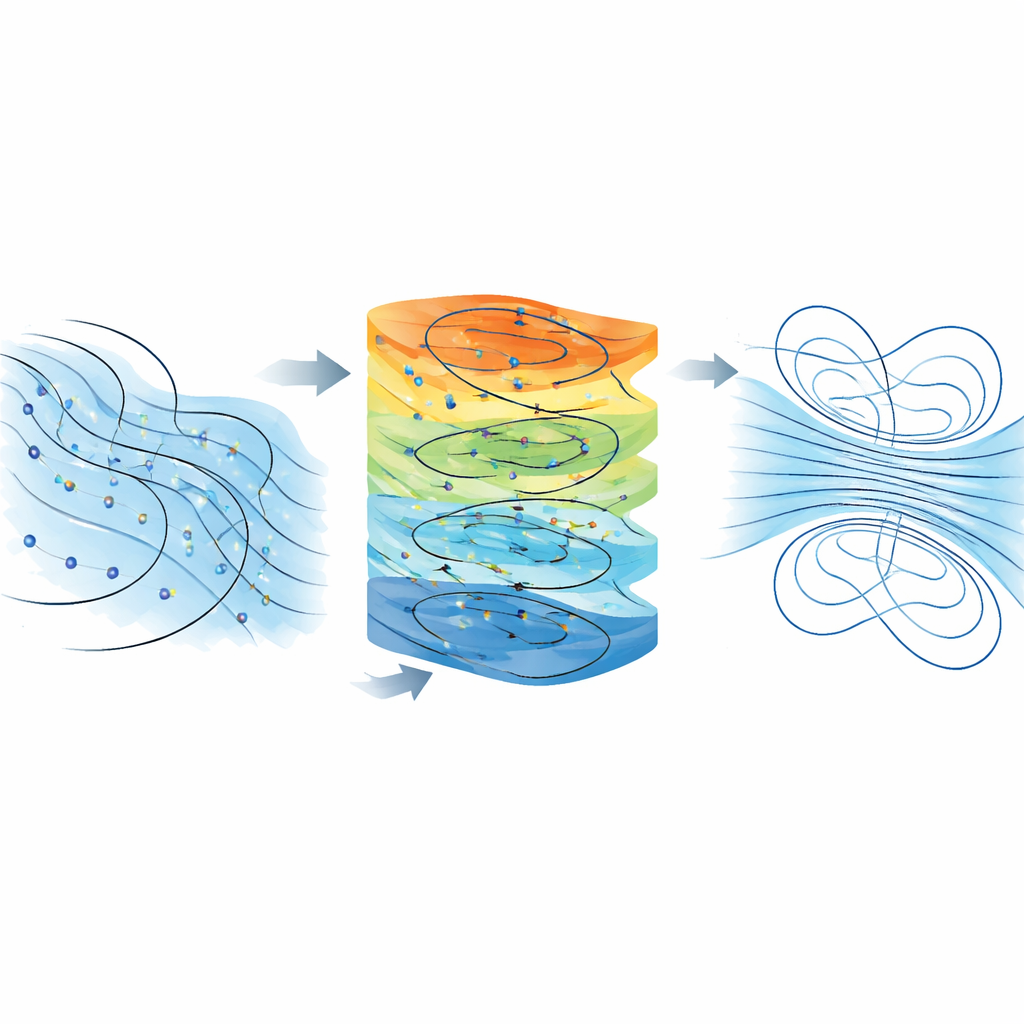
Beyond the abstract analysis, the paper describes a numerical scheme that mirrors the theoretical construction. Space is discretized with second-order finite differences, while time evolution with random forcing is handled through an Euler–Maruyama method, a standard tool in stochastic simulation. Special care is taken to approximate the Bohm potential, which involves second derivatives of the square root of the density and is notoriously sensitive to numerical errors. Simulations on a three-dimensional grid illustrate how quantum pressure and magnetic fields shape the density, velocity, and magnetic structures, and how random perturbations spread and are smoothed by the dynamics. The resulting plots show peaked density regions, orderly velocity arrows, and confined magnetic patterns consistent with the energy-based expectations.
What this means for understanding quantum plasmas
In plain terms, the authors show that a plasma model combining quantum effects, magnetic fields, and randomness is mathematically sound and can be simulated in a way that respects its energy budget. The analysis guarantees that, despite continual random shaking, the modeled system remains well behaved rather than collapsing into unphysical infinities. This provides a solid foundation for using such equations to explore realistic quantum plasmas in space and in the lab, and it opens the door to future extensions that incorporate more sophisticated physics, advanced numerical methods, and even machine learning tools for predicting and controlling high-energy quantum flows.
Citation: Divyabala, K., Durga, N. Modeling and analysis of stochastic quantum magnetohydrodynamics equations with energy estimates. Sci Rep 16, 10641 (2026). https://doi.org/10.1038/s41598-026-43494-9
Keywords: quantum magnetohydrodynamics, stochastic plasma dynamics, Bohm potential, energy estimates, numerical simulation