Clear Sky Science · en
Research on the plugging mechanism in fractured formations and the drilling fluid system for while-drilling leak prevention
Why drilling leaks matter to everyone
When engineers drill deep into the Earth for oil and gas, the fluid that cools and stabilizes the well can suddenly disappear into hidden cracks in the rock. This "lost" fluid wastes money, slows down projects, and can even trigger dangerous problems like well collapse or blowouts. The study summarized here looks at why these leaks happen in cracked rock and how a smarter recipe for drilling fluid can seal those cracks faster, hold higher pressures, and cut waste.
Cracked rocks and leaking wells
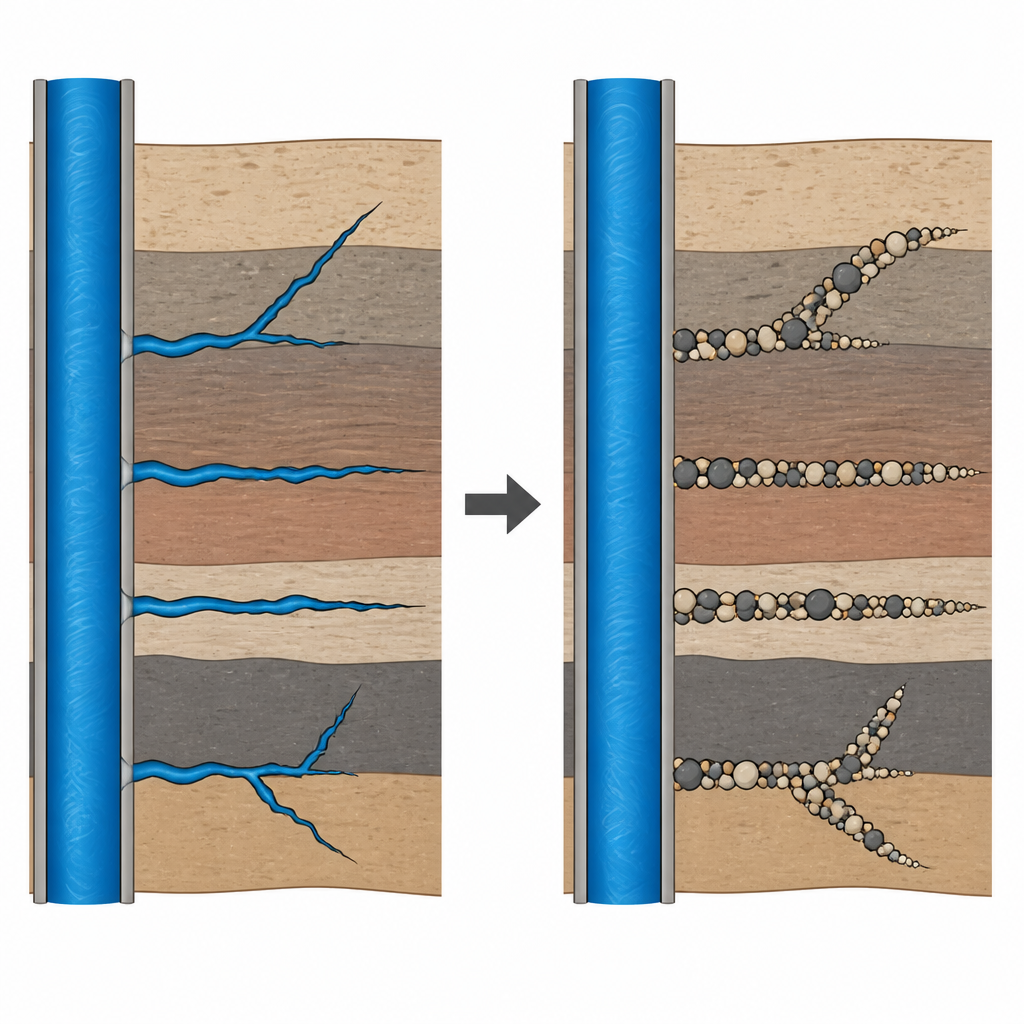
In the field studied, most leaks occur in a depth range of about 1200 to 1800 meters, where the rocks are crisscrossed with natural fractures. These cracks are typically a few hundred micrometers wide, about the thickness of several human hairs. When high-pressure drilling fluid flows through the well, it can pour into these openings instead of staying in the wellbore where it is needed. Because the cracks can widen as fluid invades and the rock is already weakened, even temporary seals are prone to fail, forcing crews to repeat repair operations and stretching the total drilling time.
How solid particles build a plug
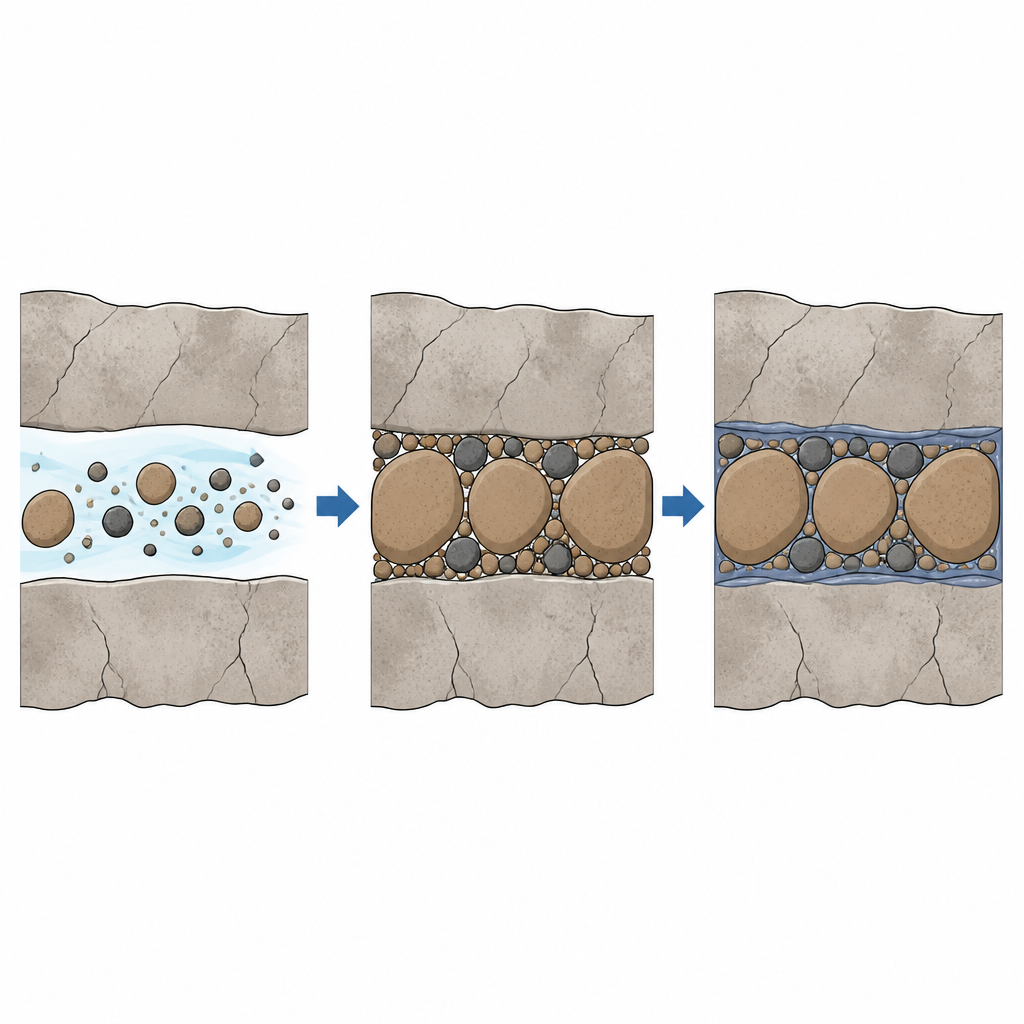
To stop leaks, drillers mix solid particles into the fluid so they can bridge across fractures and form a barrier. The researchers show that two things matter most for a strong seal: how the particle sizes match the crack width, and how strongly the particles stick to each other and to the rock. Large grains, similar in size to the fracture opening, act as the first bridge. Smaller grains then flow in and pack the spaces between them, lowering the permeability of the barrier. If the blend includes a continuous range of sizes, from coarse chunks down to fine powder, the resulting layer becomes denser and more resistant to flow, cutting both the time needed to plug and the amount of fluid lost.
From loose grains to a solid barrier
At first, particles swept along by the fluid move quickly through the fracture and only collide briefly, forming a fragile and leaky structure. As more material gathers, the motion slows and the grains begin to lock together, but the network can still be broken by pressure changes in the well. The final, stable stage is reached when the particles form a tightly packed framework and forces between grains and the rock walls are strong enough to resist shear and squeezing. The study explains that simple friction and mechanical interlocking are often not enough, especially when downhole pressures change; adding materials that create chemical bonds between grains and rock can greatly strengthen the plug and shorten the time to reach this stable state.
Designing a smarter drilling fluid
Guided by measurements of crack widths in the target rocks, the authors calculated how much of each particle size is needed to plug fractures between 200 and 600 micrometers wide. They then chose practical materials that span this range, including walnut shell powder, sawdust, and a mineral called wollastonite. To boost bonding, they added a temperature-sensitive polymer that flows easily at surface conditions but thickens and forms a network once it reaches the warmer downhole zone. This combination lets large particles form the skeleton of the plug, fine particles fill the gaps, and the polymer glue everything together into a tough, low-leakage layer.
What the tests showed
Laboratory experiments compared this tailored fluid with the system already used in the field. In simulated fractures of several widths, the optimized blend sealed cracks from 200 to 600 micrometers more quickly and held higher pressures. In many cases it achieved "instant" plugging, completing the seal in less than two seconds, while reducing leaked fluid volumes by more than 60 percent. The pressure the plugs could withstand rose by about 75 percent compared with the original fluid, yet the overall flow behavior of the fluid at the surface remained suitable for normal drilling operations.
Why this matters for future wells
For non-specialists, the key takeaway is that leak control in cracked rock is not just about throwing more material into the well. It is about matching particle sizes to the cracks and giving those particles a way to lock and bond into a firm barrier. This study offers a clear recipe and general rules that can help drilling teams in many regions design fluids that seal faster, leak less, and better protect both equipment and reservoirs.
Citation: Zhang, J., Tian, S., Wang, X. et al. Research on the plugging mechanism in fractured formations and the drilling fluid system for while-drilling leak prevention. Sci Rep 16, 14845 (2026). https://doi.org/10.1038/s41598-026-43487-8
Keywords: lost circulation, drilling fluid, fractured formations, plugging particles, wellbore sealing