Clear Sky Science · en
Dyad practice facilitates motor learning in music
Why Practicing in Pairs Matters
Learning an instrument is often imagined as a lonely pursuit: hours spent in a practice room, repeating the same passage over and over. This study asks a simple but powerful question: could practicing with a partner—taking turns playing and watching—actually help people learn musical movements more efficiently than practicing alone? By testing how pairs of musicians learn to play a marimba, the researchers show that shared practice time can sharpen motor skills, improve accuracy, and help players adapt to new musical patterns.
From Solo Practice Rooms to Shared Learning
Most music students train alone, even though real performances usually happen with others, in ensembles, bands, or orchestras. At the same time, decades of research on movement learning suggest that people improve more when practice looks like the situations in which they will eventually perform. Another line of research shows that simply watching someone else move can activate the same brain areas used to perform the movement yourself. Putting these ideas together, the authors wondered whether alternating between playing and observing a partner—"dyad practice"—might be a particularly powerful way to learn an instrument.
How the Study Was Set Up
The team recruited 73 university music students who were experienced musicians but new to the marimba, a large keyboard percussion instrument. Everyone learned the same short 18-note pattern that required precise hits on specific spots of the bars. High-speed motion capture tracked exactly where each mallet landed, allowing the researchers to measure how far each strike was from the instrument’s ideal "sweet spot." Participants were split into three groups: one practiced alone; one practiced in pairs with each person doing a full amount of playing plus watching their partner; and one paired group did half as many physical trials but matched the solo group in total exposure by watching a partner as well.
What Happened When People Practiced Together
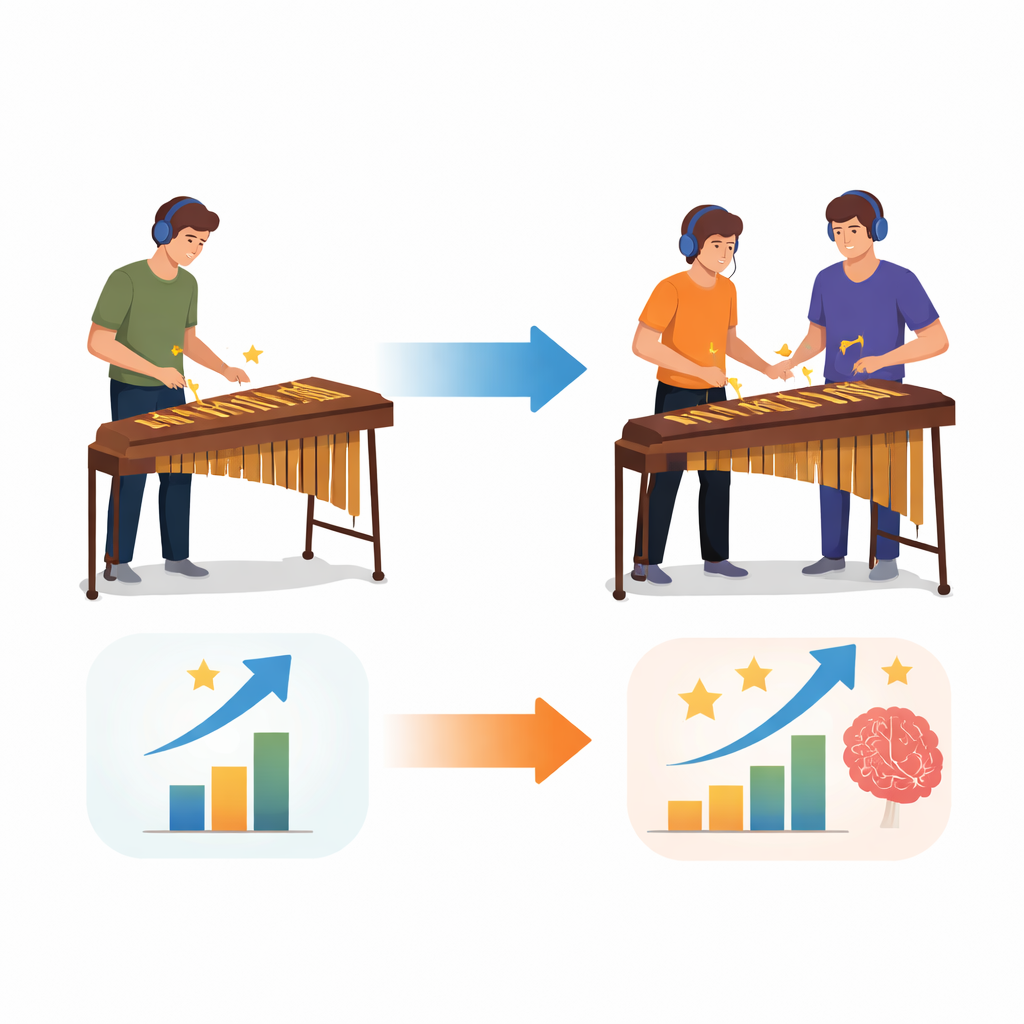
At the start, all groups performed at similar levels. During the main practice phase, however, improvements emerged only in the paired groups, and only for the right hand, which held the dominant mallet for these right-handed players. The solo group showed no clear gains in accuracy over the same period. When participants returned the next day, those in the full dyad group—who had both played and observed extensively—retained their accuracy better than either the half-dyad or solo groups. In other words, their training "stuck" more strongly over time, suggesting deeper motor learning rather than just short-lived performance gains.
Adapting to New Musical Patterns
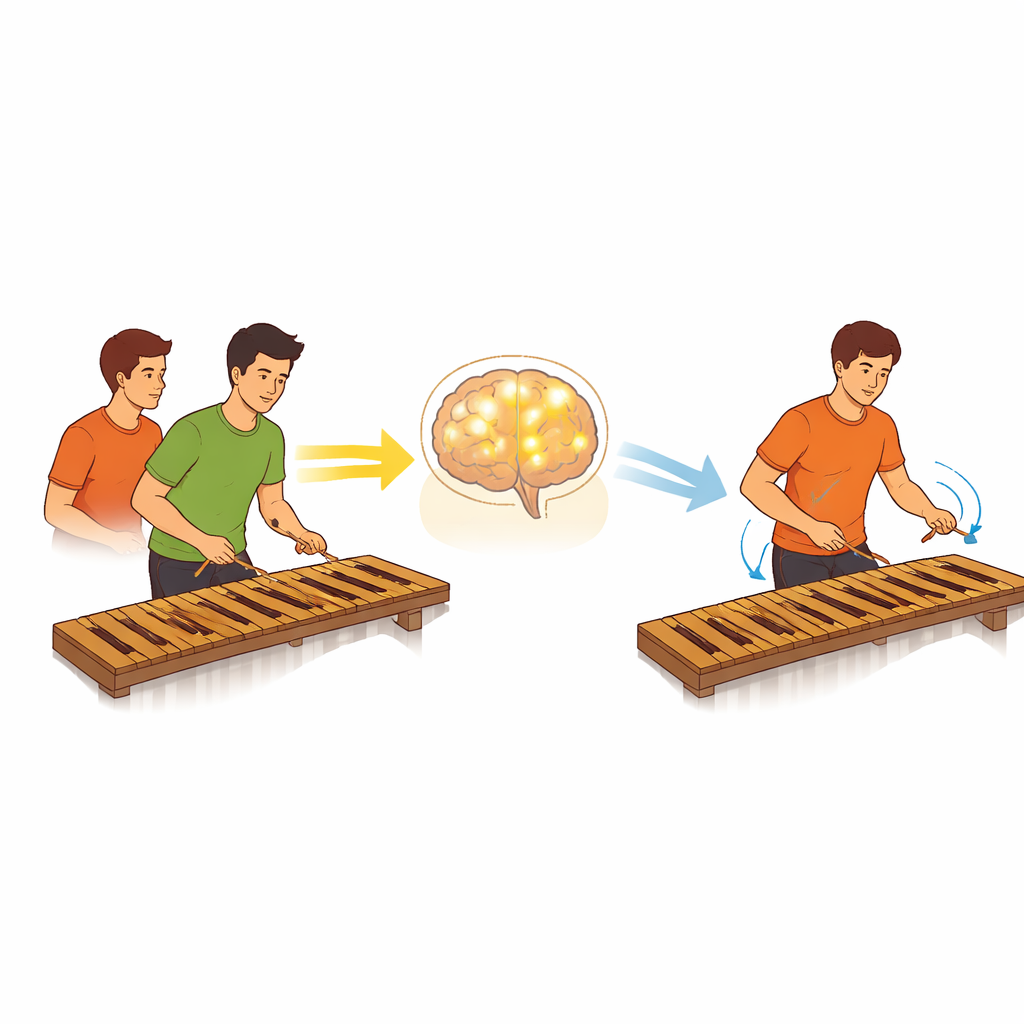
To test how well learning carried over, the musicians were also asked to play a new pattern built from the same notes but in a different order. This kind of transfer test is a key sign of robust learning: it shows whether underlying skills can be applied flexibly, not just memorized by rote. Here, both paired-practice groups outperformed the solo group with their right hand, striking the marimba more accurately on this unfamiliar sequence. The benefit did not extend as clearly to the left hand, underscoring that the advantage was strongest for the dominant limb that already had better control. Interestingly, when asked about enjoyment, confidence, and stress, participants across all groups reported similar experiences, suggesting that the main differences lay in how effectively they learned, not how they felt.
What This Means for Music Students and Teachers
These findings suggest that alternating between playing and observing a peer—a simple shift in lesson design—can lead to more precise, more adaptable motor skills than practicing alone for the same length of time. Sharing an instrument and rotating roles naturally spaces out physical effort, giving the brain time to consolidate what it just saw and did, while still keeping overall exposure high. For music programs facing limited instruments, practice rooms, or teacher time, dyad practice offers a way to stretch resources without sacrificing quality. More broadly, the study supports the idea that watching a peer at a similar level is not a passive activity but an active form of learning that can reshape how musicians build their technique.
Citation: Loria, T., Tian, G., Karlinsky, A. et al. Dyad practice facilitates motor learning in music. Sci Rep 16, 13603 (2026). https://doi.org/10.1038/s41598-026-43485-w
Keywords: music practice, motor learning, peer learning, percussion, skill transfer