Clear Sky Science · en
Development of a web platform for predicting fall risk in cardiovascular patients using machine learning
Why keeping heart patients on their feet matters
For millions of middle-aged and older adults living with heart and blood vessel problems, a simple trip at home can trigger a cascade of health crises. A bad fall may lead to fractures, hospital stays, and a serious setback for already fragile hearts. This study asked whether modern computer techniques can help doctors spot which cardiovascular patients are most likely to fall, long before an accident happens, and then act early to keep them safer and more independent.
How heart trouble and falls are linked
Falls are one of the leading causes of accidental injury and death in older people around the world, and they carry heavy emotional and financial costs for families and health systems. At the same time, cardiovascular disease is becoming more common as populations age, and many patients with heart conditions are especially vulnerable. Subtle heart problems can disturb blood pressure, balance, and stamina even before symptoms are obvious. When people with cardiovascular disease fall, they are more likely to suffer complications, need surgery, and face higher risks during recovery. That is why predicting fall risk in this group is a pressing issue for public health.
Turning big health surveys into a risk tool
The researchers drew on a large national study of Chinese adults aged 45 and older that tracks health, lifestyle, and social factors over time. From this rich dataset they identified 1,784 people who had cardiovascular disease and followed them for two years to see who reported a fall. They examined 40 potential predictors, ranging from age, education, sleep quality, and mood to medical conditions like kidney disease and rheumatism, as well as pain, previous falls, and measures of strength and thinking ability. Careful data cleaning, handling of missing values, and balancing of fallers and non-fallers helped prepare the information for advanced analysis. 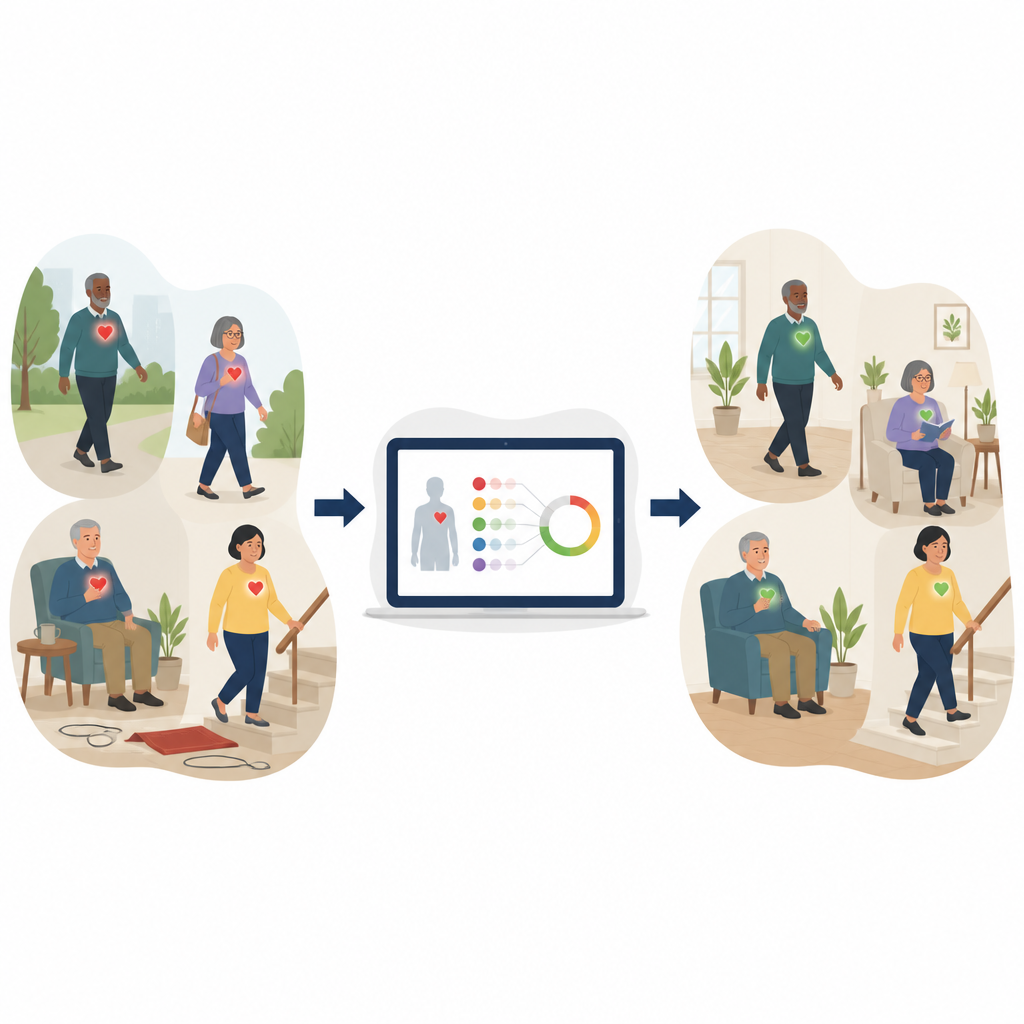
What the smart models learned
Instead of relying only on traditional statistical formulas, the team tested six different machine learning methods, which can uncover complex patterns in data. A technique called LASSO helped whittle the many variables down to the nine most informative ones. These were age, education level, sleep quality, kidney disease, rheumatism, pain, life satisfaction, depression, and history of falls. Among the six models, a method known as Light Gradient Boosting Machine delivered the most accurate predictions, correctly separating higher and lower risk patients in both the original group and in an earlier wave of the survey used as an outside check. To open the “black box” of machine learning, the team used an explanation tool that shows how much each factor pushes a person’s risk up or down.
Risk factors you can feel and change
The explanation results highlighted that older age and a past fall were the strongest warning signs, while kidney disease, rheumatic problems, pain, and depression also raised the chance of falling. On the other hand, more years of schooling, better sleep, and feeling more satisfied with life tended to protect against falls. Notably, people with only somewhat good sleep quality could be at especially high risk, perhaps because they remain active while still affected by subtle balance or attention problems. Many of these drivers are easy to ask about in a clinic visit or even in a community screening, making the model practical for busy health workers. 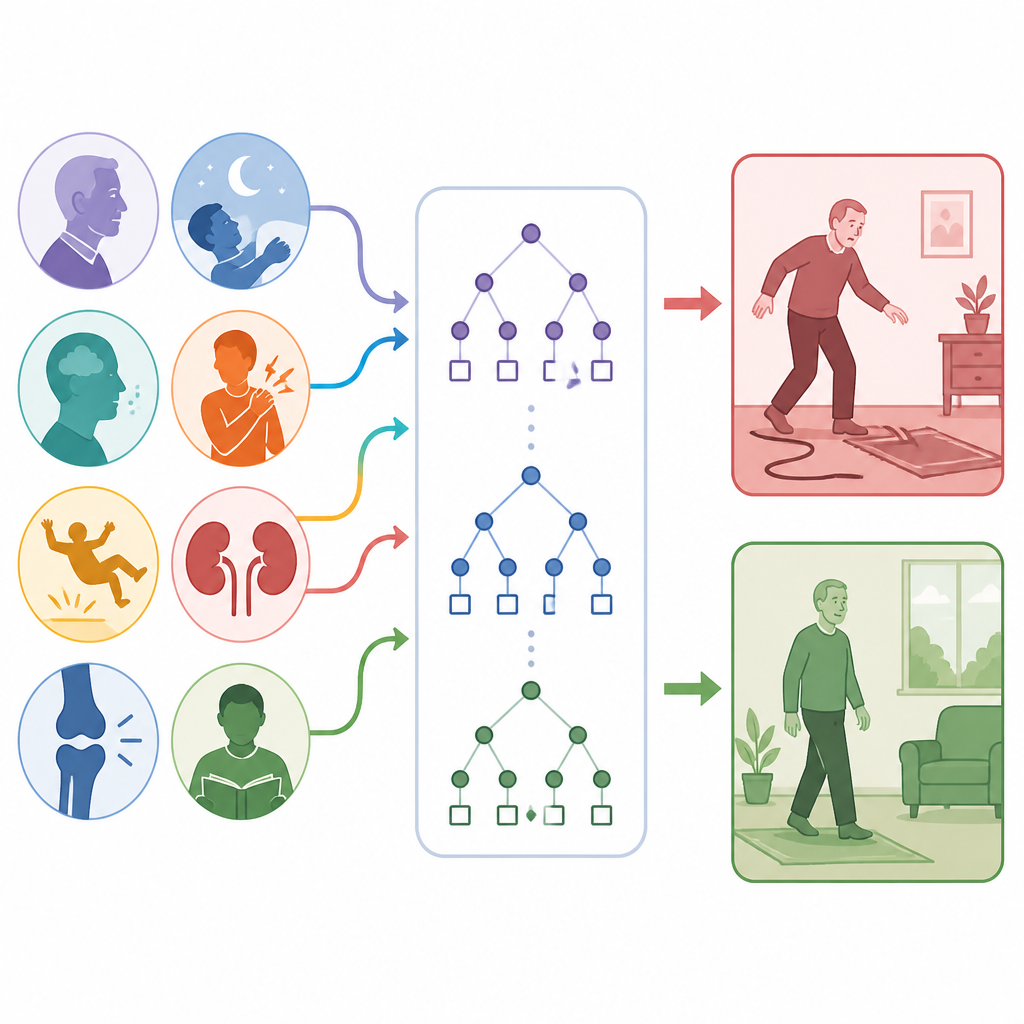
From prediction to a simple web tool
To move beyond theory, the authors turned their best-performing model into an easy-to-use web platform. A clinician or health worker can enter a patient’s age, education, sleep quality, mood, pain, kidney and rheumatic disease status, life satisfaction, and history of falls, and receive an estimated chance of falling in the next two years. While the tool does not replace medical judgment, it offers a structured way to flag cardiovascular patients who might benefit most from strength training, home safety checks, mood treatment, or closer follow-up.
What this means for everyday life
This study shows that smart use of existing survey data and machine learning can help identify cardiovascular patients who are most likely to suffer a fall. By focusing on a small set of understandable factors, the model remains usable in real-world clinics while still capturing complex patterns in the data. If applied thoughtfully, such tools could support more personalized prevention plans, reduce dangerous falls, and help people with heart disease stay on their feet and maintain a better quality of life as they age.
Citation: Dong, J., Yang, X., Zhang, Z. et al. Development of a web platform for predicting fall risk in cardiovascular patients using machine learning. Sci Rep 16, 15665 (2026). https://doi.org/10.1038/s41598-026-43482-z
Keywords: cardiovascular disease, fall risk, machine learning, older adults, risk prediction