Clear Sky Science · en
Model test study on centroid frequency evolution of reservoir landslide under water level fluctuations
Why shaking slopes matter to people living near reservoirs
Across the world, large dams and reservoirs help provide electricity, water supply, and flood control. But as water levels in these reservoirs rise and fall, the surrounding slopes can gradually weaken and sometimes fail as devastating landslides. This study explores a subtle “heartbeat” inside those slopes—the way they naturally vibrate—and shows that changes in this hidden signal could give engineers and communities earlier warnings before a slope collapses.
Hidden signals inside reservoir slopes
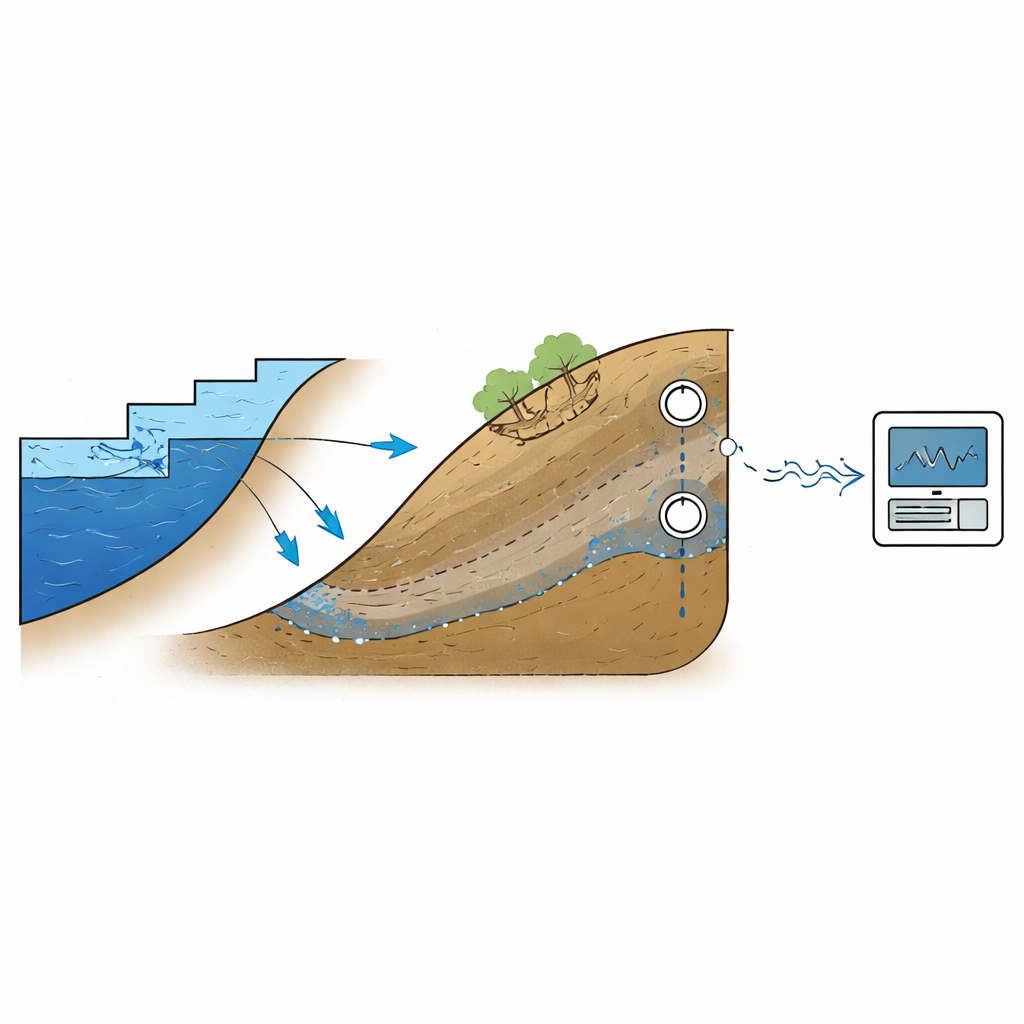
When soil and rock are stressed, they deform and crack in ways that produce tiny vibrations. Modern sensors can record these vibrations and turn them into frequency spectra, similar to how a graphic equalizer shows different pitches in music. One key measure is the centroid frequency, which describes how the vibration energy is distributed between higher and lower pitches. Earlier work used this measure to study earthquakes and the cracking of solid rock, but it had rarely been applied to the slow weakening of large reservoir slopes, which are repeatedly soaked and dried as water levels fluctuate.
How water softens the slope from the inside
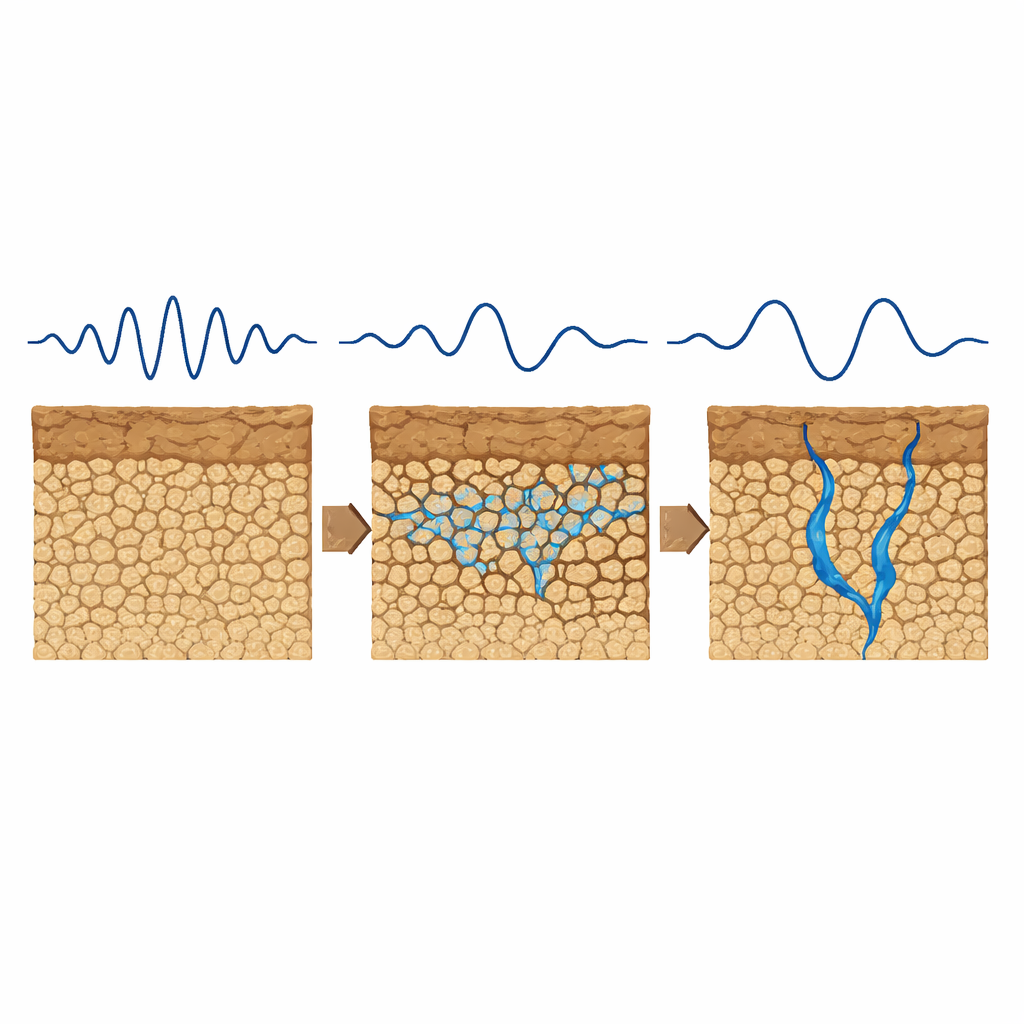
The authors first used wave physics to understand what happens when water seeps into a slope. As soil absorbs water, thin lubrication layers form between its grains, making the material behave less like a stiff solid and more like a soft, viscoelastic gel. In this softer state, high-pitch vibration waves lose energy more quickly than low-pitch waves as they travel through the ground. The theory shows that when the soil’s stiffness drops, high frequencies are filtered out more strongly, so the overall vibration “tone” of the slope shifts downward. This gives a physical reason to expect that the centroid frequency should decrease as the slope becomes weaker.
Miniature landslides built in the lab
To test these ideas, the researchers built a scaled-down slope in the laboratory, one meter high with a realistic sliding surface and weak zone. They repeatedly raised and lowered the water level next to the slope to mimic three full rise-and-fall cycles of a real reservoir, running four experiments with increasingly faster water-level changes. Sensitive accelerometers were buried at different depths and positions along the slope to record background vibrations coming from pumps and the laboratory environment. From these signals, the team tracked how the centroid frequency evolved as cracks formed and, in some tests, as small landslides actually occurred.
What changing tones revealed about slope safety
When water levels changed slowly, the slope developed only a few cracks and never failed; the centroid frequency at all monitoring points stayed almost constant. At higher fluctuation rates, however, the pattern changed dramatically. Before visible failure, especially near the lower part of the slope where water infiltration was strongest, the centroid frequency dipped sharply—sometimes by more than 7 hertz—well before the slope finally slid. Sensors closer to the toe of the slope and on the surface were much more sensitive than deeper ones, because those areas experienced more direct wetting, stronger cracking, and shorter paths for vibration waves to travel without losing information. In one test, an unexpected drop in centroid frequency even exposed a construction flaw in the model itself, hinting that this method can detect hidden weak spots as well as moisture-driven damage.
Promise and caution for early warning
The study’s main message is that a clear drop in centroid frequency, larger than about 7 hertz in this model, signaled a serious loss of stability and often appeared earlier than changes in more traditional measures such as displacement or overall natural frequency. That means this spectral “tone shift” could serve as an extra early-warning tool, buying valuable time for evacuation or reservoir operation changes. Still, the authors stress that their thresholds come from a small laboratory model and that real slopes are more complex, influenced by rainfall, earthquakes, and rock layering. To turn centroid frequency into a reliable real-world alarm, they call for larger-scale experiments and field monitoring that combine this vibration-based indicator with standard measurements in multi-parameter warning systems.
Citation: Wu, Z., Zhang, G., Xie, M. et al. Model test study on centroid frequency evolution of reservoir landslide under water level fluctuations. Sci Rep 16, 12655 (2026). https://doi.org/10.1038/s41598-026-43477-w
Keywords: reservoir landslide, early warning, water level fluctuations, slope stability, vibration monitoring