Clear Sky Science · en
Micro/meso scale investigations on F-slag sand developed with synergistic use of fly ash and slag
Turning Waste into Building Sand
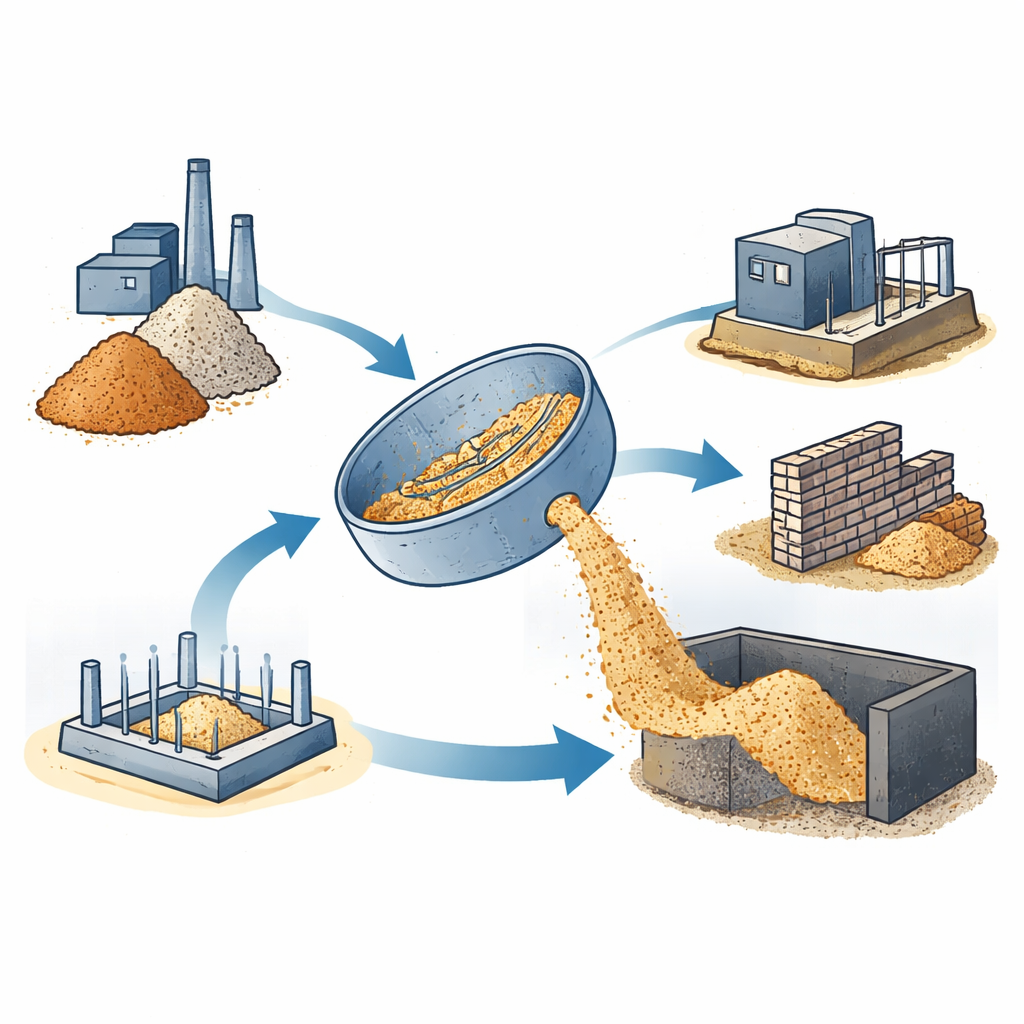
Modern cities are built on sand—literally. We need vast quantities of fine sand to make concrete, mortar, and plaster, but the world’s rivers are being dredged faster than nature can replace them, damaging ecosystems in the process. At the same time, coal power plants and steel factories generate mountains of dusty waste that often end up in landfills. This study brings these two problems together and treats them as one solution: it shows how to turn industrial waste powders into a new kind of man‑made sand, called F‑Slag sand, that could stand in for natural river sand in many construction and mining jobs.
Why We Need a New Kind of Sand
Across the globe, the construction boom has pushed demand for fine aggregates—mainly river sand—to unprecedented levels. River beds are being scooped out for building materials, leading to eroded banks, damaged habitats, and conflicts over access to this seemingly humble resource. At the same time, industries produce huge volumes of fly ash from coal combustion and ground granulated blast furnace slag from steelmaking. These powders carry potential environmental risks if stored indefinitely, yet they are chemically rich materials. The authors of this paper ask a simple question with far‑reaching implications: instead of mining rivers, can we engineer these industrial leftovers into a clean, reliable substitute for natural sand?
How Engineers Make Artificial Sand Grains
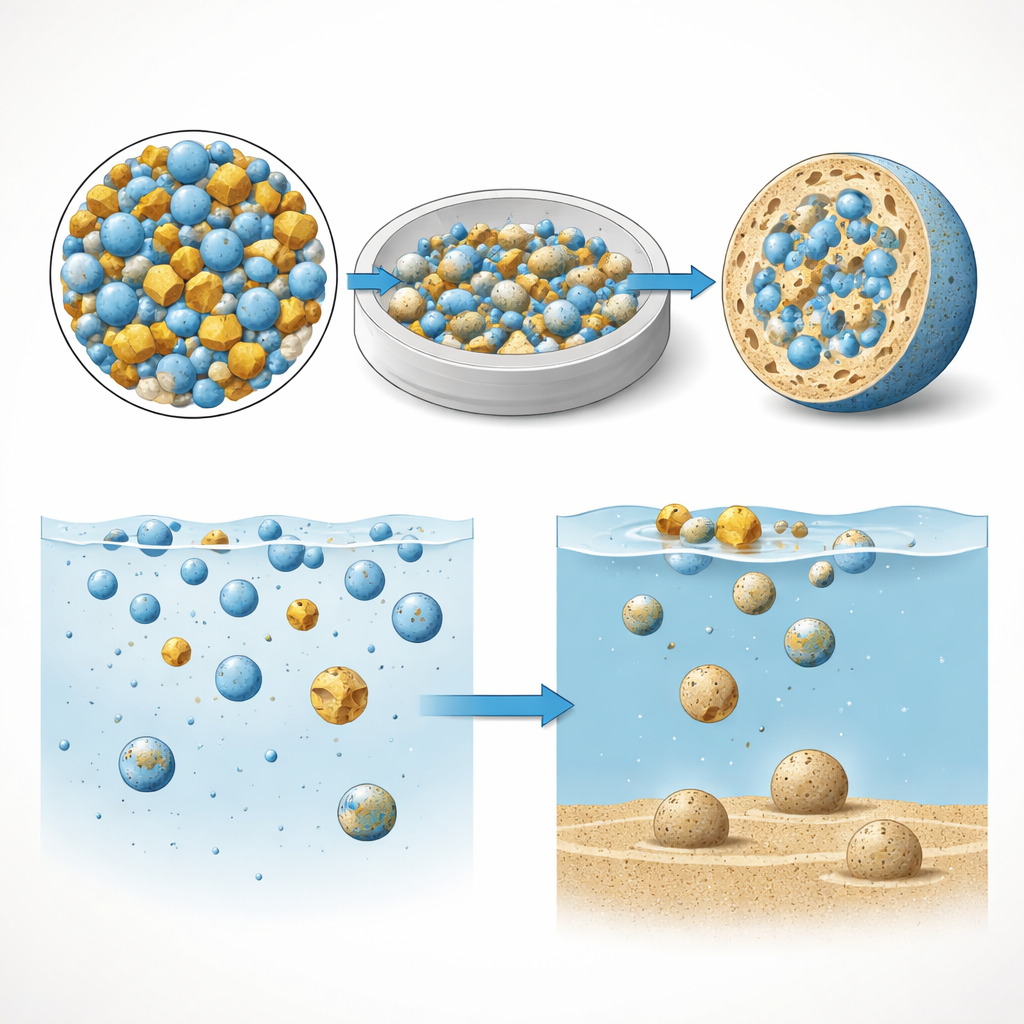
The team combines fly ash and slag powders in different proportions and feeds them into a custom‑built rotating disc, known as a disc pelletizer. Inside this spinning dish, a carefully measured spray of alkaline liquid—made from sodium silicate and sodium hydroxide—acts as a chemical activator and a binder. As the moistened particles collide and roll, they stick together and gradually grow into grains between about 5 millimeters and 75 micrometers in size, matching the size range of river sand. Crucially, this process works at normal room temperature; unlike earlier methods that relied on fly ash alone, there is no need for energy‑hungry oven curing. The most successful mix uses 60% fly ash and 40% slag, which yields almost entirely sand‑sized grains with a well‑balanced spread of fine, medium, and coarse particles suitable for concrete and mortar standards.
Looking Inside the Tiny Grains
To understand how these artificial grains behave, the researchers do more than simple strength tests. They use electron microscopes and three‑dimensional X‑ray scans to peer into the grains and map their internal structure. The images reveal that spherical fly ash particles and angular slag particles are tightly bonded together by a glassy network formed during the chemical reaction, creating dense, well‑packed grains that still contain small, connected pores. Additional techniques that probe mineral composition and heat resistance show that the grains are dominated by stable silicate structures and new binding phases that hold the particles together even when heated to 800 °C, with only a small loss of mass. This combination of a robust skeleton and controlled porosity explains why the grains are both mechanically stable and relatively lightweight.
How the New Sand Compares to River Sand
When tested like ordinary construction sand, F‑Slag sand shows a specific gravity slightly lower than river sand and a much lower bulk density, meaning it can help produce lighter structures with reduced dead load. Its ability to let water pass through is similar to that of natural sand, which is important for drainage, while its resistance to crushing easily meets standard requirements for building aggregates. The grains absorb more water than river sand, a consequence of their internal pores, but their friction behavior—the way grains lock together under load—is nearly the same. Chemical leaching tests show that potentially toxic metals remain trapped within the grains and fall well below international safety limits, and a formal ecological risk assessment concludes that the material poses negligible environmental hazard.
What This Could Mean for Building and Mining
Putting the test results together, the study argues that F‑Slag sand is not just a laboratory curiosity but a practical candidate for real‑world use. Its grading and strength make it suitable for concrete, masonry mortars, and plaster, while its low density and good flow suggest advantages in lightweight construction and in filling empty spaces underground in mines. By shifting demand away from river beds and toward industrial by‑products, this approach supports a more circular economy: waste from power and steel plants becomes feedstock for new infrastructure. The authors stress that more work is needed on long‑term durability and large‑scale production, but their findings point to a future where the sand beneath our feet is engineered, sustainable, and far kinder to rivers and landscapes than the material it replaces.
Citation: Sekhar, K., Rao, B.H. & Zalar Serjun, V. Micro/meso scale investigations on F-slag sand developed with synergistic use of fly ash and slag. Sci Rep 16, 12951 (2026). https://doi.org/10.1038/s41598-026-43476-x
Keywords: artificial sand, fly ash, slag, sustainable construction, geopolymer materials