Clear Sky Science · en
Engineering thermoelectric performance in copper-doped graphene nanoribbons for energy-aware electronics
Turning Waste Heat into Useful Power
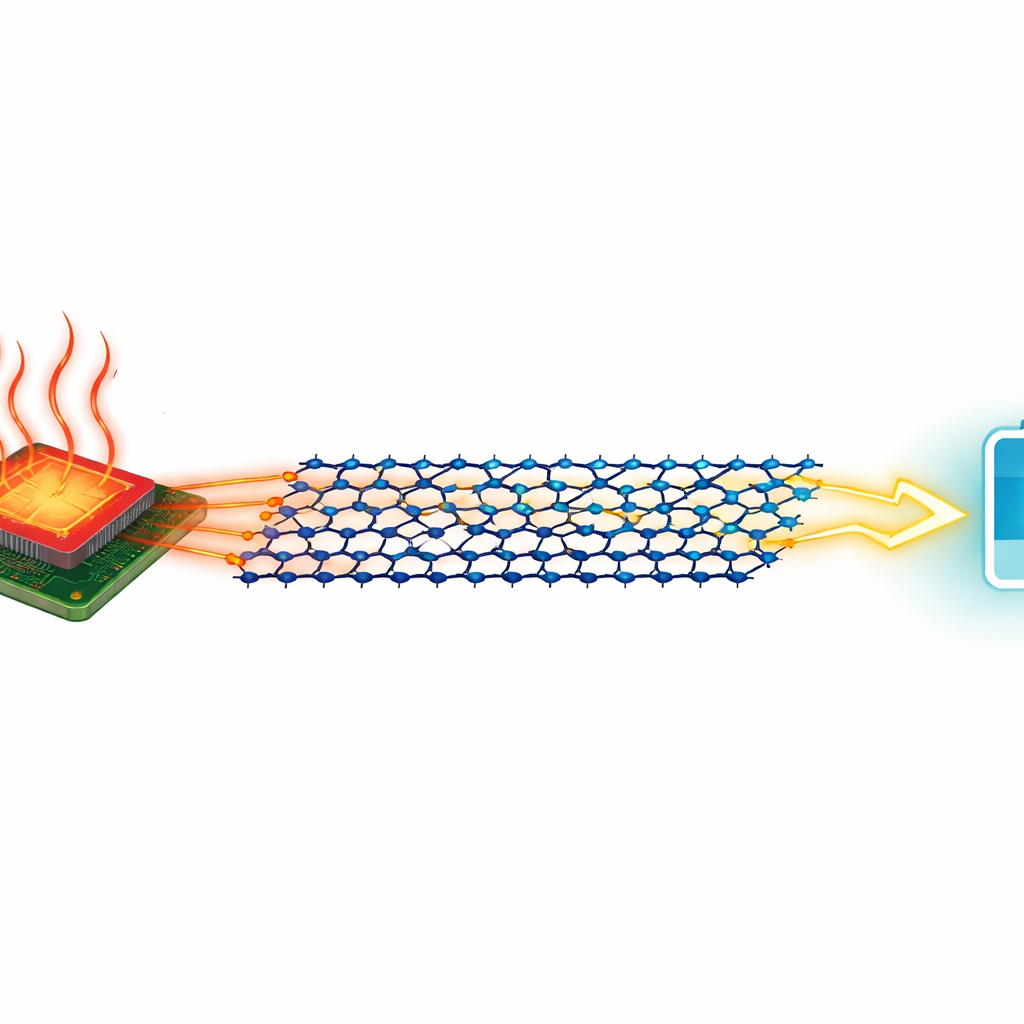
Every smartphone, laptop, and data center quietly leaks energy as heat. Most of that warmth simply warms the room and is lost. This study explores a way to capture some of that waste heat and turn it back into electricity using ultra-thin strips of carbon called graphene nanoribbons. By carefully adding tiny flaws and a sprinkle of copper atoms, the researchers show how these ribbons could become miniature power plants for the chips of future electronics.
Tiny Ribbons Built from Carbon
Graphene is a single sheet of carbon atoms arranged like chicken wire. When that sheet is cut into very narrow strips with smooth “armchair” edges, it forms armchair graphene nanoribbons. These nanoribbons are only a few atoms wide but can carry electrical current extremely well, making them attractive for tiny power generators that sit directly on a computer chip. However, perfect graphene also carries heat extremely well, which is a problem for thermoelectric devices that need a strong temperature difference to turn heat into electricity.
Using Flaws and Copper as Design Tools
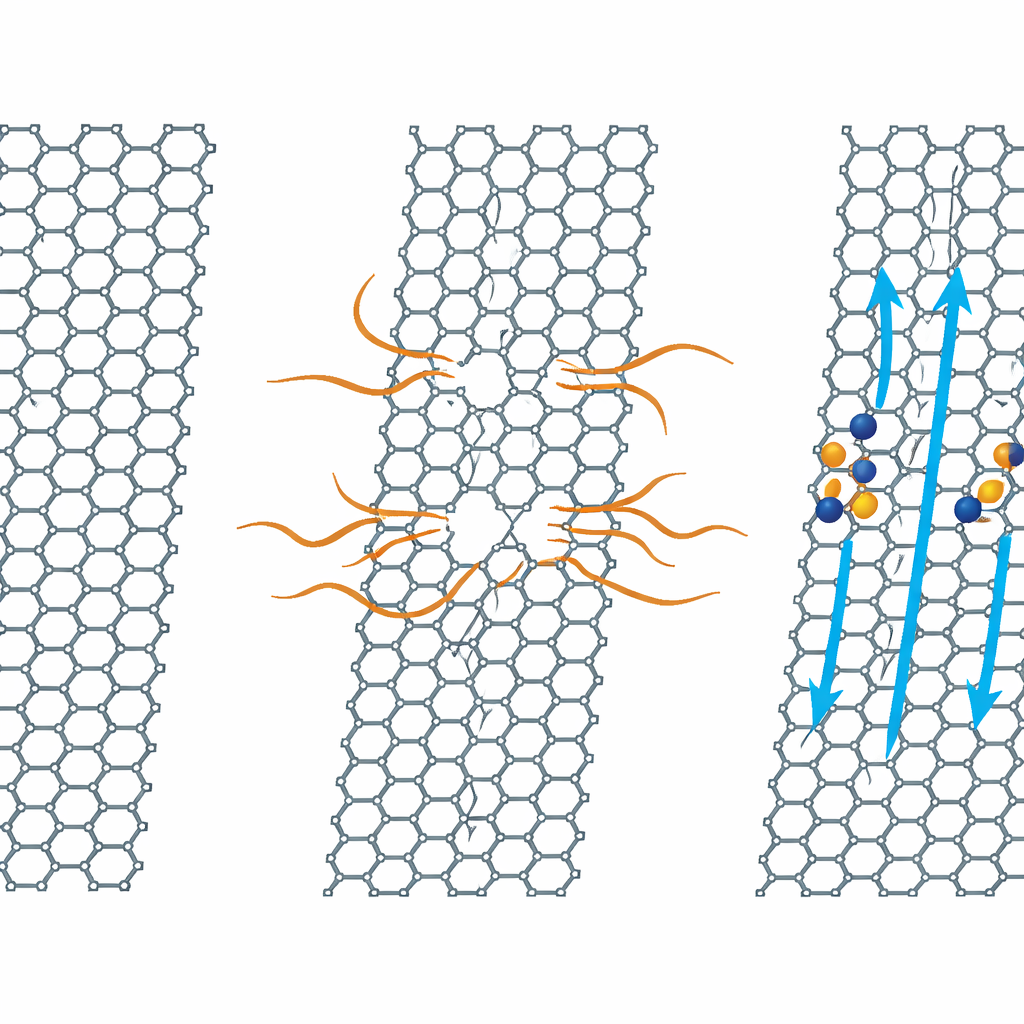
The team set out to deliberately “mess up” the nanoribbons in a controlled way to improve their ability to convert heat to electricity. First, they removed one or more carbon atoms to create vacancy defects—tiny missing spots in the atomic lattice. These vacancies disrupt how vibrations of the lattice carry heat, acting like speed bumps for heat flow while still allowing electrical current to pass. Then they replaced selected carbon atoms with copper atoms. Copper interacts gently with the carbon network, changing how easily electrons move and how they respond to temperature differences without completely wrecking the structure.
Simulating Heat and Charge at the Atomic Scale
Instead of building devices in the lab, the researchers used advanced computer simulations that follow quantum mechanical rules for electrons and vibrations. They modeled a nanoribbon section between two electrodes at different temperatures, mimicking a hot and a cold side on a chip. For each pattern and amount of copper and vacancies, the simulations calculated key quantities: how easily electrons flow, how strongly a temperature difference creates a voltage (the Seebeck effect), and how efficiently heat leaks through both electrons and lattice vibrations. From these, they evaluated the overall “figure of merit,” ZT, a standard score that tells how good a material is at turning heat into electricity.
Finding the Sweet Spot for Doping
The results reveal that there is a “just right” amount and placement of copper. Low levels of copper in a defected nanoribbon significantly boost electrical conductance and the Seebeck response while vacancy defects strongly cut down heat flow carried by vibrations. In these optimized cases, the material’s ZT score exceeds 1.5 at room temperature—very promising for practical thermoelectric applications. However, when too many copper atoms are added, the nanoribbon begins to behave more like an ordinary metal. The voltage generated by a temperature difference drops, electronic heat leakage rises, and overall efficiency falls. This shows that more dopant is not always better; atomic-scale control over where and how much copper is added is crucial.
From Atomic Design to Smarter Electronics
In plain terms, the study shows how a carefully “imperfect” graphene nanoribbon—sprinkled with just the right number of copper atoms and missing carbon sites—can act as a tiny solid-state engine that turns a chip’s waste heat into useful electrical power. By tuning these atomic details, engineers could one day build self-powered sensors, cooler-running processors, and electronics that recycle their own heat instead of throwing it away. The work offers a roadmap for designing such materials in silico before manufacturing, bringing us closer to energy-aware electronics that waste less and do more.
Citation: Maky, H.Y., Karimi, G. & Ajeel, F.N. Engineering thermoelectric performance in copper-doped graphene nanoribbons for energy-aware electronics. Sci Rep 16, 13264 (2026). https://doi.org/10.1038/s41598-026-43463-2
Keywords: thermoelectric materials, graphene nanoribbons, waste heat harvesting, nanoelectronics, copper doping