Clear Sky Science · en
Novel photonic crystal fibre for low-noise coherent supercontinuum generation
Why bright white light from fibers matters
Many modern tools in medicine, sensing, and precision measurement rely on laser light that covers a wide range of colors while staying extremely stable. This study presents a new type of optical fiber that turns a short, infrared laser pulse into a smooth, bright rainbow of light with very little noise. The design is simpler than existing fibers yet still keeps the light’s polarization under control, which is essential for the most demanding timing and frequency applications.
A new way to shape light in a fiber
The researchers built a special glass fiber, known as a photonic crystal fiber, in which a tiny solid core is surrounded by a regular pattern of microscopic air holes. By carefully choosing the size and spacing of these holes, they controlled how different colors of light travel down the fiber. The design ensures that light of slightly different colors stays grouped together rather than spreading apart too quickly, which helps the initial narrow-band laser pulse broaden smoothly into a wide spectrum. Unlike many commercial designs, this fiber keeps the light’s polarization steady using two slightly larger central holes instead of extra stressed glass rods, simplifying fabrication and handling.
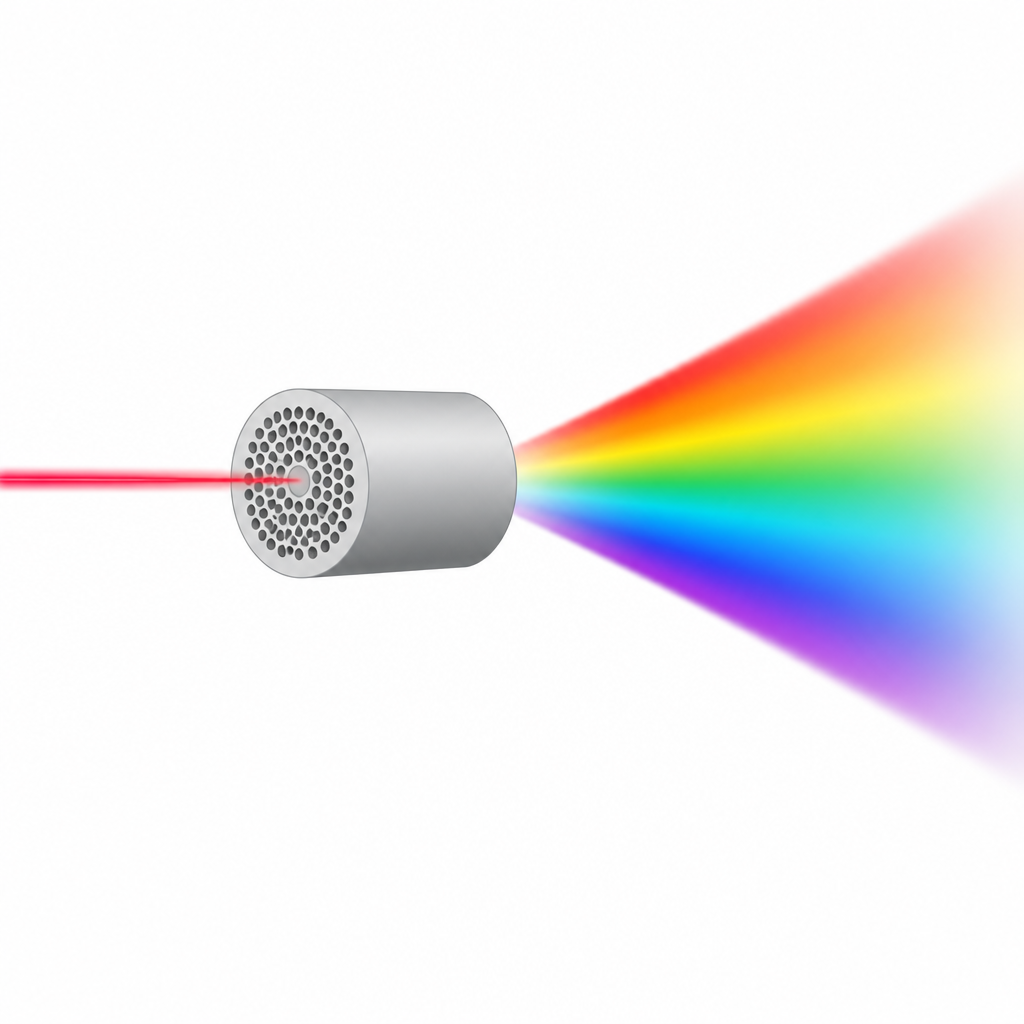
Turning a narrow laser into a smooth rainbow
The team tested the fiber with two kinds of femtosecond lasers that emit very short pulses near a wavelength of 1030 nanometers, a common range for industrial and scientific systems. With only a few tens of kilowatts of peak power and fiber pieces shorter than a quarter of a meter, the output stretched from about 630 to 1350 nanometers, covering much of the visible and near-infrared spectrum. The resulting rainbow was not only broad but also flat and symmetric, without deep dips or sharp spikes, which makes it easier to use in applications such as precision spectroscopy and optical imaging.
Comparing design choices and performance
Numerical simulations accompanied the experiments to understand how the details of the input pulses affect the final spectrum. The authors showed that imperfections in the initial laser pulse, such as small pre- and post-pulses, can leave ripples in the output. When they used cleaner, nearly ideal pulses, these ripples largely disappeared. They also compared their new fiber to a commercial polarization-maintaining fiber that uses stress rods. Under the same conditions, the new design produced a slightly wider spectrum, especially toward shorter wavelengths, helped by its smaller mode area, lower dispersion at the pump wavelength, and more convenient outer size that eases alignment and coupling.
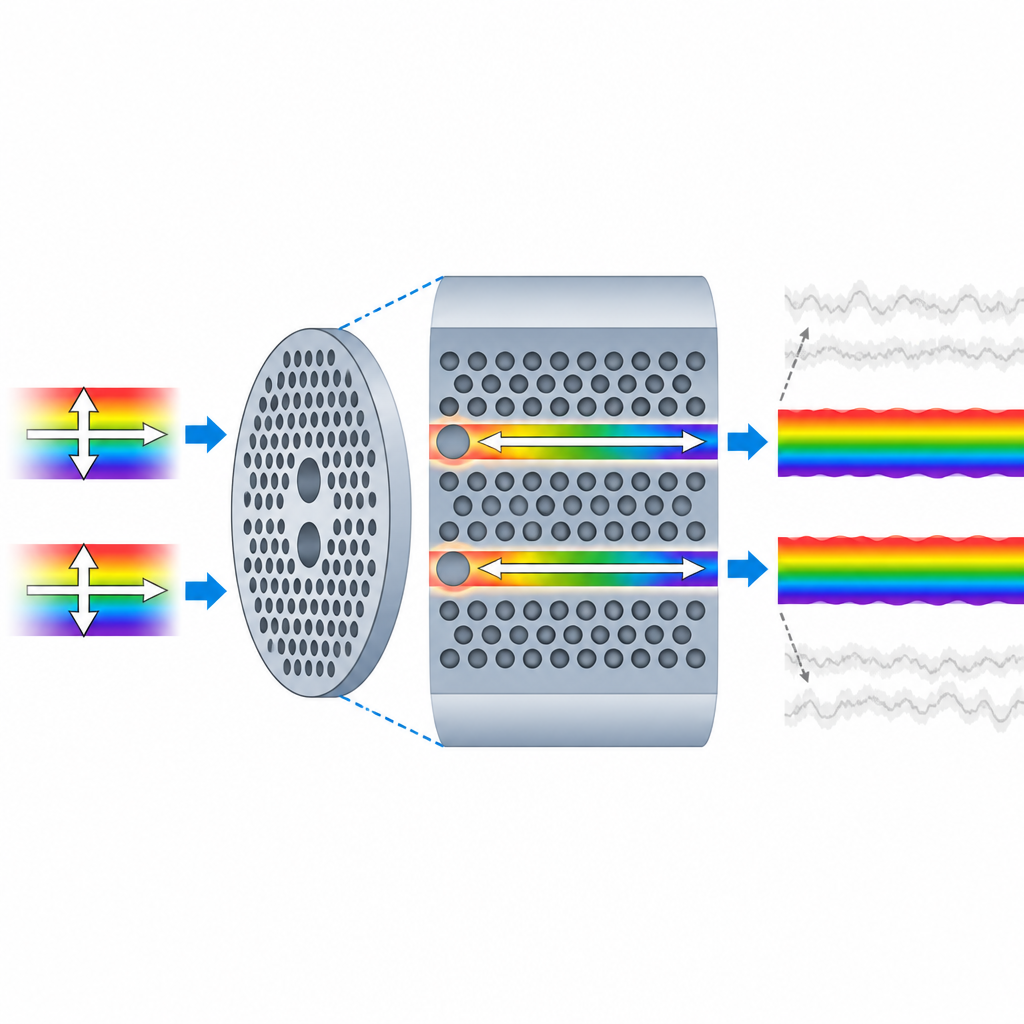
How quiet is the rainbow light
For many advanced uses, it is not enough for the spectrum to be broad; it must also be extremely stable from pulse to pulse. The authors measured this stability in several ways. First, they used a time-stretch technique to record the spectrum of hundreds of pulses in real time and found that intensity variations across most of the spectrum stayed at or below about half a percent. Second, they used an interferometric setup with two identical fibers to compare the phase of the light from shot to shot, finding phase fluctuations so small that they were essentially limited by the measuring instrument itself. Third, by converting the light into a radio-frequency signal and analyzing its noise, they confirmed that the fiber does not add noticeable extra phase noise beyond that of the original laser across a wide range of offset frequencies.
What this means for future light sources
In simple terms, the study shows that a relatively straightforward fiber design can turn standard femtosecond lasers into exceptionally stable white-light sources while keeping the light’s polarization locked. The combination of broad, flat spectra, low intensity noise, and tiny phase variations makes the fiber well suited for tasks that rely on very precise timing and color control, such as dual-comb spectroscopy, nonlinear imaging, and advanced frequency measurements. Because the design avoids complex stress structures and works with short fiber lengths and moderate power, it offers a practical route to compact, reliable supercontinuum systems for future scientific and technological applications.
Citation: Morel, R., Millo, J., Forget, N. et al. Novel photonic crystal fibre for low-noise coherent supercontinuum generation. Sci Rep 16, 14901 (2026). https://doi.org/10.1038/s41598-026-43460-5
Keywords: supercontinuum, photonic crystal fiber, ultrafast lasers, low noise light, frequency combs