Clear Sky Science · en
Modulation of feedback-related negativity by objective and subjective response correctness
Why our brains care about mistakes
Every day we press buttons, type passwords, or respond to messages, usually without thinking much about how we know we are right or wrong. Yet our brains are constantly checking our actions and the feedback we receive, using this information to adjust future behavior. This study looks inside that monitoring system, asking a subtle question: does the brain’s response to feedback reflect only what we consciously believe about having made a mistake, or does it also track whether we were in fact objectively right or wrong, even when we might not realize it?
Watching people type under pressure
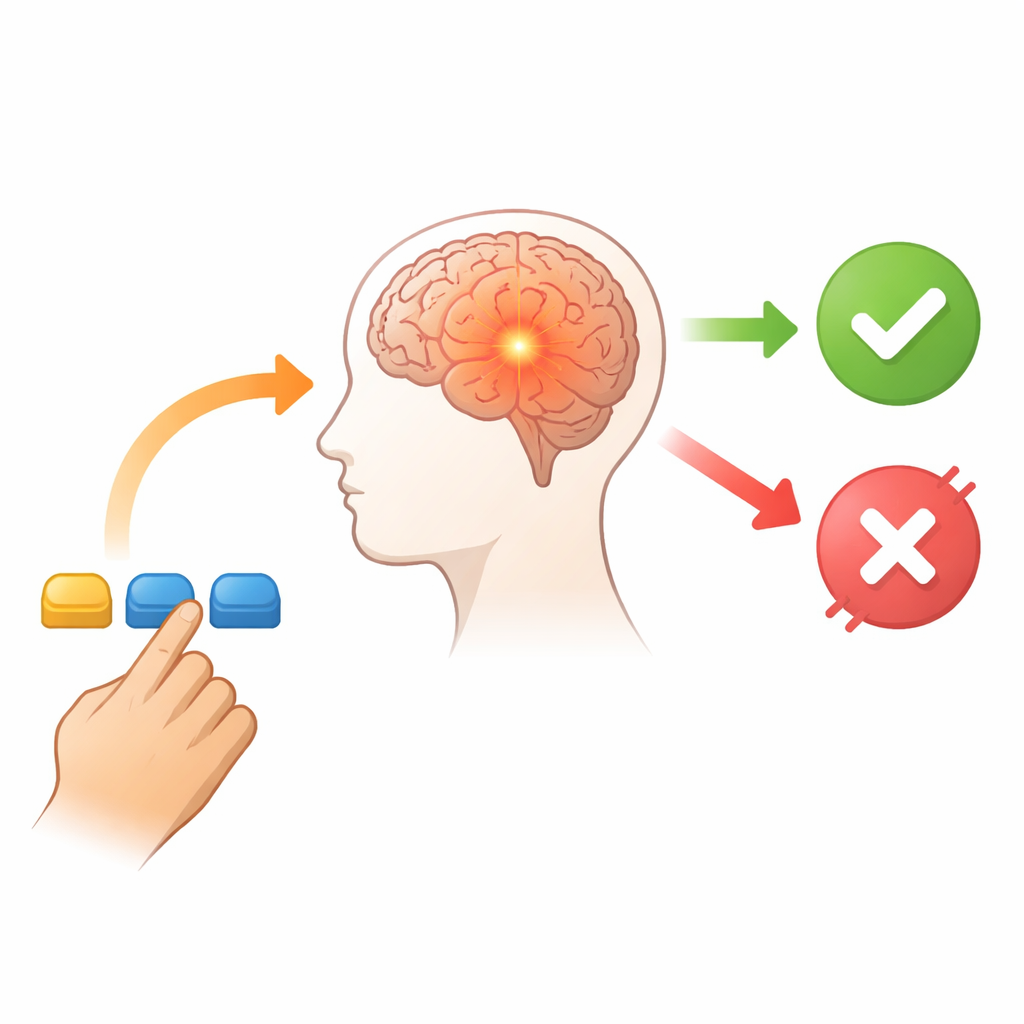
To explore this, researchers had volunteers perform a demanding digit-entry task. On each trial, a five-digit number appeared on a screen, and participants had to retype it quickly using a numeric keypad with one finger. If they entered all digits correctly, they received pleasant visual and sound feedback; if they hit a wrong key, they immediately saw and heard a negative signal. Sometimes, however, the experiment secretly presented false negative feedback even when the person had typed the number perfectly. After each trial with negative feedback, participants reported how certain they were that they had made an error, using four confidence levels ranging from “certainly correct” to “certainly wrong.” This setup allowed the team to tease apart three things: whether the response was truly correct or not, what feedback was shown, and how sure people felt about their performance.
Recording hidden electrical signals in the brain
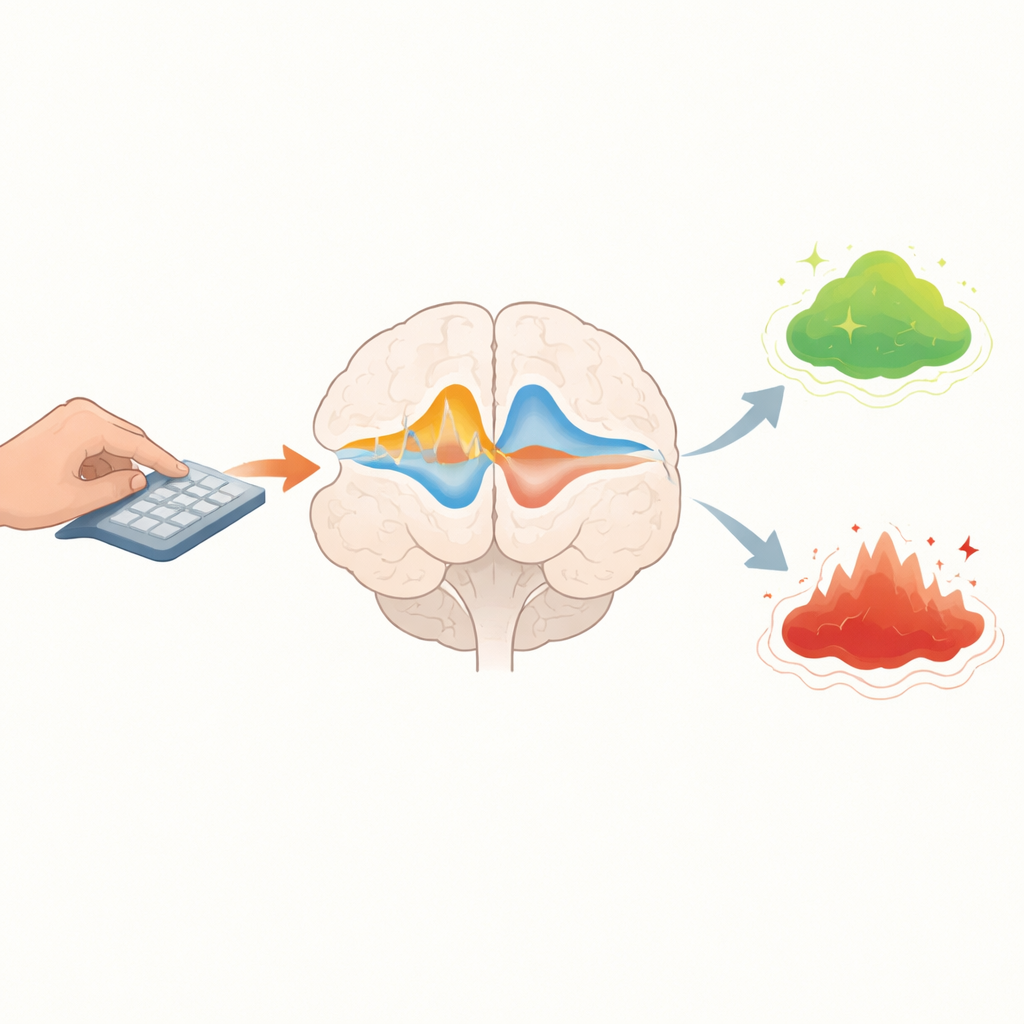
While participants worked through 1,000 trials each, the researchers recorded their brain activity with an electroencephalogram (EEG). They paid particular attention to brief electrical patterns known as event-related potentials. One, called error-related negativity, appears around the moment a person presses a wrong key and is thought to reflect an internal “oops” signal generated before or without conscious awareness. Another, called feedback-related negativity, appears a few hundred milliseconds after feedback is shown and is linked to how the brain evaluates outcomes, especially when something turns out worse than expected. By analyzing these signals on single trials with sophisticated statistical models, the team asked whether the feedback-related response depended only on what participants believed, or also on the actual correctness of their actions.
How real mistakes shape reactions to feedback
The results showed that the brain’s response to feedback carried a strong imprint of objective correctness. When people received negative feedback after a truly correct response (the false-feedback trials), their feedback-related signal was larger than when they got negative feedback after a genuine error, even when their reported certainty was taken into account. In other words, identical negative feedback produced different brain responses depending on whether the underlying action had actually been right or wrong. The internal error signal at the moment of the keypress appeared reliably for real mistakes but not for false feedback, confirming that the performance-monitoring region in the brain distinguished actual errors from merely bad news on the screen. At the same time, both feedback-related and earlier brain responses were modulated by how certain people felt about their performance, indicating that subjective awareness and confidence also sculpt these signals.
Small behavior changes, big brain signals
Behaviorally, people slowed down slightly on the next trial after real errors compared with after false negative feedback, a classic “post-error slowing” effect. They also tended to be more accurate in the following trial when they believed they had made a mistake, regardless of whether that belief was correct. However, these changes in speed and accuracy did not mirror the neural patterns perfectly, suggesting that the brain’s monitoring signals are richer and more complex than any simple measure of behavior. The study also uncovered an additional, earlier brain response to feedback that seemed more tied to how strongly people were paying attention to incoming information than to whether they were objectively right or wrong.
What this means for understanding self-monitoring
Taken together, the findings suggest that a shared monitoring system in the midline frontal part of the brain keeps track of both the factual correctness of our actions and our subjective sense of having erred. The feedback-related signal does not simply echo what we consciously think; it also reflects an internal representation of whether our action was actually correct, even when feedback is immediate and occasionally misleading. For a layperson, this means that the brain maintains an internal scorecard that goes beyond what the outside world tells us, combining objective performance with personal confidence to guide learning and future decisions.
Citation: Maruyama, Y., Aoyama, K. & Fukayama, O. Modulation of feedback-related negativity by objective and subjective response correctness. Sci Rep 16, 13574 (2026). https://doi.org/10.1038/s41598-026-43451-6
Keywords: error monitoring, brain feedback signals, electroencephalography, decision confidence, cognitive control