Clear Sky Science · en
Surface-engineered silica core-shell enables an ideal ratiometric fluorescent probe for highly selective Hg2+ detection
Why Watching for Mercury Matters
Mercury is one of the most dangerous metals in our environment. It can seep into rivers, lakes, and even drinking water, where it quietly builds up in living things and threatens human health. Detecting tiny traces of mercury quickly and cheaply is a major challenge: the best current methods rely on bulky, expensive machines in specialized labs. This study introduces a new kind of glowing nanoparticle that can spot mercury in water with high precision, using simple light measurements and a built-in way to double‑check its own signal.
Building a Tiny Layered Bead
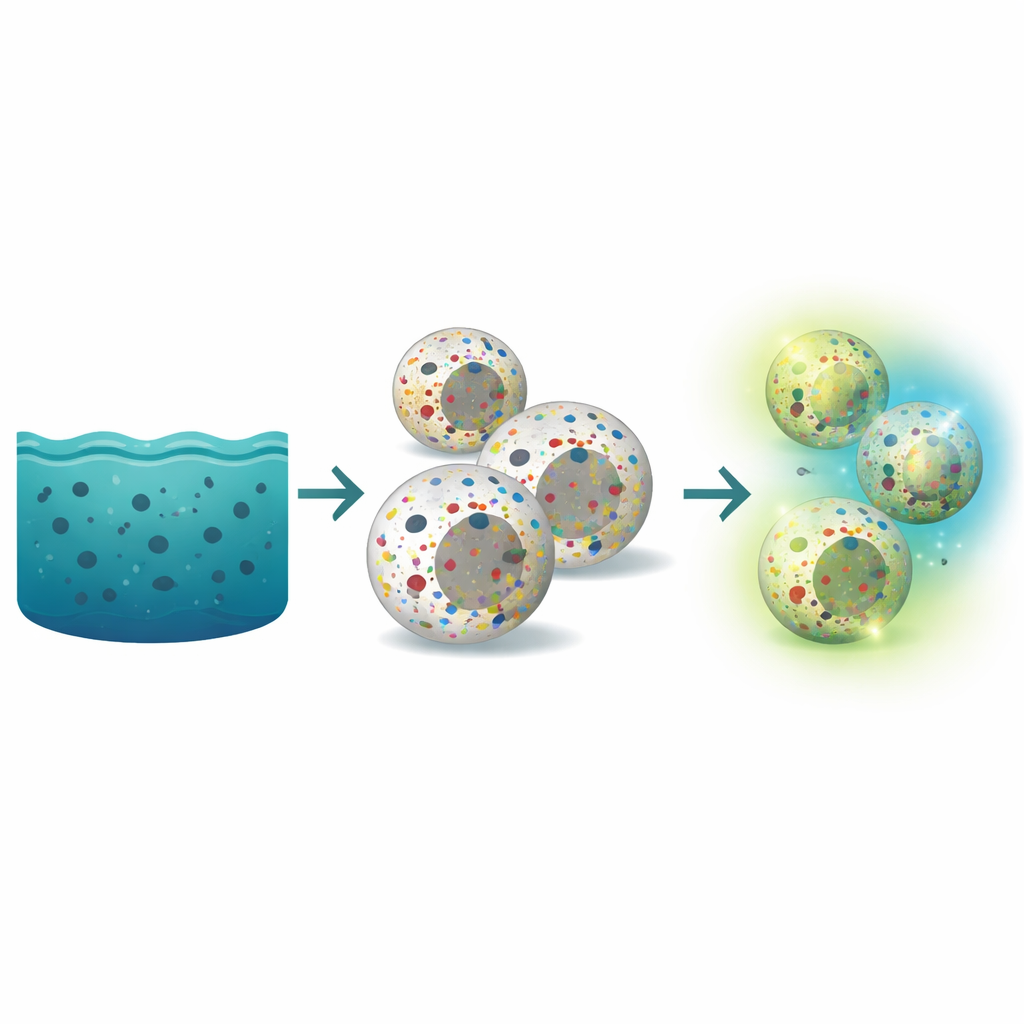
The researchers started by engineering microscopic glass-like beads made of silica. Each bead has a solid center and a surrounding shell full of tiny channels, like a sponge wrapped around a marble. This core–shell design provides a sturdy framework and a large internal surface where other functional materials can be anchored. Using well-established chemical methods, the team produced nearly identical spheres about 270 nanometers across—thousands of times smaller than the width of a human hair—ensuring uniform behavior when used as sensors.
Adding Two Kinds of Glow
To turn these beads into light-based detectors, the scientists attached two different fluorescent components. First, they immobilized semiconductor nanocrystals called CdTeS quantum dots on the silica surface. These dots give off a deep red light and are stable under prolonged illumination, serving as a constant reference signal. Next, they chemically grafted organic dye molecules based on a coumarin structure onto the outer shell. These dyes emit bright blue-green light and are designed to interact strongly with mercury ions. Together, the quantum dots and dyes create a dual-color system that glows in two distinct bands when excited by a single light source.
How the Color Balance Reveals Mercury
When the sensor is placed in water and illuminated, both colors appear: the coumarin dyes shine at shorter wavelengths, while the quantum dots emit at longer wavelengths. The crucial feature is how mercury changes this balance. As mercury ions approach and bind to the dye region, they strongly dampen its glow through a heavy-atom effect, where the presence of mercury encourages the excited dye molecules to release their energy without emitting light. The quantum dots, however, are largely unaffected and keep shining steadily. As a result, the ratio of blue-green to red light drops in a predictable way as mercury concentration increases, providing a built-in comparison that corrects for changes in lighting, sensor amount, or minor experimental disturbances.

Reliable Detection in Real Water
The team carefully tested the new particles in the presence of many other metal ions commonly found in water, such as sodium, calcium, and lead. Only mercury produced a strong change in the color ratio, even when the other metals were present at higher levels, demonstrating excellent selectivity. The sensor could measure mercury down to about 10 billionths of a mole per liter—well below limits of concern for drinking water—and showed stable performance under continuous illumination. When applied to samples from lake water, groundwater, and tap water, the readings closely matched those obtained with a high-end laboratory technique, confirming its practical usefulness.
What This Means for Everyday Safety
In essence, the researchers have created a tiny glowing "balance" that tips whenever mercury is present, comparing one color of light against another rather than relying on a single fragile signal. This dual-emission approach makes the measurement more trustworthy and easier to interpret, even outside of advanced laboratories. With further development, such robust, color-ratio-based sensors could be built into portable devices for routine checks of drinking water and natural waterways, helping communities detect mercury contamination early and protect both environmental and human health.
Citation: Mohammadi Ziarani, G., Banitalebi, A., Mokhberi, K. et al. Surface-engineered silica core-shell enables an ideal ratiometric fluorescent probe for highly selective Hg2+ detection. Sci Rep 16, 13684 (2026). https://doi.org/10.1038/s41598-026-43448-1
Keywords: mercury detection, fluorescent nanosensor, water quality, quantum dots, environmental monitoring