Clear Sky Science · en
Comprehensive enhancement of blasting performance and dust suppression in open-pit mines using a modified mudstone–fly ash geopolymer stemming material
Cleaner Blasting for Big Mines
Open-pit coal mines are essential for energy, but every blast that breaks rock also throws huge clouds of dust into the air, especially in dry, windy grassland regions. That dust harms workers’ lungs, wears out machines, and drifts far beyond the mine, affecting nearby ecosystems. This study explores a new way to tackle dust at its source during blasting, while also making each explosion work more efficiently, by turning local mining waste into a smart, fast-hardening plug inside the blast holes.
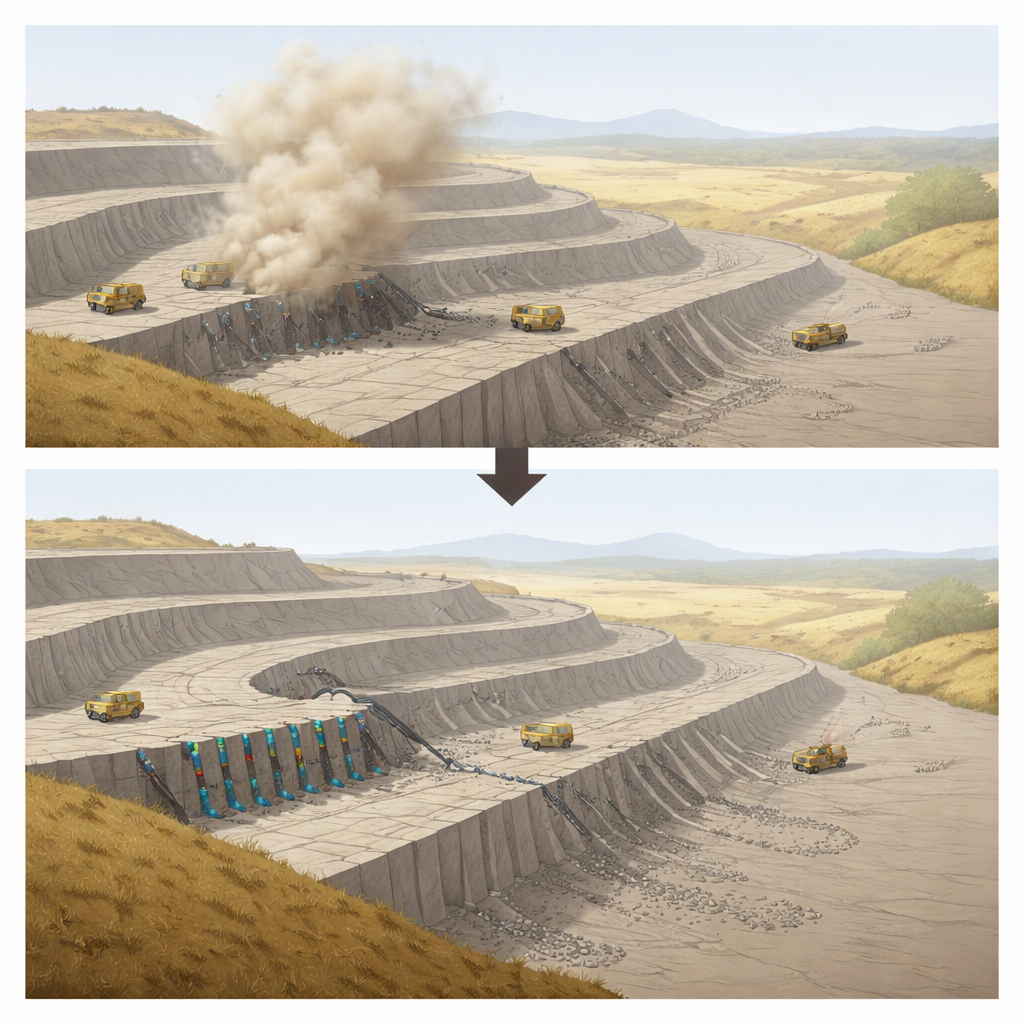
Dust Problems in Open-Pit Mining
As China’s open-pit coal production has grown, so have environmental pressures in its northern grasslands. Open pits are wide and deep, summers are hot and dry, and strong winds easily carry fine particles. In these conditions, dust from blasting and from disturbed rock surfaces is the main air-quality problem. Mines often rely on spraying water or chemical solutions to knock dust down after a blast, but water is scarce, spraying is expensive, and the effect fades quickly as surfaces dry out or are disturbed again. The authors argue that dust control and good blasting should be treated as one combined problem, governed by how well the blast holes are sealed.
Turning Waste Rock into a Useful Plug
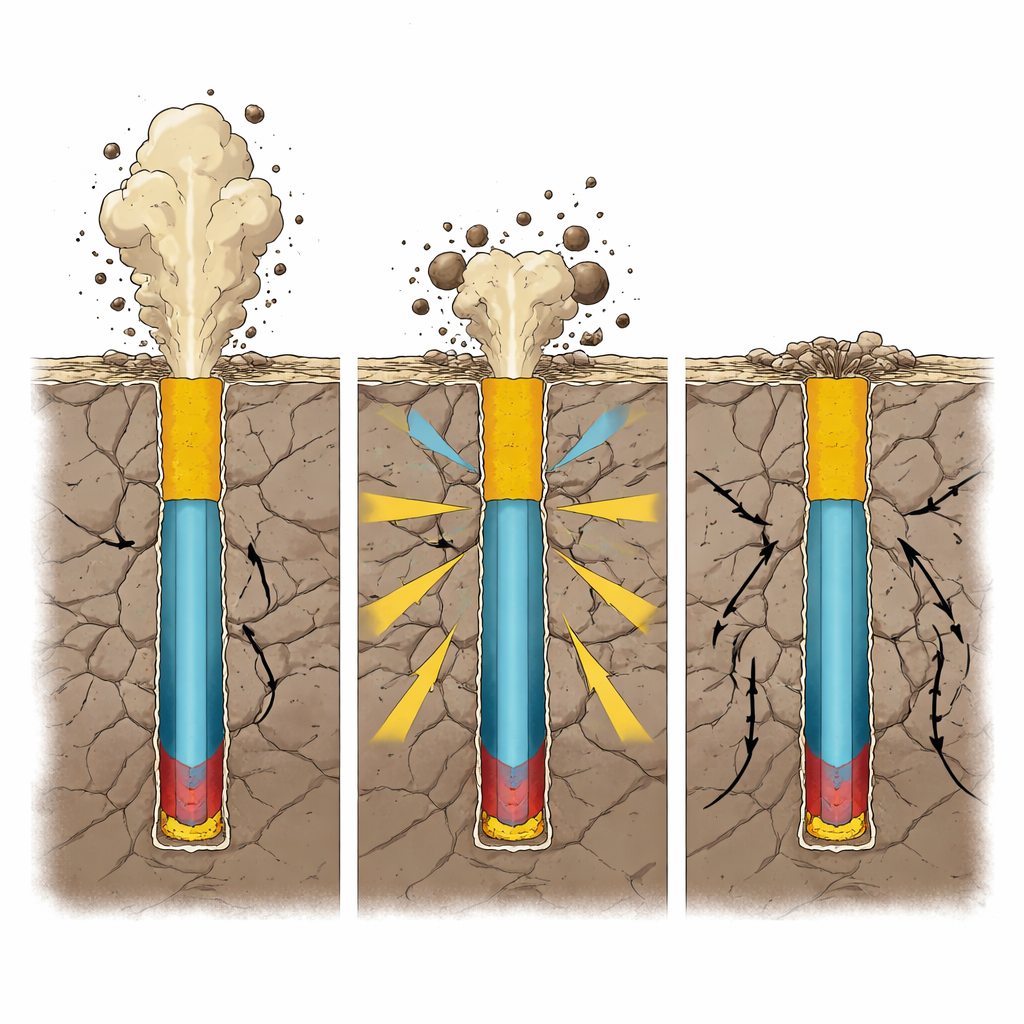
The researchers developed a new “stemming” material—the plug that seals the top of a blast hole—made from mudstone drill cuttings and fly ash, both common solid wastes. They mix these powders with a strongly alkaline liquid blend of water glass and sodium hydroxide plus a chemical accelerator so the slurry flows easily, then hardens in less than half an hour. Inside the plug, microscopic gels form and weave together into a dense, low-porosity network that bonds tightly to the surrounding rock. By adjusting the amount of accelerator and liquid, the team found a recipe that balances easy pumping with fast setting and strong, slightly flexible behavior when struck by the blast.
How the New Plug Handles an Explosion
To see how this new material behaves under real blast-like conditions, the team ran both physical and computer experiments. Lab tests, including high-speed impact experiments, showed that the geopolymer plug is tougher than natural mudstone: instead of shattering, it tends to crack in a controlled, “quasi-ductile” way, absorbing energy without flying apart. Microscopy and X-ray analyses revealed that intertwined calcium–silicate and calcium–aluminum–silicate gels fill pores and bind particles, creating a compact, resilient microstructure. Computer simulations of entire mine benches, using a particle-based method for tracking explosive gases and rock motion, showed that if the geopolymer plug is too short, gas vents early and energy shoots upward; if it is too long, energy is trapped and rock breaks poorly. An intermediate plug length, about 2.5 meters in their case, delivers a more even spread of fractures through the rock mass.
Field Trials in a Working Mine
The real test was in an operating open-pit coal mine. The researchers compared conventional mudstone stemming with their new mudstone–fly ash geopolymer in sets of 20 blast holes each. Drones with dust sensors flew through the blast plumes, while ground instruments monitored vibration and the size of broken rock. Where the new plug was used, peak dust levels dropped by about 40 percent. The blasted rock pile contained fewer overly fine particles and fewer very large boulders, with more material in a medium size range that is easier and cheaper to haul and crush. Ground vibration near the blast was slightly reduced, and because each blast worked more efficiently, the mine could use fewer blast holes to move the same amount of rock.
A Greener Path for Mine Blasting
For non-specialists, the key message is that this new plug turns a local waste—mudstone cuttings—into a fast-setting, durable seal that helps each blast break rock more cleanly while throwing much less dust into the air. By keeping explosive energy confined long enough to do useful work in the rock, the geopolymer stemming material reduces dust at the moment it is created instead of trying to chase it with water afterward. That makes blasting safer for workers, kinder to nearby communities and ecosystems, and more efficient for mine operators, offering a practical step toward cleaner, greener open-pit mining.
Citation: Ding, X., Wang, Y., Shi, Z. et al. Comprehensive enhancement of blasting performance and dust suppression in open-pit mines using a modified mudstone–fly ash geopolymer stemming material. Sci Rep 16, 12877 (2026). https://doi.org/10.1038/s41598-026-43442-7
Keywords: open-pit coal mining, dust suppression, geopolymer stemming, blasting optimization, solid waste utilization