Clear Sky Science · en
Matrix stress relaxation promotes glioblastoma cell migration in a ligand-specific manner
Why the Tumor’s Surroundings Matter
Brain tumors such as glioblastoma do not spread in empty space: they move through a soft, gel-like environment made of proteins and sugars that fill the brain. This study asks a deceptively simple question: how does the “feel” of that environment – not just how stiff it is, but how it slowly gives way under stress – influence how brain cancer cells move, and does it depend on which molecules they grab onto while crawling? The answers reveal that the same mechanical cue can either speed or barely affect tumor cell migration, depending on the specific “handles” available on the surrounding matrix.
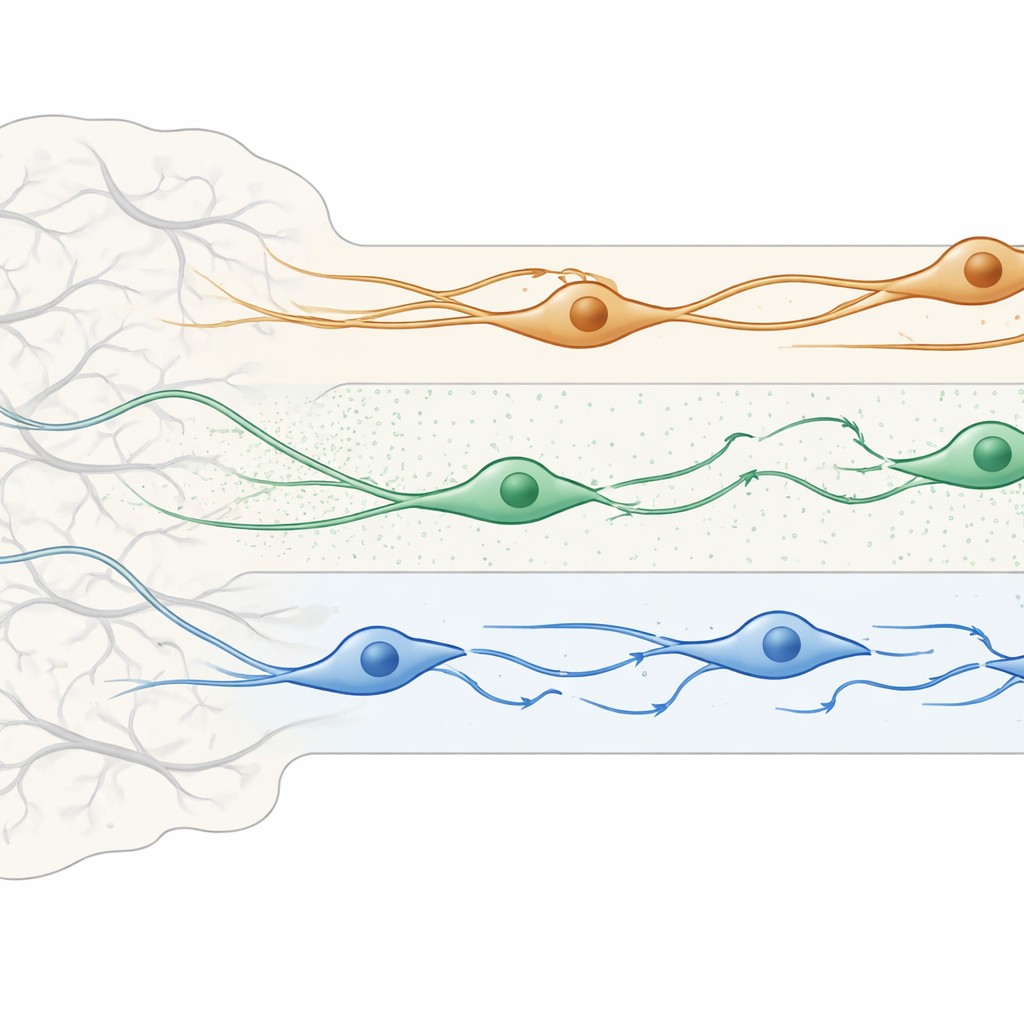
Soft Gels That Imitate Brain Tissue
To explore this, the researchers built laboratory versions of the brain’s supporting material using synthetic hydrogels. These materials were engineered so that one property, basic stiffness, stayed nearly the same, while another property, stress relaxation, could be tuned over a wide range. Stress relaxation describes how a material initially resists a pull or push but then slowly lets that stress fade away, like memory foam that gradually reshapes. Onto the surface of these gels, the team attached one of three common tissue proteins – collagen, fibronectin, or laminin – which act as docking sites that cells can grab with specialized receptors. This allowed them to separate the influence of mechanics (how the gel behaves under force) from chemistry (which protein the cells adhere to).
Watching Tumor Cells Crawl
Human glioblastoma cells were placed on each type of gel and filmed for hours under a microscope. From these time-lapse movies, the scientists traced the paths of hundreds of individual cells, measuring how fast they moved, how straight their paths were, and how far they ended up from where they started. They also stained the cells to see how spread out they were and used mathematical models to classify different styles of movement, such as highly exploratory, stop-and-go paths versus more continuous, directed walks. In parallel, they examined the activity of dozens of genes involved in adhesion, force sensing, and movement to see how the cells’ internal machinery responded to changes in the surrounding material.
When Extra “Give” Helps – and When It Doesn’t
The most striking finding was that increasing stress relaxation in the matrix did not have a uniform effect. On collagen-coated gels, making the material more able to relax stress consistently boosted how fast and how far the cells moved, and nudged them toward a more organized, persistent style of migration. In simple terms, when the collagen-rich surface could slowly “give” under the cells’ pulls, those cells traveled farther and in a more directed way. On fibronectin, however, the same mechanical change barely altered speed or overall displacement, suggesting that the internal signaling triggered by this protein dominates over the mechanical cue. Laminin presented yet another picture: higher stress relaxation switched on a broad set of invasion- and growth-related genes, but this molecular activation did not translate into faster or more persistent movement on the flat gels.
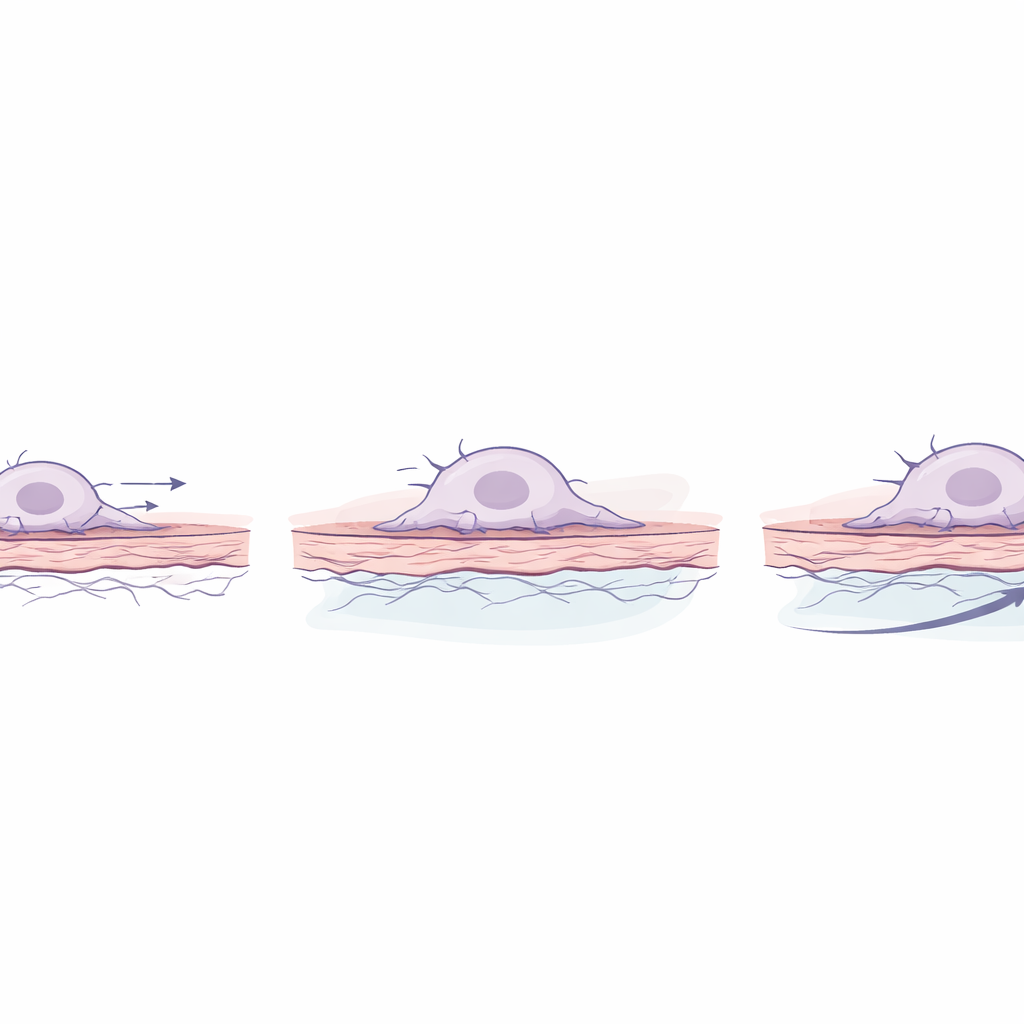
Hidden Programs Inside Moving Cells
The gene activity patterns underscored how strongly the type of surface protein shapes cell behavior. Compared with collagen, fibronectin tended to push cells into a more aggressively invasive molecular state, engaging enzyme systems that can chew through surrounding material. Laminin encouraged a profile reminiscent of tumor cells that creep along blood vessels, with signals tied to vascular niches and growth control. Altering stress relaxation then fine-tuned these ligand-specific programs: on collagen, it strengthened certain adhesion and force-sensing pathways that are known to support polarized, directional movement; on laminin, it broadly activated pathways for adhesion, matrix remodeling, and growth, without necessarily freeing the cells to move faster in this simplified two-dimensional setting.
What This Means for Treating Brain Tumors
To a non-specialist, the core message is that there is no single mechanical switch that universally turns glioblastoma invasion up or down. The same soft material that slowly relaxes stress can speed up migration when tumor cells grip collagen, have little effect when they grab fibronectin, and mainly rewire gene activity when they bind laminin. In other words, the impact of how “squishy and flowing” the tissue feels depends critically on which molecular handles the cells are using. For therapies that aim to slow tumor spread by altering the tumor’s physical environment, this work suggests that both the mechanics and the dominant adhesion molecules in each tumor niche must be considered together, rather than targeting stiffness or viscosity alone.
Citation: Żochowski, K., Szczepanek-Dulska, M., Zakrzewska, M. et al. Matrix stress relaxation promotes glioblastoma cell migration in a ligand-specific manner. Sci Rep 16, 13220 (2026). https://doi.org/10.1038/s41598-026-43432-9
Keywords: glioblastoma, extracellular matrix, cell migration, viscoelasticity, mechanotransduction