Clear Sky Science · en
Optical pumping effect on modulation transfer spectroscopy of the $$D_1$$ line of $$^{85}$$ Rb atoms with non-cycling transition
Why tuning laser light matters
Lasers used in modern physics experiments and quantum technologies must be tuned to very precise colors, or frequencies. Keeping a laser perfectly locked to a particular atomic transition is essential for things like atomic clocks, sensitive magnetic field sensors, and experiments with ultracold atoms. However, some atomic transitions naturally give very weak signals, making stable locking difficult. This paper shows how a second laser can cleverly "prepare" rubidium atoms so that a previously weak signal suddenly becomes strong and clean enough for highly stable laser control.
Making atoms prefer certain states
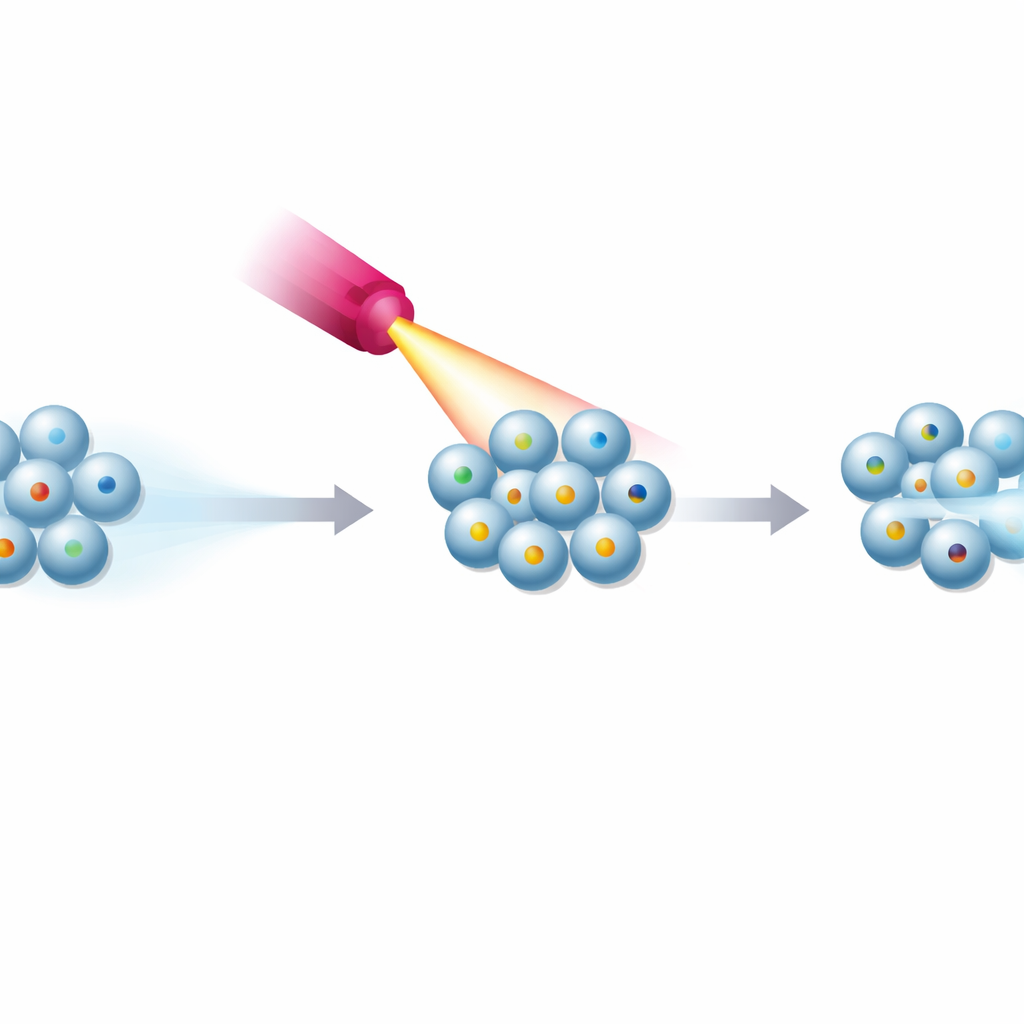
The key idea rests on optical pumping, a technique that uses light to nudge atoms into specific internal states. In rubidium atoms, electrons can occupy different closely spaced energy levels, and each of these levels is split into several sublevels. By shining a carefully chosen laser (the optical pumping laser) on one set of transitions, the authors redistribute the atoms so that many more of them end up in the particular ground-state level that is useful for detecting another transition. In this experiment, they used one color of light (the D2 line of rubidium-85) to manipulate the atomic populations, and another color (the D1 line) to produce the measurement signal.
Turning a weak signal into a strong one
The measurement method is called modulation transfer spectroscopy, a widely used technique for laser frequency stabilization because it yields sharp, background-free signals. Unfortunately, for the D1 line of rubidium-85 the relevant transitions are "non-cycling"—atoms easily leak out of the state being probed—so the signals are usually weak. By adding the optical pumping laser on the D2 line, the researchers dramatically increased how many atoms participate effectively in the D1 transition. Under an optimized configuration, the slope of the D1 signal (a key measure of how tightly one can lock the laser) increased by about a factor of 41 for one of the transitions. In practical terms, a signal that was previously too faint to use becomes robust enough for precise control.
How polarizations shape the outcome
The experiment’s power lies not only in adding a second laser, but in how the team chose the polarizations—the orientations and handedness of the light waves—for the optical pumping, pump, and probe beams. They systematically tested several combinations: linear beams aligned in parallel or at right angles, and circular beams that rotate clockwise or counterclockwise. These choices determine which magnetic sublevels in the atom are populated and which are probed. For certain linear arrangements, they found that all relevant sublevels in a ground state contribute to the signal, giving very strong enhancement. In other configurations, some highly populated sublevels remain invisible to the probe, leading to much weaker gains. Thus, the geometry and polarization of the light fields are just as important as their colors.
Matching experiment with theory
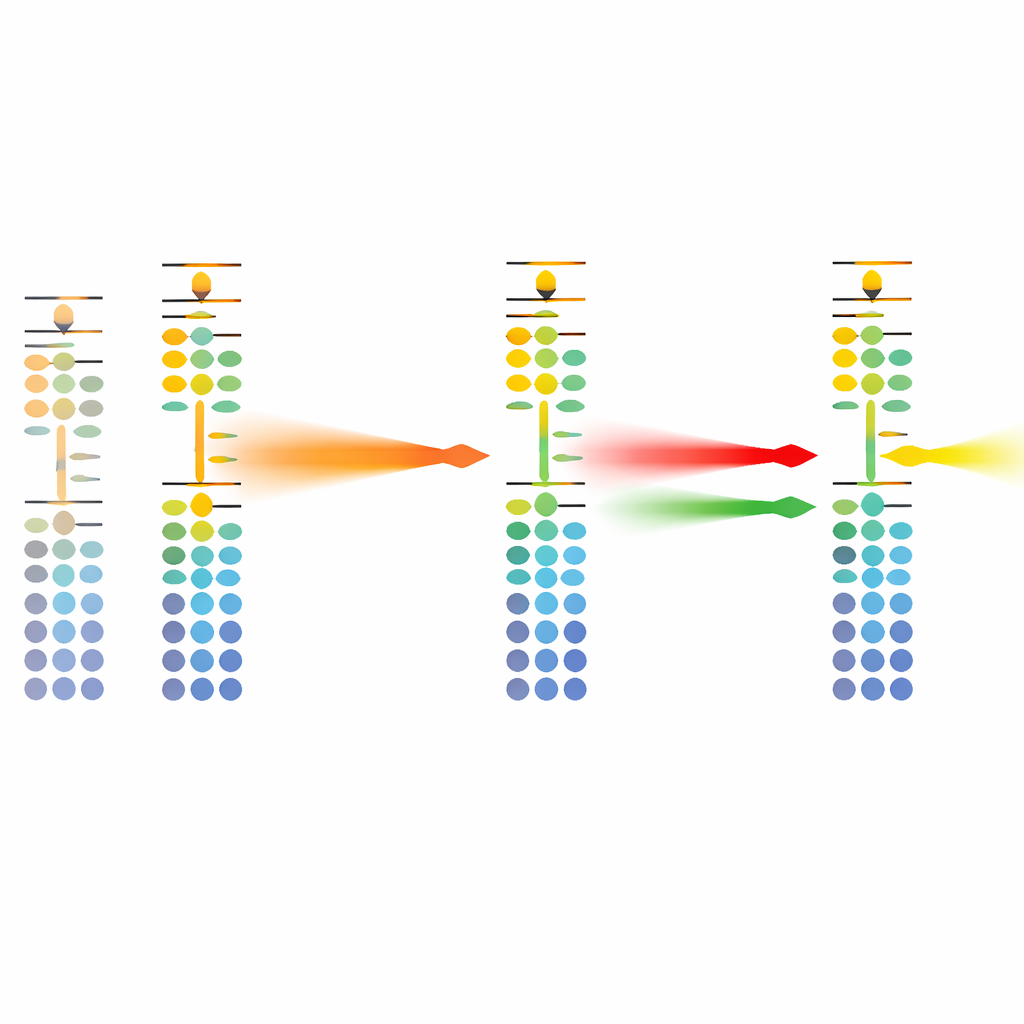
To understand the physics in detail, the authors built a theoretical model based on density matrix equations, which track populations and coherences among many sublevels of the atom. They focused especially on one circular polarization configuration as a representative case. Their calculations predicted how the optical pumping laser should reshape the modulation transfer spectra for different polarizations. When they compared these predictions with the measured signals, they found very good agreement: both showed large amplification of the main resonance features, with similar enhancement factors in amplitude and slope. This close match confirms that the observed improvements truly originate from controlled population reshuffling by the optical pumping beam, rather than from experimental artifacts.
What this means for future experiments
In accessible terms, this work shows how shining one color of light on rubidium atoms can “pre-load” them into the right internal states so that another color of light sees a much clearer, sharper response. That clear response is exactly what laboratories need to lock laser frequencies with high stability, even on tricky, non-cycling transitions that used to be avoided. The method should be useful for laser cooling, optical pumping, and precision control schemes that rely on the D1 line of rubidium, and it can likely be extended to other alkali atoms such as potassium and cesium. By turning weak atomic features into strong, tunable reference points, this approach expands the toolbox for building more reliable quantum and atomic-physics technologies.
Citation: Khan, S., Noh, HR. & Kim, JT. Optical pumping effect on modulation transfer spectroscopy of the \(D_1\) line of \(^{85}\)Rb atoms with non-cycling transition. Sci Rep 16, 13129 (2026). https://doi.org/10.1038/s41598-026-43427-6
Keywords: optical pumping, rubidium atoms, laser frequency stabilization, modulation transfer spectroscopy, atomic spectroscopy