Clear Sky Science · en
Preferential path attachment model for quantum key distribution networks
Why the shape of future quantum networks matters
Quantum key distribution networks promise ultra-secure communication, but building them across countries or even continents is not as simple as plugging in more fiber. Because quantum signals fade quickly and cannot be copied, engineers must stitch together many short links and special relay stations. This paper explores how such large, real-world quantum networks are likely to grow, and what their overall shape means for security, reliability, and cost.
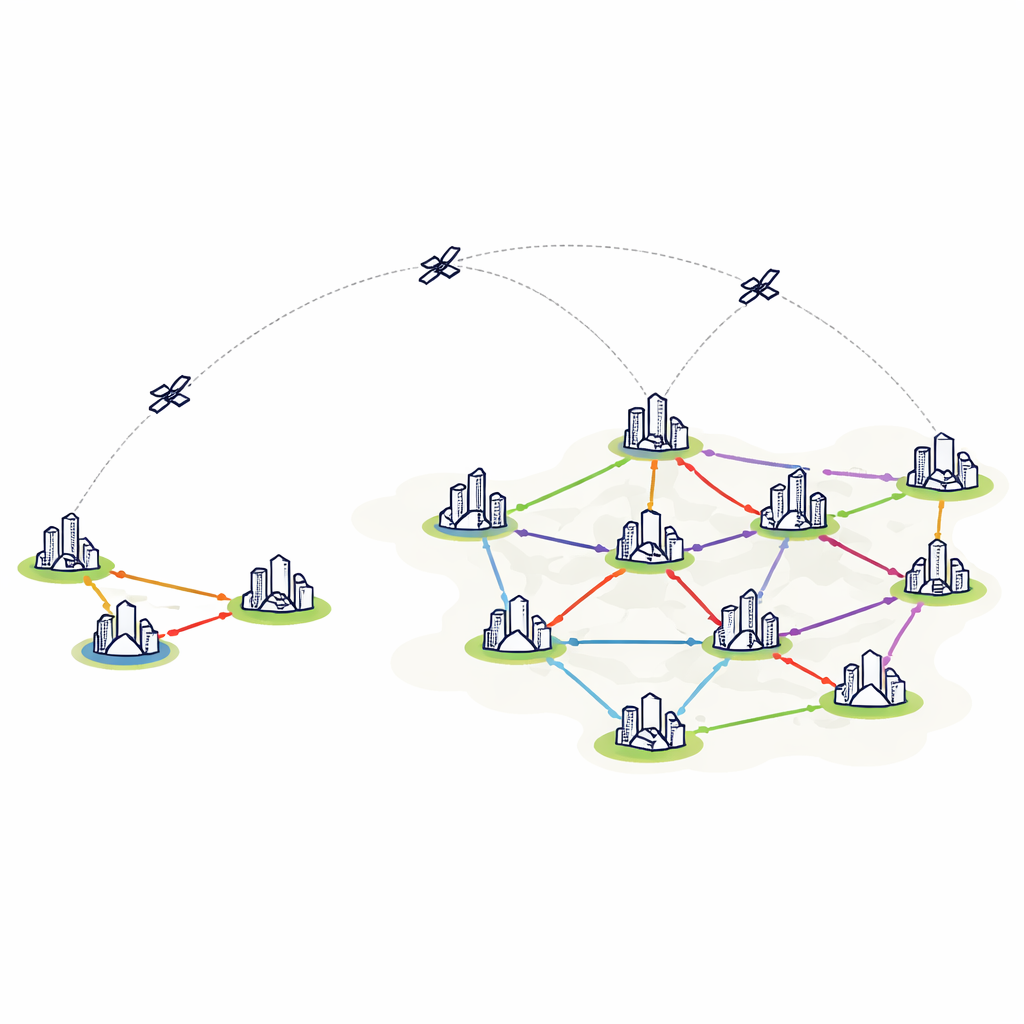
How quantum keys travel across many stops
In today’s quantum networks, two distant users cannot usually share secret keys directly; the quantum signals survive only over distances of roughly a hundred kilometers. To bridge larger gaps, operators place trusted relay nodes along the way. Neighboring nodes use quantum devices to create shared keys on each short link, and a higher-level management system then “hops” an encryption key along the chain using one-time-pad style operations. Each hop consumes key material at the intermediate node, so the more relay points a message must cross, the more quantum keys must be generated and stored. This makes the average distance between users, measured in number of hops, a crucial factor for both performance and cost.
From simple chains to more realistic layouts
A straight line of nodes, or a simple ring, is easy to analyze but fragile: removing a single busy node or link can split the network and force traffic onto long detours. Real deployments are expected to consist of many such chains linking distant cities, gradually connected together into a continent-scale backbone. The authors therefore introduce a more realistic construction rule: the network grows by adding entire path-like segments, each made of several nodes in series. The endpoints of each new segment are merged into existing nodes, forming trusted junctions where chains meet. A key design knob in this model is how often new segments connect at one end versus both ends, which determines how many loops and alternative routes appear.
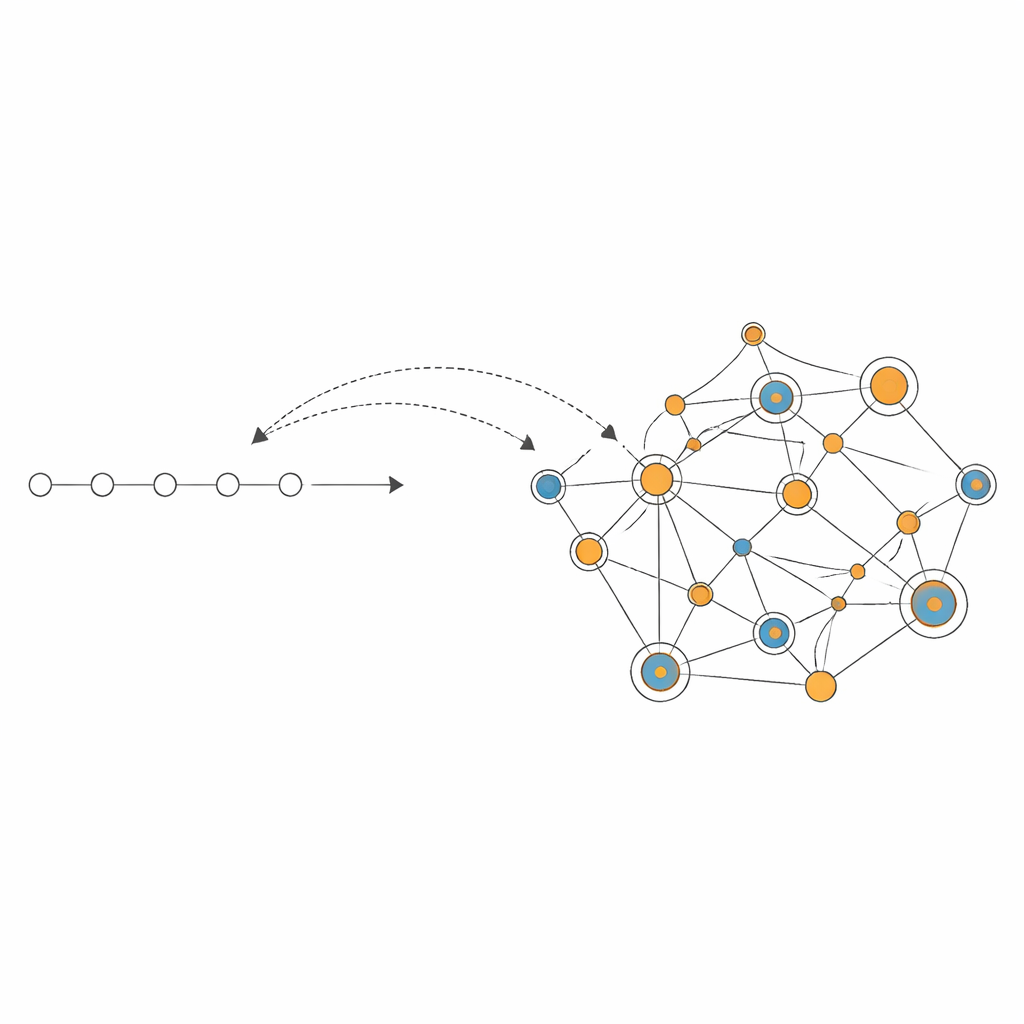
A new growth rule inspired by popular hubs
Many familiar infrastructures, from airline routes to parts of the Internet, develop prominent hubs because new connections are more likely to attach to already well-connected locations. This “preferential attachment” mechanism usually leads to a so-called scale-free structure with a few very large hubs and many small spokes, which keeps typical travel distances surprisingly short. The authors build this tendency into their “Preferential Path Attachment” model by letting the ends of each new segment prefer nodes that already have many connections. Using mathematical tools that track how node degrees change over time, together with detailed computer simulations, they derive the exact spread of connection counts across the network and compare it to classical scale-free models.
Why path-based quantum networks stay more ordinary
Despite including a bias toward well-connected nodes, the study finds that real-world constraints of path-based construction fundamentally limit hub growth. Because new nodes usually arrive bundled in segments and must remain in series, the resulting network does not exhibit the extreme hubs typical of scale-free systems. Instead, its behavior is closer to that of a random network: the probability of finding highly connected nodes falls off quickly, and the average distance between any two points grows roughly with the logarithm of the total number of nodes. The team also adds a controlled number of long-range “shortcut” links, meant to mimic satellite connections or express routes, and shows that while these links reduce typical distances and increase robustness, their benefits taper off beyond a moderate density.
What this means for secure quantum communication
For non-specialists, the takeaway is that the most realistic way to build large quantum key networks—by chaining together many short-distance segments—naturally leads to layouts that are reasonably robust and efficient, but not optimally compact. Key consumption due to relaying grows slowly but steadily as networks expand, and dramatic savings from a few giant hubs are unlikely under these constraints. Strategic use of a limited number of long-range links can meaningfully improve reliability and shorten routes, but endlessly adding more brings diminishing returns. These insights give planners of future national and international quantum networks a practical guide: they can estimate how much secure key material they will need, where extra links buy the most benefit, and why quantum infrastructure will probably resemble carefully reinforced transportation grids rather than ultra-hub-dominated superhighways.
Citation: Weiss, J., Lucki, M., Mařík, R. et al. Preferential path attachment model for quantum key distribution networks. Sci Rep 16, 13578 (2026). https://doi.org/10.1038/s41598-026-43414-x
Keywords: quantum key distribution networks, network topology, preferential attachment, satellite links, secure communication