Clear Sky Science · en
Properties of foamed concrete utilizing Fe(II) as foam stabilizer for hydrolyzed pumpkin seed protein
Greener Walls from Everyday Seeds
Keeping buildings warm in winter and cool in summer often depends on what is hidden inside their walls. One promising material is foamed concrete, a type of lightweight concrete filled with tiny air bubbles that act like insulation. This study explores an unexpectedly simple source for making that foam more stable and more sustainable: proteins extracted from pumpkin seeds, strengthened with a small dose of iron. The work shows how tuning the way these natural ingredients are processed can yield tougher, more water‑resistant and more uniform foamed concrete for energy‑efficient buildings.
Why Bubbly Concrete Matters
Foamed concrete is full of sealed air pockets that make it light, fire‑resistant and good at blocking heat and sound. But its performance depends on how long the foam bubbles survive while the concrete sets. If bubbles burst or merge, the finished material can become uneven, weak or leaky. Many current foaming agents rely on synthetic chemicals called surfactants, which can be costly, energy‑intensive to produce and sometimes difficult to break down in the environment. Animal‑based protein foams work well but raise concerns about supply and processing. Plant‑based proteins are more sustainable, yet they typically form weaker foams. The authors set out to fix this weakness without relying on extra synthetic additives.
Turning Pumpkin Seeds into a Foaming Ingredient
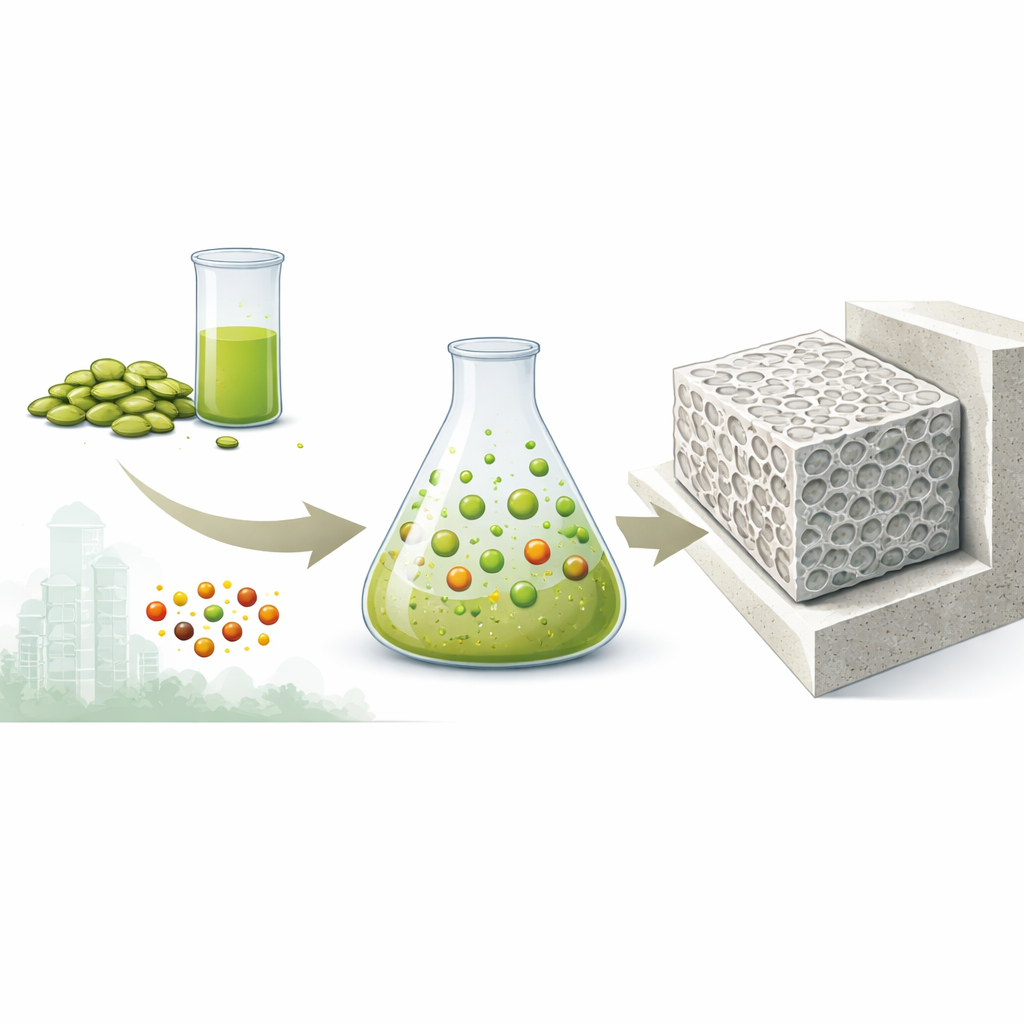
The team began by treating pumpkin seeds in a hot alkaline solution to pull proteins into water and partially break them into smaller pieces, creating hydrolyzed pumpkin seed protein. They systematically varied three simple processing conditions—how basic the solution was (pH), the temperature and the reaction time—and measured how much foam the resulting liquid could produce. Using a statistical optimization method, they found a sweet spot: a pH of 11.5, a temperature of 55 °C and a reaction time of 1.5 hours. Under these conditions, the pumpkin protein solution whipped up the largest, most consistent foam volume, showing that careful control of processing can turn a common seed into an effective foaming agent.
Iron as a Quiet Bubble Bodyguard
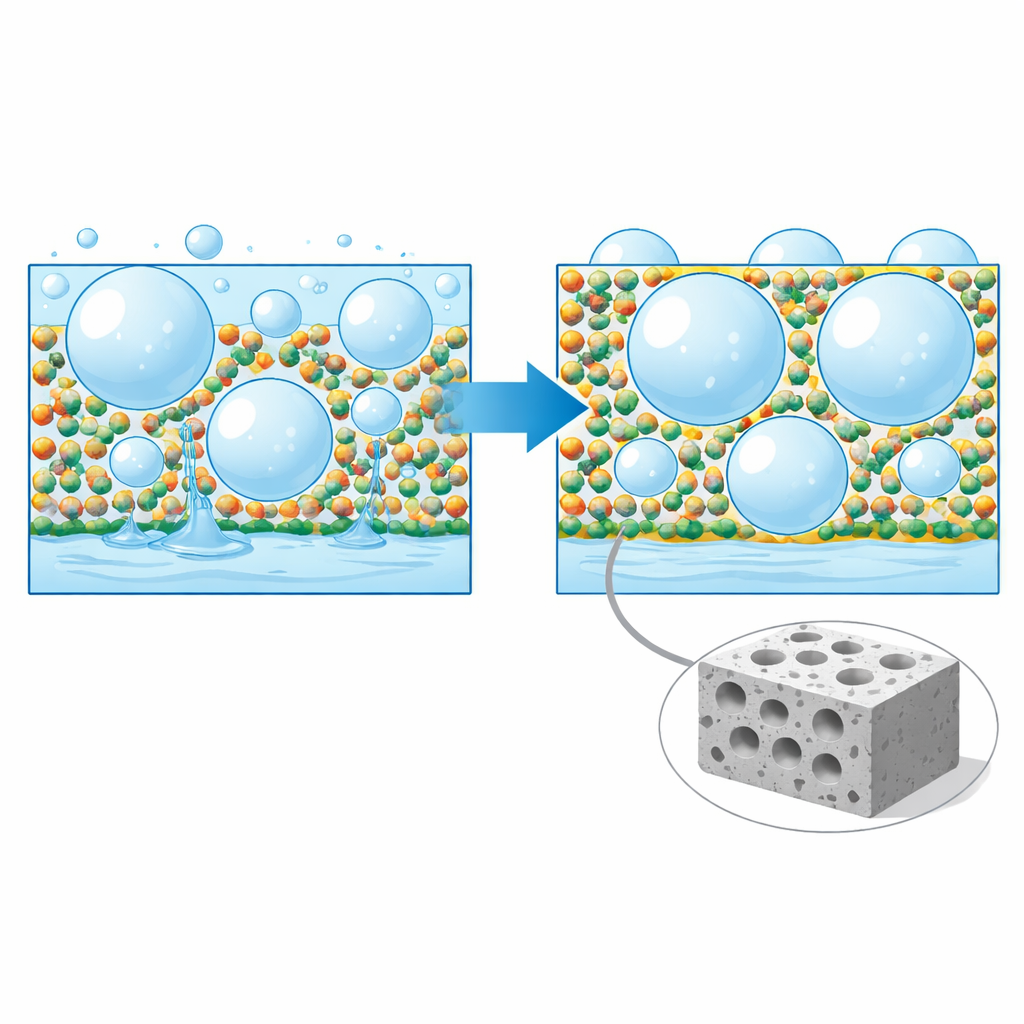
Next, the researchers introduced iron in its Fe(II) form, dissolved as ferrous sulfate, into the pumpkin protein solution. At the molecular level, iron ions latch onto parts of the protein that dislike water, encouraging protein molecules to clump into larger, partly water‑repelling particles. Microscopy and X‑ray scattering experiments confirmed that these iron–protein clusters grow in size and change structure when more iron is added. These enlarged clusters gather at the surfaces of bubbles, forming thicker, stronger liquid films. As a result, the foam drains liquid more slowly, resists collapse and shows higher density and viscosity, all hallmarks of a sturdier bubble network.
Better Bubbles Make Better Concrete
To see whether these improved foams matter in real construction materials, the team compared concrete made with their iron‑stabilized pumpkin foam to concrete made with a commercial plant‑protein foaming agent. Both concretes had similar overall density, but their behavior diverged sharply. The iron‑enhanced foam produced concrete with higher compressive strength after curing, lower drying shrinkage, and dramatically reduced water absorption. X‑ray imaging and electron microscopy revealed why: the upgraded concrete contained more uniform, smaller pores with smoother, more complete walls and fewer cracks. The bubbles created by the iron‑pumpkin system translated directly into a more even and robust internal structure.
What This Means for Future Buildings
In simple terms, the study shows that a foaming agent made from processed pumpkin seeds and a modest amount of iron can outperform standard plant‑based products while remaining based on abundant, renewable raw materials. By strengthening the microscopic films around bubbles, iron helps preserve a fine, even foam that leads to stronger, less leaky and more dimensionally stable foamed concrete. This approach points toward greener insulating materials that waste less energy over a building’s lifetime, demonstrating how subtle tweaks in chemistry can have large, practical effects on the places we live and work.
Citation: Song, N., Zhang, Z., Ma, C. et al. Properties of foamed concrete utilizing Fe(II) as foam stabilizer for hydrolyzed pumpkin seed protein. Sci Rep 16, 12934 (2026). https://doi.org/10.1038/s41598-026-43413-y
Keywords: foamed concrete, pumpkin seed protein, green building materials, foam stability, iron-based additives