Clear Sky Science · en
Evaluating cross-dataset transfer learning for photoplethysmography-based blood pressure estimation
Why blood pressure without a cuff matters
High blood pressure is a leading cause of heart attacks and strokes, yet most people only have it checked occasionally with an arm cuff at the doctor’s office. This study explores how wearable sensors and artificial intelligence could estimate blood pressure continuously, without squeezing your arm, by learning from large hospital databases and then adapting to new devices such as smartwatches. The work tackles a key obstacle: how to make algorithms trained in one setting still work well when the sensor and environment change.
From arm cuffs to light-based sensing
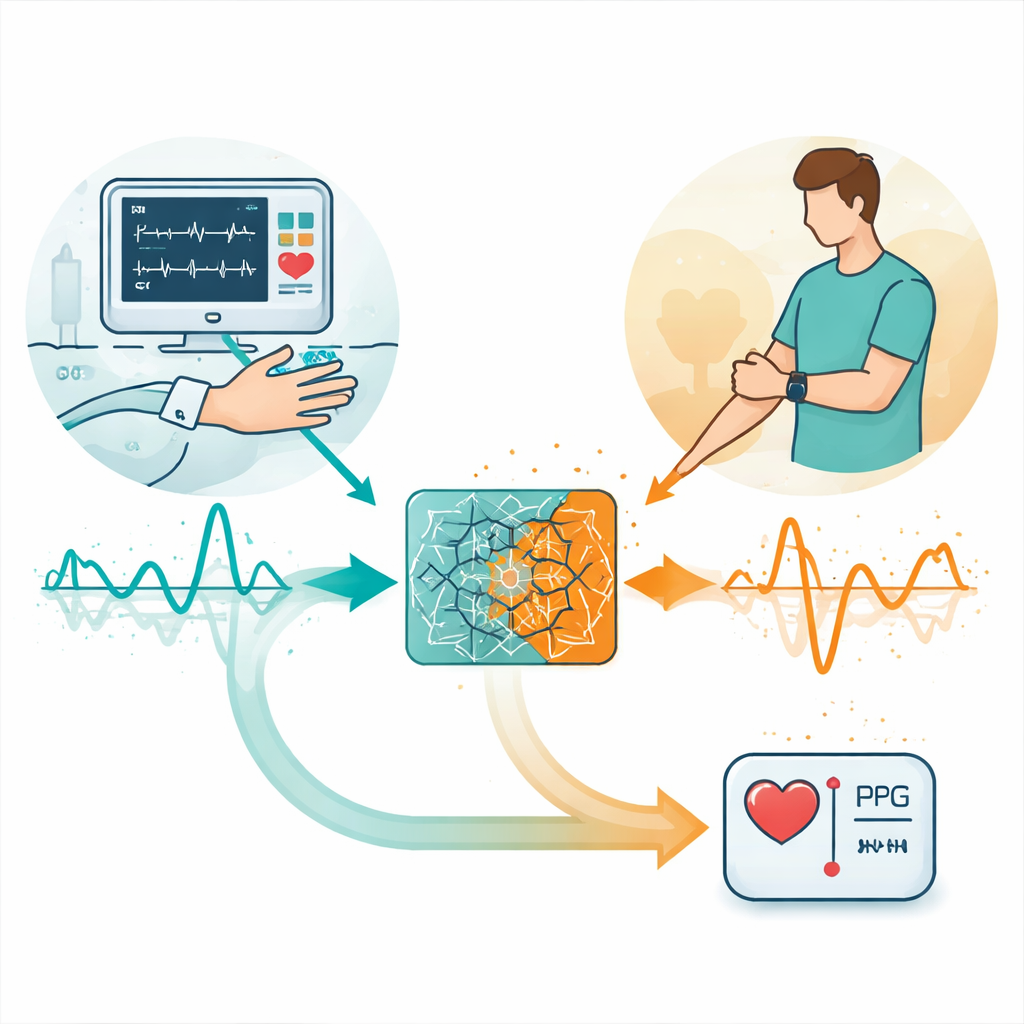
Traditional blood pressure cuffs are reliable but awkward for frequent use. They require inflation until blood flow is briefly stopped, can be uncomfortable, and only capture a few readings a day. An alternative is photoplethysmography, or PPG, which uses a small light source and detector, much like those in pulse oximeters and wearables, to pick up tiny changes in blood volume with each heartbeat. These light-based waveforms carry information related to blood pressure, raising the possibility of cuffless monitoring that could work during daily life, at home, or on the move.
Teaching an algorithm to read pulse waves
Instead of handcrafting a long list of mathematical features from PPG signals, the authors use a deep learning model that learns patterns directly from short, five-second snippets of the waveform. They start from an existing architecture that combines convolutional layers (good at spotting shapes) with recurrent layers (good at following time patterns), then streamline it so it has less than half the original number of trainable parameters. This downsized network is easier to train when only a few hours of data per person are available, yet still captures the complex relationships between pulse wave shape and blood pressure.
Making hospital-trained models work elsewhere
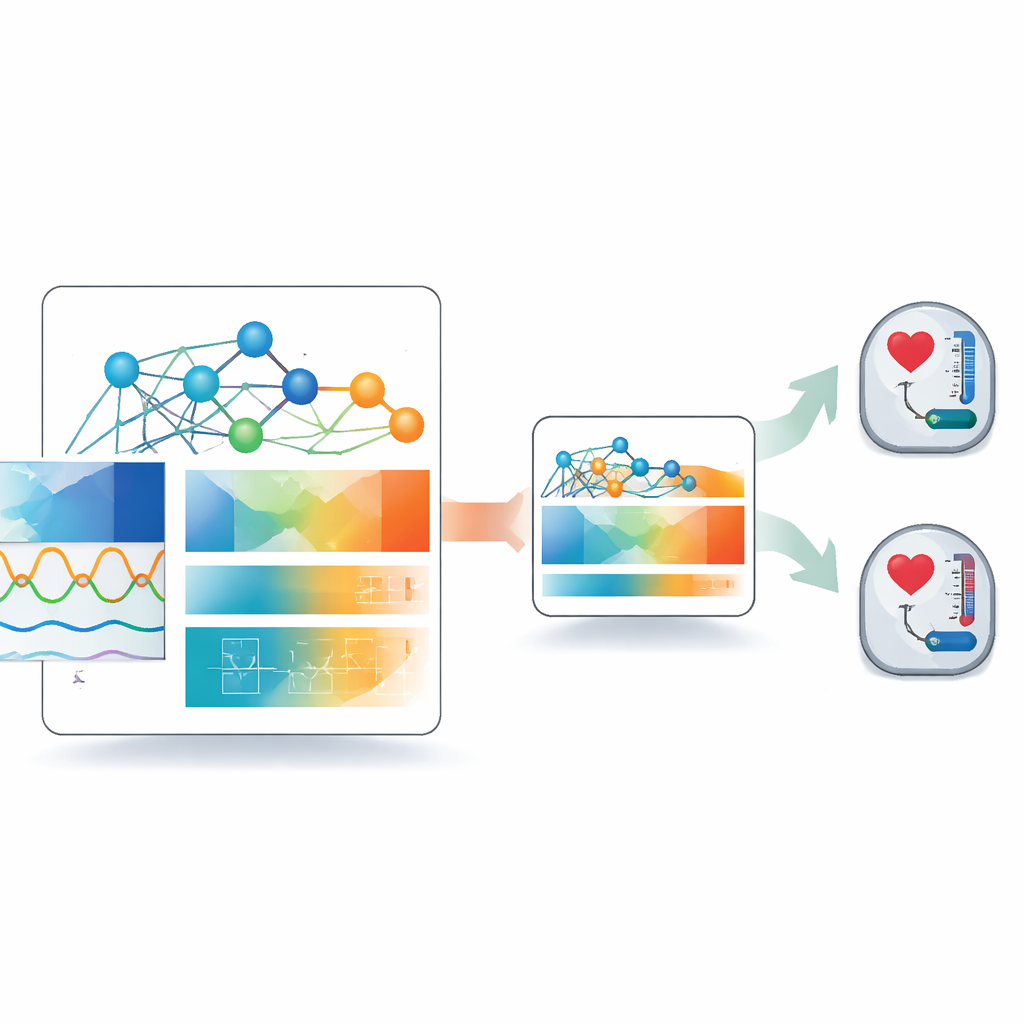
A major hurdle is that PPG signals change when the hardware, recording site, or environment changes. The team tests whether “transfer learning” can help. They first train their neural network using data from one large hospital database, where patients have fingertip PPG and invasive blood pressure recorded continuously. Then they fine-tune only selected deeper layers of the model for each new person using a much smaller amount of data from a second, separately collected database. This cross-dataset setup mimics what happens in practice, where a company might start from public hospital data and then adapt its model to a new device or user with limited personal recordings.
How well the adapted models perform
The researchers compare three approaches: training from scratch on each person, transfer learning within a single database, and transfer learning across databases. On 200 patients drawn from two large datasets, cross-dataset transfer learning improves average error by about 13 percent compared with training from scratch, reaching roughly 3.4 mmHg for systolic and 1.8 mmHg for diastolic pressure. These results meet key international performance benchmarks used to judge blood pressure devices. Importantly, models adapted across databases perform within about 1 percent of models adapted within the same database, and the small difference is not statistically meaningful. The authors also show that transfer learning remains helpful when very little data are available for fine-tuning, and that it still boosts accuracy when applied to a smaller, non-hospital dataset collected with different sensors.
What this means for everyday health monitoring
To a non-expert, the takeaway is that an algorithm trained on large banks of hospital data can be successfully “re-used” and lightly adjusted for new people, new devices, and new environments, without needing massive new clinical trials each time. By carefully cleaning the signals, trimming the model size, and updating only the most informative layers for each user, the study shows that continuous, cuffless blood pressure estimation from light-based sensors can reach error levels compatible with existing standards. While more work is needed in real-world, active daily-life conditions and on wrist-based sensors, this cross-dataset transfer learning strategy brings practical, wearable blood pressure tracking another step closer.
Citation: Kim, Y.C., Baek, H.J. Evaluating cross-dataset transfer learning for photoplethysmography-based blood pressure estimation. Sci Rep 16, 10725 (2026). https://doi.org/10.1038/s41598-026-43409-8
Keywords: cuffless blood pressure, photoplethysmography, wearable health monitoring, deep learning, transfer learning