Clear Sky Science · en
Study on detachment mechanism of rice wet extruded mixtures adhering to cleaning sieve for combine harvester
Why sticky rice chaff matters to your dinner
Every grain of rice that reaches your plate has survived a mechanical gauntlet in the field. Modern combine harvesters cut, thresh and clean rice in one pass, but when plants are wet—such as in the early morning or after rain—sticky fragments of leaves, stems and husks can clog the machine’s cleaning sieve. This blockage makes more good grain spill out as waste. The study reported here asks a very down‑to‑earth question with big implications for food security: why exactly do these wet rice mixtures stick so stubbornly, and what simple changes could keep more of the harvest out of the mud and in the bin?
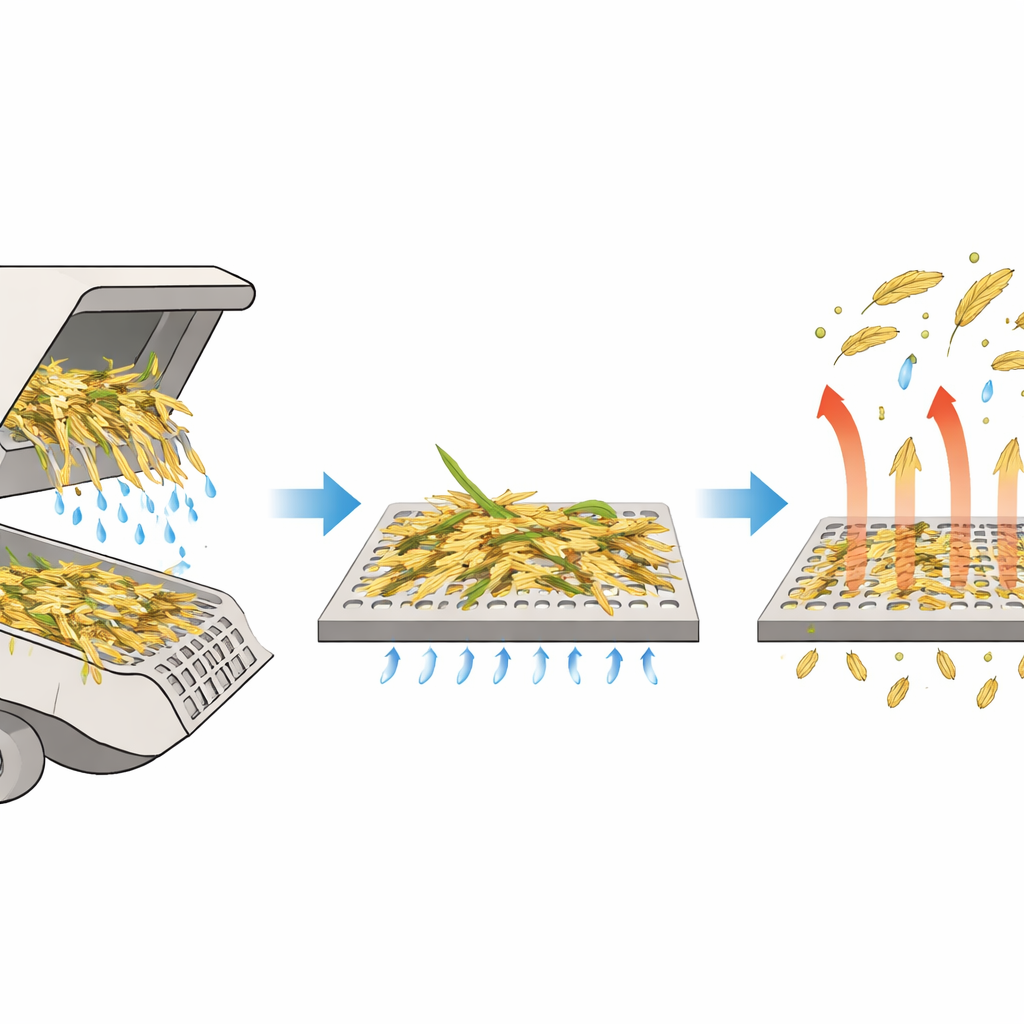
What happens inside a rice harvester
China plants rice on around 30 million hectares, and combine harvesters do much of the work. Inside each machine, a vibrating, perforated metal plate called a cleaning sieve helps separate heavy grains from lighter bits of straw and chaff using airflow. Under humid conditions, however, the material dropping onto the sieve does not behave like a loose mix of dry particles. Instead, fragments of leaves, broken stalks, husks, dust and small impurities clump together into wet aggregates that plaster themselves over the sieve. These clumps trap grains and block the small openings, sharply reducing cleaning performance and increasing grain loss.
Seeing stickiness up close
To uncover why these mixtures cling so well, the researchers collected real wet material from a rice field in Jiangsu Province, China, during a humid November harvest. Under a zoom microscope, they saw that grains, stems and fine impurities were covered by discontinuous films of water and had rough surfaces with bumps, stripes and tiny burrs. This roughness, together with the thin liquid films, encourages microscopic particles to attach firmly and promotes clump formation. Measurements showed that light impurities had the highest surface moisture and lowest density, stems had the lowest moisture, and grains were heaviest. The team also measured how water droplets sat and spread between different material pairs and the metal sieve, quantifying how easily liquid bridges could form between them.
Invisible liquid bridges that glue particles to the sieve
The heart of the study is a detailed look at liquid bridges: tiny necks of water that connect a wet particle to the sieve surface. The authors modeled the mixtures as spherical wet particles exposed to airflow and analyzed the forces acting on them. They showed that, for small stems and especially for light impurities, the attractive force from a liquid bridge can greatly exceed the particles’ own weight, dominating whether they detach or remain stuck. This bridging force depends on how far the particle is from the sieve and on its surface moisture. As distance grows, the bridge stretches and its pull weakens; the team calculated how this decline behaves for stems and fine impurities at different moisture levels. They also used rolling‑detachment theory to derive a “critical shear velocity”: the airflow strength needed to roll a particle off the sieve. Smaller‑diameter particles and light impurities needed higher airflow to detach, explaining why fine, wet debris is hardest to remove.
How air humidity and heat change the game
Because the liquid bridge strength is tied to surface moisture, the researchers next linked that moisture to the humidity inside the cleaning chamber. In controlled tests, they placed grains, stems and light impurities in boxes at different relative humidities and measured how their surface moisture changed, building simple mathematical relationships between humidity and wetness. These relationships fed back into the liquid‑bridge model, showing that lowering air humidity reduces surface moisture and thus weakens the liquid glue holding particles to the sieve. To test a practical solution, they used a hot‑air cleaning bench that blows warmed air through a vibrating sieve. When they raised the fan outlet temperature from 30 °C to 45 °C—effectively drying the mixtures slightly as they passed through—the cleaning grain loss rate dropped from 1.20% to 0.68, a reduction of about 43 percent.
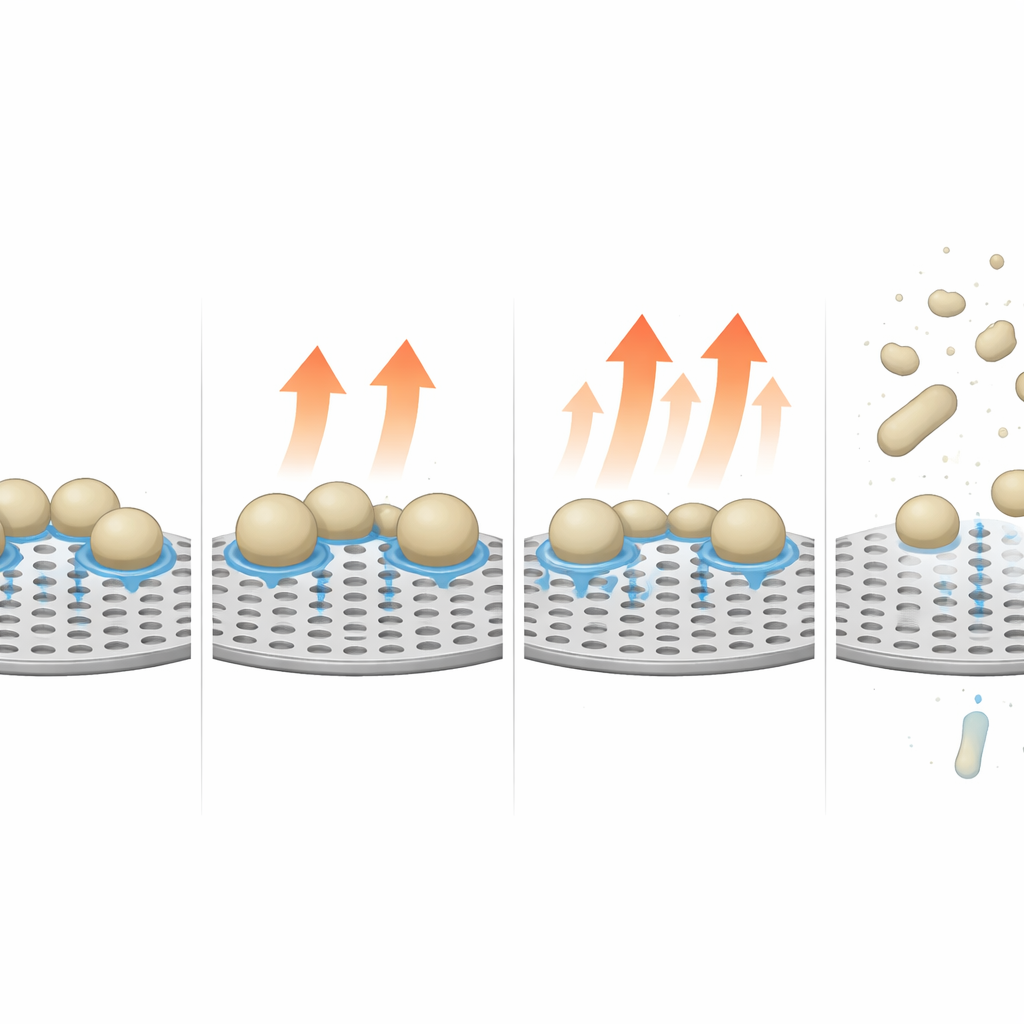
What this means for better rice harvests
In everyday terms, this work shows that the main culprit behind clogged sieves is not just “wet rice” in general, but tiny water bridges that form between rough, moist plant fragments and the metal sieve. These bridges act like microscopic glue, especially for the smallest, lightest pieces of debris. By understanding how particle size, shape, surface wetness and air humidity affect these invisible connections, engineers can design harvesters that keep sieves cleaner—whether by adjusting airflow, warming the cleaning air, or reshaping components to reduce contact. The experiments confirm that modest heating of the cleaning airflow can significantly cut grain losses, offering farmers a relatively simple way to save more of the crop when the weather is damp.
Citation: Liu, Y., Zhang, T. & Zeng, L. Study on detachment mechanism of rice wet extruded mixtures adhering to cleaning sieve for combine harvester. Sci Rep 16, 13330 (2026). https://doi.org/10.1038/s41598-026-43403-0
Keywords: rice harvesting, combine harvester cleaning, wet particle adhesion, liquid bridge force, hot air flow