Clear Sky Science · en
Effects of plate interface frictional heterogeneities on earthquake cycle dynamics in subduction zones
Why some big quakes stop while others race on
Along the world’s deep ocean trenches, huge earthquakes sometimes rip through hundreds of kilometres of fault, while other times ruptures stall or slip quietly without shaking. This study asks a simple but vital question: when rough features on a subducting plate help to stop destructive earthquakes, and when they fail to do so. By combining table‑top experiments with computer models and real fault systems in Alaska and the Himalaya, the authors uncover a surprisingly simple size rule that helps decide whether such features act as reliable blockers or merely speed bumps for megathrust quakes. 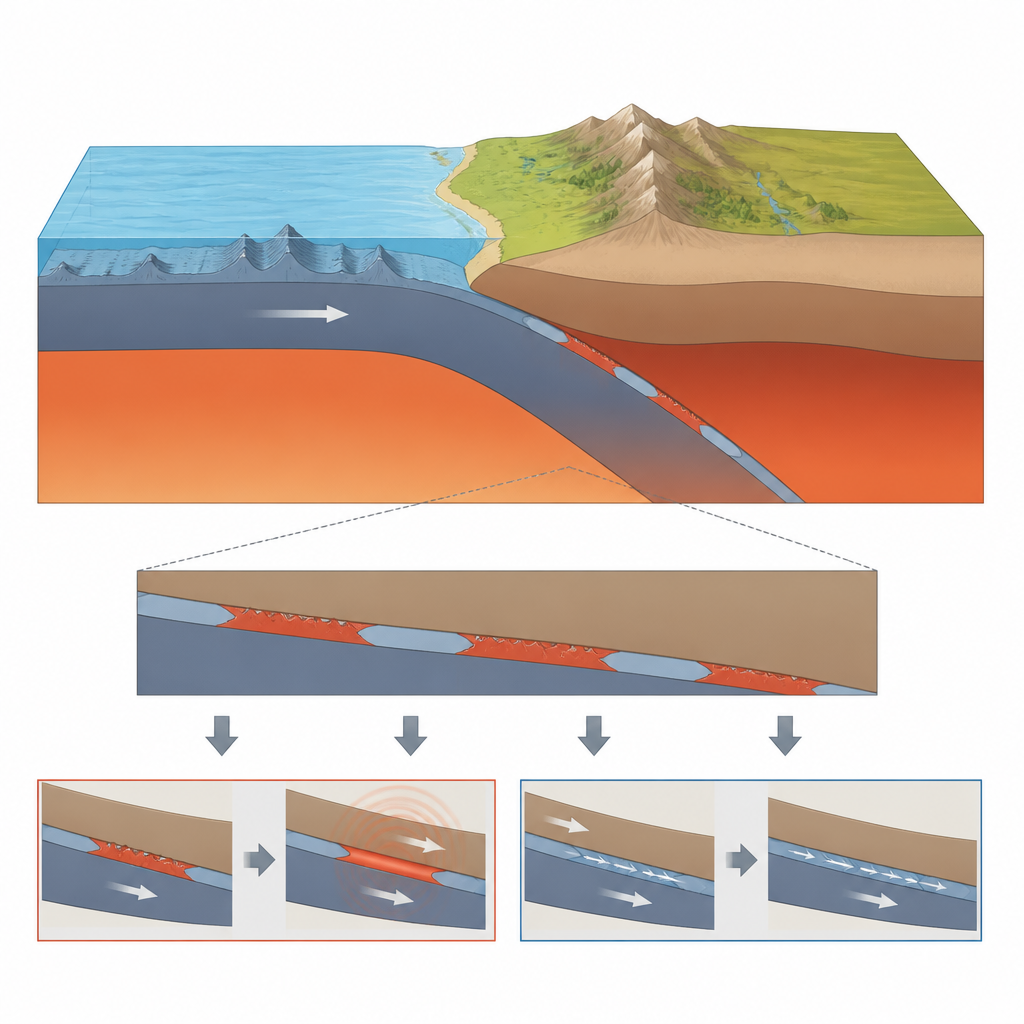
Hidden roughness beneath the sea
Where an oceanic plate dives beneath a continent, the plate surface is far from smooth. Seamounts, ridges and other bumps are dragged into the subduction zone, creating patches where the plates either lock together and store strain or creep past one another more gently. Locked patches are prone to sudden, damaging earthquakes, while creeping patches can behave as barriers that slow or stop ruptures. Seafloor surveys and historical quakes show that some rough regions appear to halt great earthquakes, but in other places similar features coexist with powerful events. This puzzle suggests that not only the presence but also the size and arrangement of these frictional patches control how earthquake cycles unfold.
Earthquake cycles in a tabletop lab
To strip the problem down to basics, the researchers built a spring‑block experiment that mimics a fault patch sliding over a mixed surface. Smooth, fine sandpaper represents strong, locked zones that fail in sudden “stick‑slip” events like regular earthquakes. Coarser sandpaper behaves more weakly, sliding more steadily and standing in for creeping barriers. When a single circular barrier is small, the system produces repeated, sharp slips with clear seismic signals. As the barrier grows, the slips become smaller and more irregular, until beyond a critical area between about 8 and 11 percent of the contact surface the sudden events vanish and motion becomes slow or aseismic. The team also arranged many small barriers in lines and clusters. They found that barriers aligned perpendicular to the direction of sliding still allow a mix of fast and slow slips, while barriers aligned parallel to sliding favour largely quiet, aseismic motion.
A simple length ratio that matters
From these lab results the authors distilled a single key measure: the along‑fault length of a creeping barrier divided by the total length of the fault segment it sits within. When this ratio stays below roughly one third, adjacent locked areas can fail together, allowing ruptures to jump across the barrier. Once it grows to around 0.4 or more, fast stick‑slip events no longer cross the barrier and motion there is dominated by slow or aseismic slip. 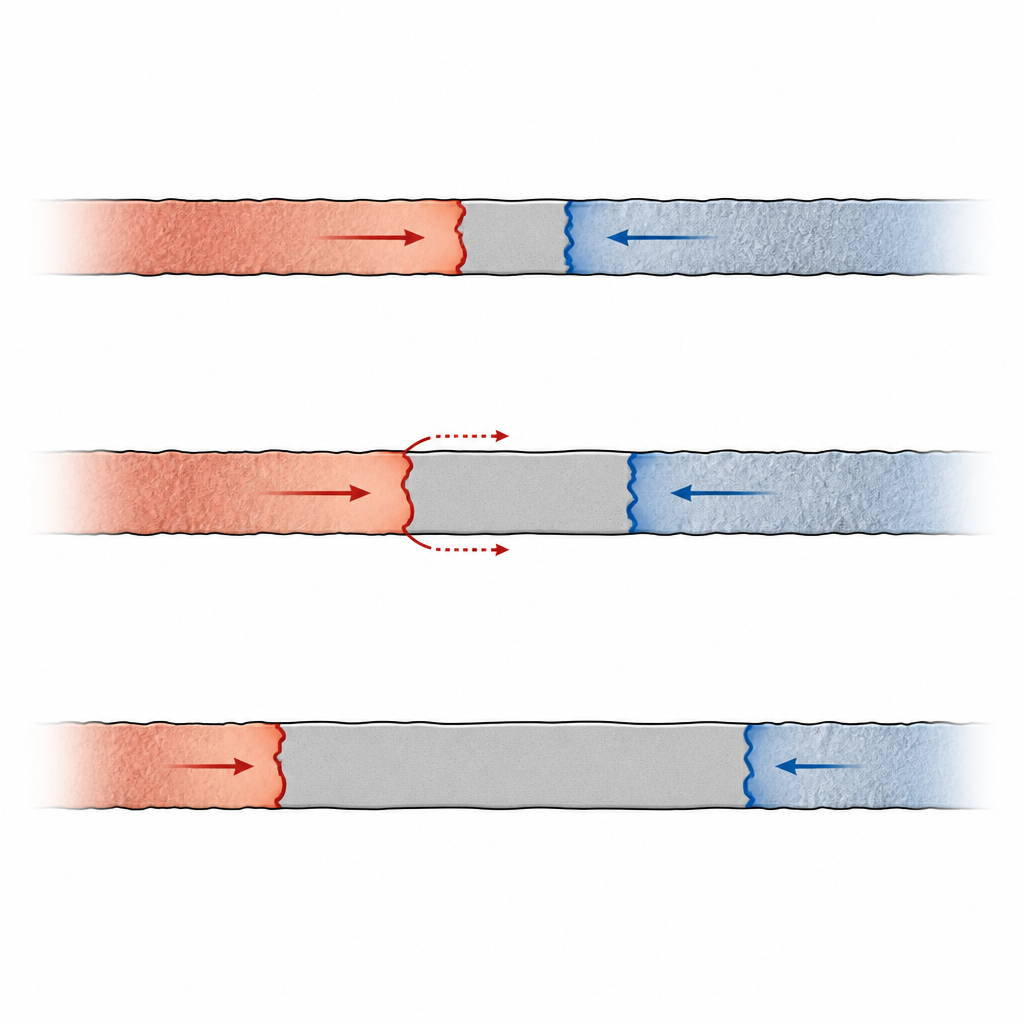
From the Shumagin Gap to the Himalaya
The researchers then applied the same framework to two very different tectonic settings. In the Alaska–Aleutian subduction zone, a relatively quiet section known as the Shumagin Gap separates neighbouring segments that have produced great earthquakes. Geodetic data suggest that this gap mostly creeps rather than locking. Scaled in their model, the creeping Shumagin section occupies about 0.38 of the combined segment length, right within the critical range where a barrier should reliably block large through‑going ruptures. In contrast, ridges beneath the Himalayan front, long suspected to divide great earthquakes into separate segments, occupy a much smaller fraction of the arc length. The simulations show that under realistic loading conditions, ruptures can often cross these features, implying that some historical Himalayan earthquakes may have been larger and longer than the sparse surface evidence alone would suggest.
What this means for future hazard
This work suggests that whether rough patches on a subduction interface behave as dependable stopping points for earthquakes depends not just on their presence, but on how large they are along the fault and how they line up with plate motion. A simple, dimensionless ratio of barrier length to fault length emerges as a useful guide: when that ratio is small, neighbouring locked zones can link up in multi‑segment earthquakes; when it approaches two fifths, creeping patches can act as lasting barriers that keep ruptures contained. While real subduction zones add more complications such as fluids, sediments and complex 3D shapes, this study shows that a first‑order geometric rule can help identify where the largest earthquakes are most likely to stop and where they may cascade across segments.
Citation: Ray, S., Ghosh, A., Kundu, B. et al. Effects of plate interface frictional heterogeneities on earthquake cycle dynamics in subduction zones. Sci Rep 16, 15396 (2026). https://doi.org/10.1038/s41598-026-43399-7
Keywords: subduction zone, megathrust earthquake, fault friction, seismic barrier, earthquake cycle