Clear Sky Science · en
Restricting facial mimicry does not impair emotion recognition or influence the evaluation of human affect vocalizations and instrumental sounds
Why our faces copy the feelings we hear
When we listen to someone laugh or cry, tiny muscles in our own faces often move in response. Many scientists have argued that this subtle copying helps us understand other people’s emotions. This study asks a simple but important question: if we stop the face from moving, do we actually get worse at telling what others feel from the sounds they make, or from emotional music?
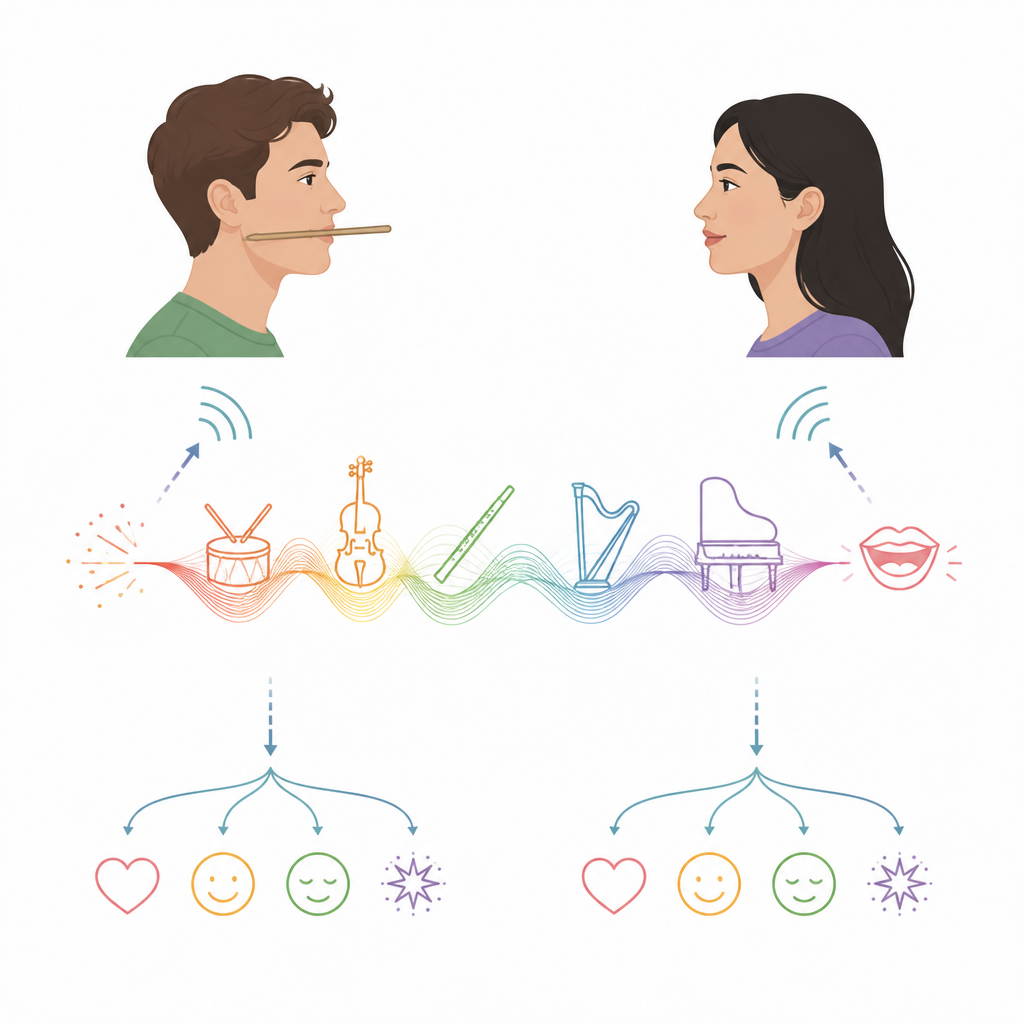
How people usually think mimicry works
For decades, researchers have known that people tend to mirror one another’s expressions, gestures, and posture. Some see this mimicry as a kind of social glue that builds closeness. Others view it as an automatic habit we pick up through learning. A third idea, called the embodied simulation view, suggests that copying expressions is part of how we mentally “recreate” what others feel. In that view, moving the same muscles as a smiling or crying person should help us quickly and accurately read their emotions.
A simple way to block facial movement
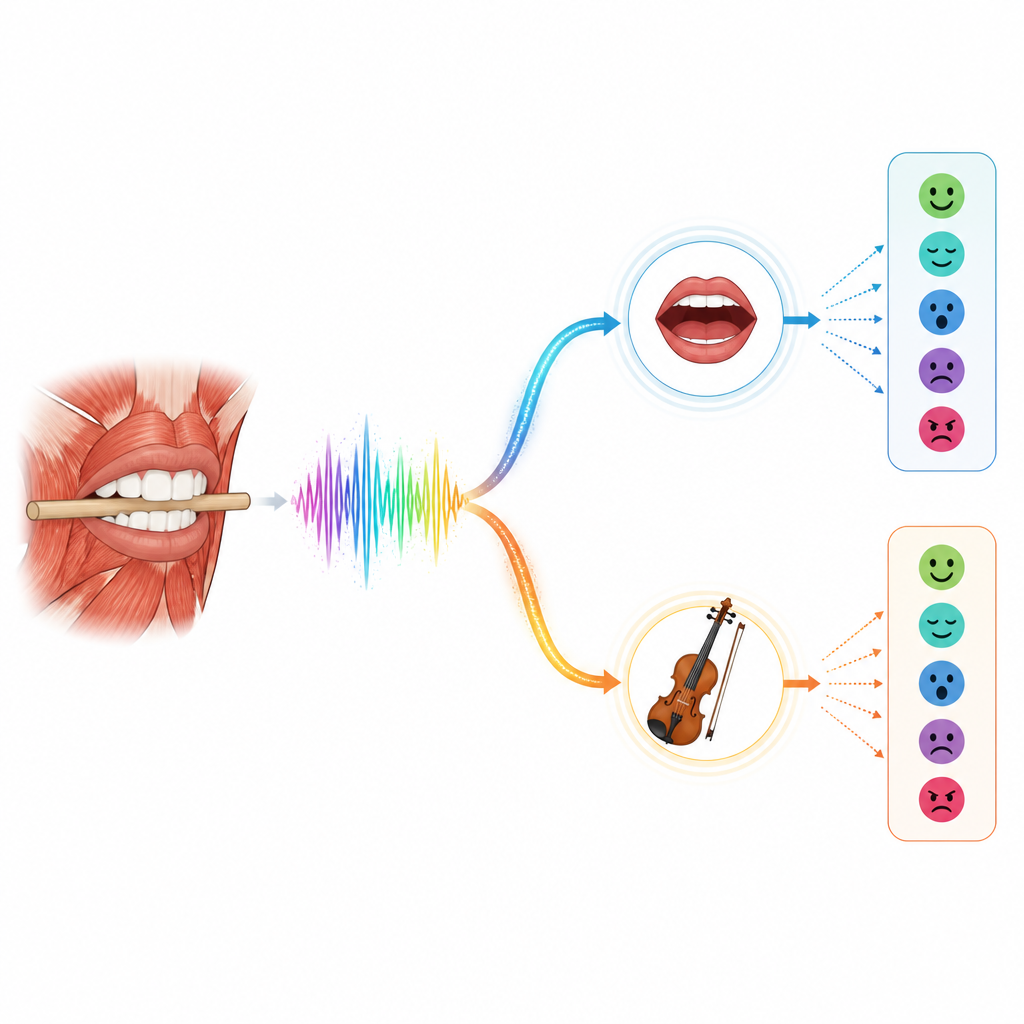
To test this idea, the authors used a classic trick: having people hold a thin stick between their teeth. This position tenses the lower face and limits normal smiling movements. In one block of trials, volunteers held the stick with their teeth, which restricted facial movement. In another block, they held it loosely with their lips, leaving the lower face free. While doing this, 66 young adults listened to short emotional sounds: human vocalizations such as laughs and cries, and brief melodies played on violin or clarinet designed to convey fear, sadness, happiness, or a neutral mood.
Listening, judging, and rating the sounds
After each sound, participants chose which emotion it expressed in a four-option task and then rated how positive or negative it felt, and how arousing it was, using visual sliders. Earlier work had hinted that blocking facial movement might make all sounds feel slightly more positive, and that human vocal sounds, which are naturally linked to facial movements, would be especially affected. The researchers therefore looked carefully at accuracy, speed, and ratings for each emotion and for human versus instrumental sounds, using both standard statistics and Bayesian methods that can weigh evidence for no effect as well as for an effect.
What facial restriction did and did not change
The key result is straightforward: limiting facial movement did not reliably harm people’s ability to recognize emotions in the sounds. Accuracy and reaction times were essentially the same whether the stick was between the teeth or lightly held by the lips, across all emotions and both sound types. Instrumental sounds were generally harder to classify and took longer to judge than human vocalizations, especially for fear, sadness, and neutral tones, but this difficulty had nothing to do with the facial restriction. The study also failed to replicate the earlier finding that blocking lower-face movement makes all sounds seem slightly more positive; ratings of pleasantness and arousal were not influenced by the stick position.
What this means for body and mind
For a general reader, the message is that our subtle habit of copying others’ expressions may not be as central to hearing-based emotion reading as some theories propose, at least in simple lab tasks with clear emotional signals. People could still tell laughs from cries and happy tunes from sad ones even when their own smiles were mechanically constrained. The authors do not claim that facial feedback never matters; instead, they suggest its role may be limited, highly dependent on context, and stronger in more ambiguous or lifelike situations. Their work adds to a growing call for larger, carefully designed studies to pinpoint when and how bodily reactions truly shape our emotional understanding.
Citation: Wołoszyn, K., Hohol, M. & Winkielman, P. Restricting facial mimicry does not impair emotion recognition or influence the evaluation of human affect vocalizations and instrumental sounds. Sci Rep 16, 14558 (2026). https://doi.org/10.1038/s41598-026-43390-2
Keywords: facial mimicry, emotion recognition, vocalizations, music and emotion, embodied cognition