Clear Sky Science · en
Automated real-time surveillance of Bithynia snails using a comparative YOLO based approach for liver fluke host detection
Why tiny snails matter for human health
In parts of Southeast Asia, tiny freshwater snails play a big role in spreading a parasitic liver fluke linked to a deadly bile duct cancer. Doctors and field workers need to know exactly which snail species are present in ponds and rice fields, but many of these snails look almost identical. This study explores whether modern artificial intelligence can watch for these snails in real time, helping health workers track disease risk faster and more accurately.
The snails behind a hidden cancer risk
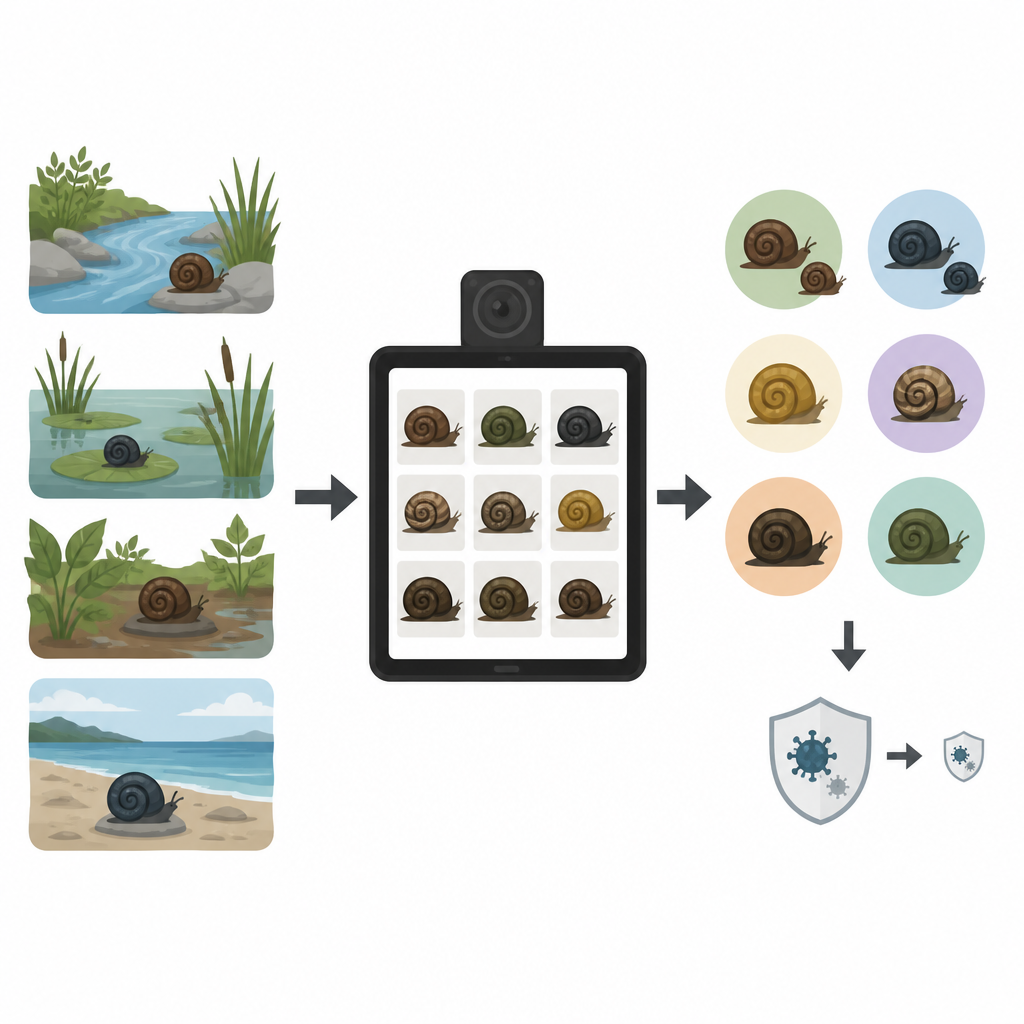
The focus of this research is on Bithynia snails, small freshwater snails that act as required hosts for the liver fluke Opisthorchis viverrini. When people eat raw or undercooked fish from waters where these snails live, they can become infected. Long term infection greatly raises the risk of cholangiocarcinoma, a hard to treat cancer of the bile ducts. Several Bithynia species and subspecies share overlapping habitats across Thailand and neighboring countries, and they can be very hard to tell apart by eye. Traditional methods based on shell details or DNA tests are slow and labor intensive, making it difficult to monitor large areas.
Teaching computers to spot and sort snails
The team tested four versions of a popular image recognition system known as YOLO, which can find and label objects in pictures almost instantly. They collected thousands of high resolution images of snails from 47 sites across Thailand, including laboratory shots on a plain white background and natural scenes in rice paddies, canals, ponds, and irrigation channels. Experts first identified the snails using standard taxonomic keys and then drew boxes around each specimen in the images. Three medically important Bithynia types and a fourth "unknown" group were used to train the computer models to both detect snails and decide which kind they were.
Putting AI and human experts to the test
After training, the researchers compared the four YOLO models with five human specialists using a separate set of images that none of the models had seen before. Humans were perfect at spotting that a snail was present, never missing a specimen. The AI systems, in contrast, failed to detect a small number of snails, especially when they were tiny, overlapped, dirty, or partly hidden in cluttered backgrounds. However, once a snail was found, the best model, called YOLOv10, was much better than humans at saying which species it was. It reached a classification accuracy of about three quarters on detected snails, while human experts averaged under half, reflecting how subtle the shell differences can be.
Finding the right model for tough field conditions
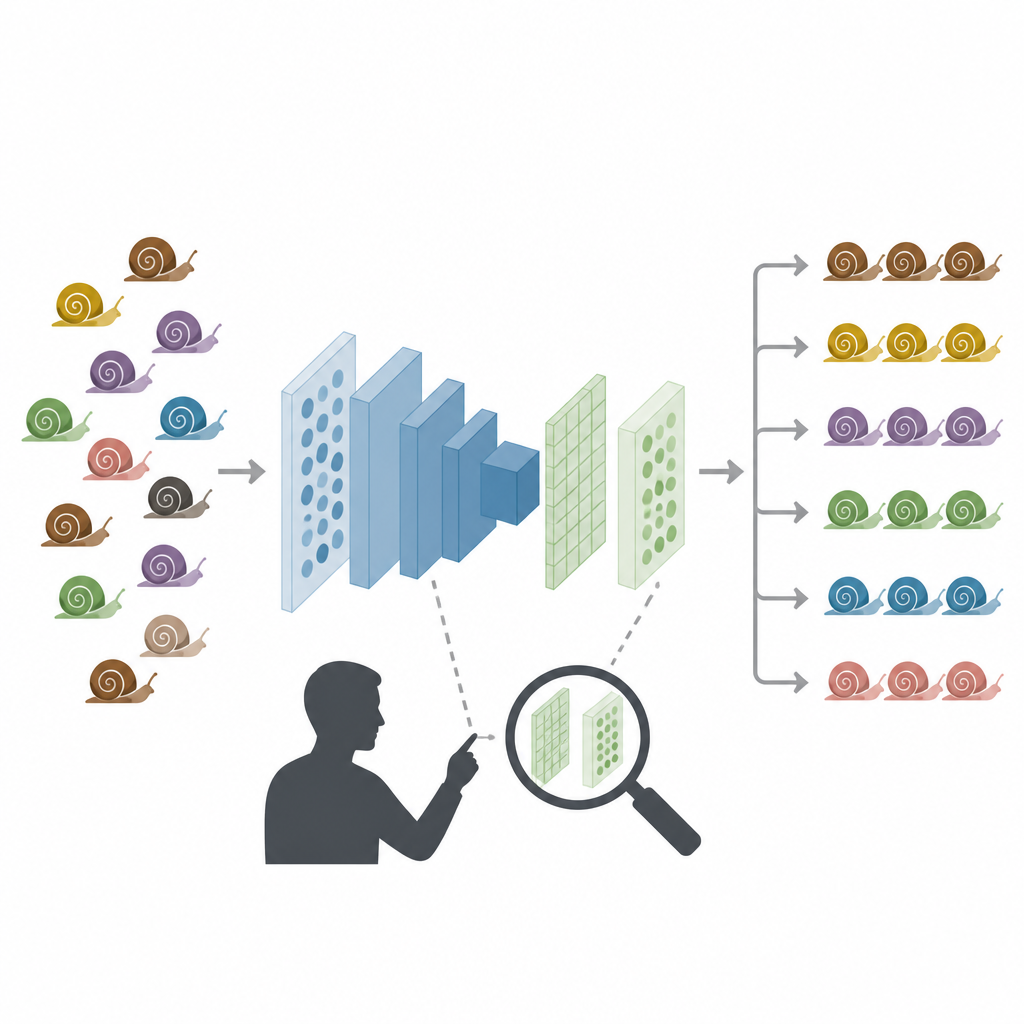
Among the four versions tested, YOLOv10 offered the best balance of accuracy, speed, and compact file size. It reached 98.7% overall accuracy on validation data and high scores on standard detection measures, while running at more than four frames per second on a modest graphics card. It also held up well under difficult real world conditions, such as low light, complex vegetation, and cluttered scenes, and it coped better with small or oddly oriented snails than older versions. At the same time, the model is small enough to be deployed on portable devices, which is important for field teams who may have limited computing power.
A shared job for people and machines
To a non specialist, the key message is that neither people nor machines can do this job perfectly alone, but together they perform much better. Humans are excellent at scanning messy images and making sure no snail is overlooked. The AI system, once a snail is pointed out, is more reliable at telling which nearly identical species it belongs to. The authors propose a hybrid workflow in which field workers or technicians first locate snails, then pass those images to the YOLOv10 system for rapid, standardized species labeling. This combined approach can greatly increase the speed and consistency of snail surveillance, giving public health programs a practical tool to track where risky snail hosts are spreading and to plan control efforts in regions where resources and specialist expertise are limited.
Citation: Jenwithee, T., Meererksom, T., Limpanont, Y. et al. Automated real-time surveillance of Bithynia snails using a comparative YOLO based approach for liver fluke host detection. Sci Rep 16, 14886 (2026). https://doi.org/10.1038/s41598-026-43387-x
Keywords: Bithynia snails, liver fluke, YOLO detection, disease surveillance, human AI collaboration