Clear Sky Science · en
Multi-scale fusion convolution network with progressive dilation for real-time salient object detection of surface defects on strip steel
Why tiny flaws in steel matter
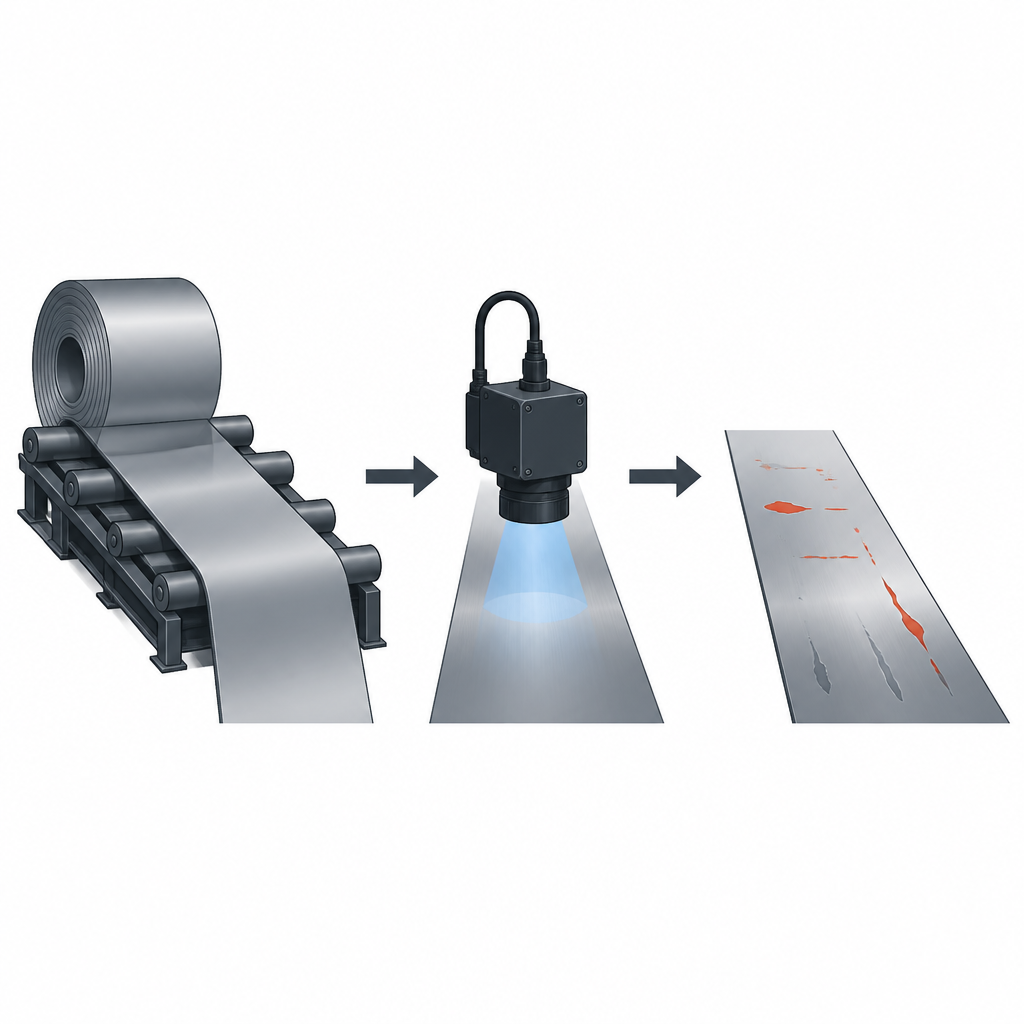
From car bodies to bridges, long ribbons of steel roll off production lines every day. Even tiny pits or scratches on these steel strips can weaken the final product or force costly rework. Inspecting every centimeter by eye is impossible at industrial speeds, so factories rely on computer vision. This study introduces a new image analysis method that spots surface flaws on strip steel quickly and reliably enough to keep up with real production lines.
Seeing what stands out
The authors focus on a task called salient object detection, which asks a computer to highlight the most visually noticeable regions in an image. On strip steel, those regions are usually defects such as spots, patches, or scratches. Past methods based on deep learning already do this job better than hand-crafted image filters, but many are too slow or too bulky for real-time use. Others struggle when defects vary in size or appear under different lighting, which is common in busy factory environments.
Looking at details and the big picture
To tackle these issues, the researchers design a new network called MSFNet-PD. At its core, it breaks an input image into several layers of features, each capturing a different level of detail. A key idea is multi-scale fusion: the model looks at both fine local textures and broader shapes at the same time, then blends this information. This helps it distinguish a faint scratch from normal texture and recognize irregular patches that do not follow the usual steel pattern. Instead of using heavy attention blocks, the design relies on streamlined connections that keep the computation light.
Stepping outwards with progressive views
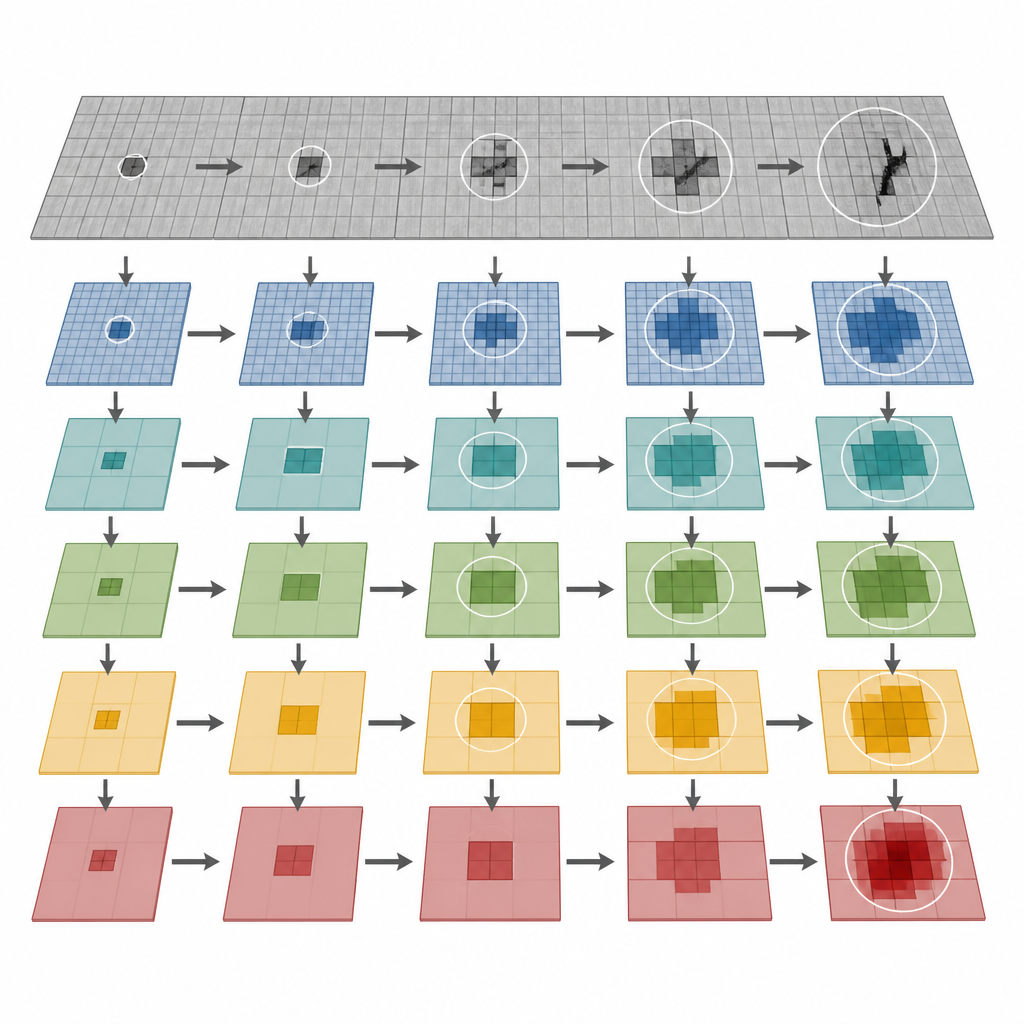
A second idea is progressive dilation. In simple terms, the model begins by examining small neighborhoods of pixels and then gradually widens its view as features move deeper through the network. This stepwise increase in the “field of view” lets the system sense small and large defects without blurring away important edges. By carefully arranging these dilated filters, the network captures long thin scratches, tiny inclusions, and broad stains while still preserving clear borders between damaged and undamaged regions.
Fast enough for the production line
The team tests MSFNet-PD on a public dataset of steel strip images that includes three main defect types. They compare it with a wide range of existing models, from heavy high-accuracy systems to ultra-light ones tuned for speed. Their approach reaches a strong balance: it matches or rivals many accurate methods while running far faster than most, processing thousands of images per second on a modern graphics processor. Careful experiments show that combining several dilation sizes and fusing features at multiple scales is crucial to this balance of speed and precision.
What this means for industry
For a non-specialist, the takeaway is that the study offers a smarter camera brain for steel inspection lines. MSFNet-PD can scan moving metal strips in real time, highlight likely defects with crisp outlines, and do so using modest computing power. While the authors note that more tests on other materials and factories are needed, their results suggest that such lightweight, multi-scale designs can help manufacturers catch flaws earlier and more reliably, improving safety and reducing waste without slowing production.
Citation: Zhang, Z., Zou, Y., Liu, X. et al. Multi-scale fusion convolution network with progressive dilation for real-time salient object detection of surface defects on strip steel. Sci Rep 16, 15387 (2026). https://doi.org/10.1038/s41598-026-43386-y
Keywords: strip steel defects, salient object detection, real-time inspection, deep learning, industrial vision